Friday, October 29, 2010

Recycle

You can recycle your Propeller chip projects from one to the next, exploiting green Earth technology in the process. This is an example list of starting small and increasing to progressively larger machines. However, as these machines become larger, it takes longer times to recycle and rebuild. (I'm still working on the Progression Machine, beyond the 40-Prop Barrier.) See the examples below.

List of Recycled Propeller Green Machines
This is simply to show that by recycling, it's possible to more economically build projects with increasingly larger numbers of prop chips. Not only are parts recycled, but technology too.

 
01) PEK 1
02) MC Computer
03) LED Machine
04) 2-Proper 2 props, 1 PEK, 1 on same breadboard, 2-Prop-Experiment
05) Spark 2
2 props, 1 Proto Board & 1 in parallel
06) PiggyTwins
2 props, 1 piggybacked on another
07) Dueling Breadboards
2 props, one on ea., f/interface tests
08) Spark 4 Tiny Tim, 4 props, two proto boards w/2 props on ea
09) Spark 5 5 props stacked Proto Boards
10) Spark 6 6 props 3 proto boards 2 props on each
11) Spark 8 Tertiary ADJUNCT, 8 props 4 proto boards 2 props on each
12) Propalot 10 props on solderless breadboard
13) Spark 10 10 props, 5 proto boards w/10 props total
14) TTB Test Bed of Ten
10 props single board
15) Twelvenator Board of Twelve, 12 props green board
16) UltraSpark 15 15 props, interrupted stack Proto Boards
17) Tertiary 20 20 props, 15 proto boards stacked 5 props
18) UltraSpark 20
20 props stacked
19) Boe-Bot Brain Project
20 props as Brain on Boe-Bot
20) MLEPS Super Language Machine 25 props
21) UltraSpark40 Supermicrocontroller 40 props 320 cores, 6,400/8,320 MIPS
22)
Smartest Boe0Bot Brain Temp Experiment40 props, US40, 1 BOE, 321C 

*This is a partial list of Propeller projects that were built leading up to the UltraSpark40 Machine. Some projects have lots of documentation and others not because of rapid development time. Photos were take of most projects in their unique configurations. There may be gaps in the Spark and UltraSpark series because some of indice were test beds existing a fleeting time for testing purposes.

Thursday, October 21, 2010

Second Brain

10-21-2010, 10:16 AM  SECOND BRAIN The 2nd brain could be housed inside the 1st. Though I expect the ability to connect and disconnect brains on the outside would be a useful feature in times of service, debugging or expanding with more brains. Maybe if brains are made inexpensively, they could be discarded and recycled. With multiple brains come dedicated brains. Brains could be located anywhere inside the robot. How about off-the-shelf brains. Companies could compete to see who can make the best brain.

Multi Brain Concept

10-21-2010, 10:12 AM  MULTI BRAIN CONCEPT Today I'm working on a new robot brain concept. The overall brain concept up to this point is macro in nature. However, why not induce more than one brain? More than one brain, or a multi-brain could be more useful. Humans have duplicate hands, feet, legs, ears, arms, cheeks, and eyes. Why did evolution stop there? Why don't we have a duplicate brain. It could help Alzheimer's or other brain challenged patients and certainly help solving problems with double brain power.

Friday, October 15, 2010

Smaller Brain

10-15-2010, 06:51 AM  SMALLER BRAIN Actually a smaller brain is possible, modeled after the bigger brain. This can fit the budget and resources of the hobbyist. But the question remains about filling it. I think we want a robot brain that can go above and beyond the basics. The basics include vision, obstacle avoidance, beeping, moving in some patterns, determining location and orientation, sumo, maze solving, wandering, not falling off a ledge, ranging, mapping, accepting input from sensors, recharge batteries when necessary, and other fundamental age proven activities. Therefore the purpose of a brain beyond the basics would include thinking, reasoning, and the ability to resolve problems and accept new challenges.

Thursday, October 14, 2010

Algorithm Machine

10-14-2010, 01:14 PM  AM ALGORITHM MACHINE One important aspect of a brain is the ability to move information and thoughts. It takes much more than an artificial neuron and a synapse. Not much can be accomplished without the techniques and algorithms to transport and understand information and thought. So I put together the AM Algorithm Machine for developing algorithms leading to this project of filling a brain. The AM is rather small so the WIDE BUS was introduced. The brain is a really big project requiring a lot of resources. Obviously we will deal with some kind of machine approximation.

Friday, September 17, 2010

Work Begins

09-17-2010, 01:05 PM  WORK BEGINS Work has begun on the actual big brain. (wood, chewing gum, paper clips, cardboard, liquid solder and white elmers glue) As I said before, get your brain work submitted soon - so your name can be included with the roster on the upper inverted neural underside rotated etching of the frontal upper occipital lobe. It now seems we have a way of thinking with the big brain that is faster than the original specs of the Propeller chip. Internal pure thought should be the fastest, above any I/O. The prop chip now has faster internals methodology and faster I/O's. This is just the beginning.

Monday, September 13, 2010

Brain Build 1

09-13-2010, 06:37 PM  INFORMATION TRANSFER The next section of brain material will focus on the transfer of information. I think wiring from cog to cog is an ideal way to communicate in a special brain lobe. The experiments with this approach are fantastic fast. This has become an incorporated feature of UltraSpark 40. The next step is to decode the 32 x 40 wiring potential with part allotment going to peripheral I/O and the other part going to communications.

09-17-2010, 01:05 PM  WORK BEGINS Work has begun on the actual big brain. (wood, chewing gum, paper clips, cardboard, liquid solder and white elmers glue) As I said before, get your brain work submitted soon - so your name can be included with the roster on the upper inverted neural underside rotated etching of the frontal upper occipital lobe. It now seems we have a way of thinking with the big brain that is faster than the original specs of the Propeller chip. Internal pure thought should be the fastest, above any I/O. The prop chip now has faster internals methodology and faster I/O's. This is just the beginning.

10-14-2010, 01:14 PM  AM ALGORITHM MACHINE One important aspect of a brain is the ability to move information and thoughts. It takes much more than an artificial neuron and a synapse. Not much can be accomplished without the techniques and algorithms to transport and understand information and thought. So I put together the AM Algorithm Machine for developing algorithms leading to this project of filling a brain. The AM is rather small so the WIDE BUS was introduced. The brain is a really big project requiring a lot of resources. Obviously we will deal with some kind of machine approximation.

10-15-2010, 06:51 AM  SMALLER BRAIN Actually a smaller brain is possible, modeled after the bigger brain. This can fit the budget and resources of the hobbyist. But the question remains about filling it. I think we want a robot brain that can go above and beyond the basics. The basics include vision, obstacle avoidance, beeping, moving in some patterns, determining location and orientation, sumo, maze solving, wandering, not falling off a ledge, ranging, mapping, accepting input from sensors, recharge batteries when necessary, and other fundamental age proven activities. Therefore the purpose of a brain beyond the basics would include thinking, reasoning, and the ability to resolve problems and accept new challenges.

10-21-2010, 10:12 AM  MULTI BRAIN CONCEPT Today I'm working on a new robot brain concept. The overall brain concept up to this point is macro in nature. However, why not induce more than one brain? More than one brain, or a multi-brain could be more useful. Humans have duplicate hands, feet, legs, ears, arms, cheeks, and eyes. Why did evolution stop there? Why don't we have a duplicate brain. It could help Alzheimer's or other brain challenged patients and certainly help solving problems with double brain power.

10-21-2010, 10:16 AM  SECOND BRAIN The 2nd brain could be housed inside the 1st. Though I expect the ability to connect and disconnect brains on the outside would be a useful feature in times of service, debugging or expanding with more brains. Maybe if brains are made inexpensively, they could be discarded and recycled. With multiple brains come dedicated brains. Brains could be located anywhere inside the robot. How about off-the-shelf brains. Companies could compete to see who can make the best brain.

11-19-2010, 10:06 AM  INTERFACE The next idea in the massive brain is the interface. This is open source and allows the connection of hybrid processors. Hybrid processors establish compatibility from module to module. So a big brain can be filled with interconnected hybrid processors. An example of this is currently designed and in the building process.


11-19-2010, 10:15 AM  BRAIN STEM ALMOST COMPLETE The big brain should also have a compatible Brain Stem. The Brain Stem should route specific information via the nerve center to the mobility center. A working Brain Stem Module BSM is in the works and almost completed. It include a quasi-duplex interface including half and full depending on location and direction. All information to and from the robot will pass through the BSM. The project is going very well.

Interactive Atlas of the Brain Stem - Swenson

http://www.dartmouth.edu/~rswenson/A...tem/index.html

11-20-2010, 10:18 PM  HYBRID BRAIN PROCESSOR  The first Hybrid Brain Processor is now working. I'm taking some photos of it and tomorrow will work more on the hybrid software. Currently it uses two languages. This HBP is essentially the first successful prototype brain stem.

12-21-2010, 08:52 AM  BRAIN STEM See the 12-21-2010 entry here to the Robotic Brain Stem that was recently completed and upgraded. The Brain Stem handles the nerve sending ability for robotic motor and various motion control functions. It uses a protected interface that communicates between the 5-volt level of the BASIC Stamp and the 3.3-volt level of the Propeller chip. A serial software interface joins processors and enables inter-board communications. This is the next step in filling the big brain.

12-21-2010, 09:04 AM BRAIN BASE Adding the Brain Base to the Big Brain. Another step has recently unfolded in the quest to build and fill the Big Brain. Now completed is the first hardware Brain Base. This part of the brain has two Propeller boards interfaced in common.

Information Transfer

09-13-2010, 06:37 PM  INFORMATION TRANSFER The next section of brain material will focus on the transfer of information. I think wiring from cog to cog is an ideal way to communicate in a special brain lobe. The experiments with this approach are fantastic fast. This has become an incorporated feature of UltraSpark 40. The next step is to decode the 32 x 40 wiring potential with part allotment going to peripheral I/O and the other part going to communications.

Tuesday, August 24, 2010

AM Algorithm Machine

08-04-2010, 01:37 AM
AM Algorithm Machine
A Tiny Tester for Developing Parallel Algorithms
You can use this tiny tester, built from Parallax parts, for developing parallel algorithms and running tests for much larger machines (including large Propeller based parallel cluster machines under design and construction). It's a real time saver! The tester is an upgrade and a spin-off of the Minuscule BASIC Stamp Super Computing Machine. This is a tiny algorithm machine, simple to build, easy to use. The field of parallel clustering computing is relatively new to hobbyists. Developing techniques and methods is an important aspect of cluster computing to gain the greatest rewards and benefits from not only paralleled space but multiprocessors as well.

Features 
  • Operates in five BUS modes
  • Serial & Parallel options
  • Includes WIDE BUS
  • Handles up to 200 step code
  • Programs in PBASIC
  • Very small footprint
  • Builds with Parallax BASIC Stamp 1 Project Boards #27110
  • Speakers & LEDs for output
  • Twin 9-volt battery operated

SCHEMATIC

Use the above schematic to build the tester, then program it with parallel algorithms to test various interfaces and parallel configs. Provisions are made for converting between single wire, full duplex, and data buss interfaces.
_____________________

Overview
It doesn't matter if you're using stamps or props, parallel techniques work cross platform. Here's a chance to use a language that's been proven over time and develop routines for new parallel machines. The addition of the upgraded interface bus allows for trying out several hardware configurations such a one wire, serial full duplex, and data bus.

Criteria
The AM is currently being used with the UltraSpark 40 Supermicrocontroller Parallel Computing Machine and satisfies several conditions for testing the new series.

Interface
This versatile machine operates in four modes, which can be wired as single mode A, single mode B, or dual modes A & B, or simply C mode. Operate the AM using a single wire and serial PBASIC code commands or program the machine using the seven parallel port bits.

A - Single Wire Serial P0
B - Parallel Bus P3, P4, P5, P6, P7
A + B Dual BUS, as seen above
C - Parallel Bus Only P0, P3. P4, P5, P6, P7


Code and Parallel Algorithms
It is left up to the user to derive various parallel algorithms in PBASIC
code. However, as code becomes available, it can be posted in this thread. The 1st proposal is a split function task for n processors. In this example, one program is written that supplants itself into n processors and auto determines the work share for each processor. Time passes and the work conclusion is collected and concluded. It is ok to create a separate collection program.

10-12-2010, 07:15 AM  Update 10.12.2010 NAME ESTABLISHED
This update includes the name AM - Algorithm Machine. This is a tiny minimal two core machine capable of quickly running tests on simple parallel algorithms. The second advantage of the machine is that it introduces a new wide bus for experimentation.

10-12-2010, 07:20 PM  Update 10.13.10 REVISED SCHEMATIC
Revised Draft Schematic Posted

10-13-2010, 08:56 AM  INTRODUCING WIDE BUS

A - Single Wire Serial P0
B - Parallel Bus P3, P4, P5, P6, P7
A + B Dual BUS, as seen above
C - Parallel Bus Only P0, P3. P4, P5, P6, P7
D - P0 - P7


Regarding bus modes. For a D mode, WIDE BUS, remove the LEDs and Peizo speakers to gain a parallel eight bit BYTE bus data array using pins P0- P7. Connect, P0 to P0, P1 to P1, P2 to P2 up to P7 to P7, confirming a protection resistor (220 ohm) across each port.

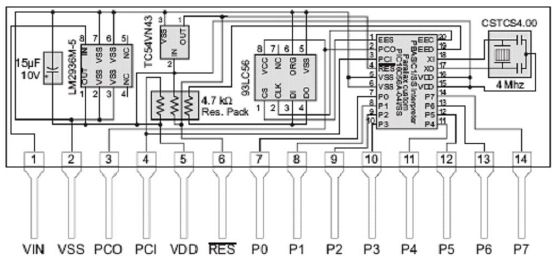
10-13-2010, 08:57 AM  BS1 PROJECT BOARD SCHEMATIC
BASIC Stamp 1 Project Board Schematic - Use for Wiring the AM

Schematics may be difficult to find these days. Use this BS1 Project Board schematic when wiring two boards together to create the AM project. The 93LC56 chip is an EEPROM with 256 bytes size or 1/4th K. This holds up to 100 instructions. The microcontroller is a Microchip PIC16C56A running at 4MHz. This gives about 2,000 IPS Instructions Per Second. The serial PC interface runs at 4,800 BAUD for programming and debug. Power can be within the range of 6 to 15 volts.

Source / Sink Current per I/O.................. 20 mA / 25 mA
Source / Sink Current (device) ................ 40 mA / 50 mA
Power Consumption................................ 7 mA running (no loads); 5 mA Sleep (Rev B). On Rev B boards the power LED remains illuminated when the BASIC Stamp is in sleep mode

10-13-2010, 08:57 AM  PROGRAMMING COMMANDS
BRANCH Branch to address specified by offset
BUTTON Monitor & manage button input; branch if button in target state
DEBUG Send variables and/or messages to PC for viewing
EEPROM Store user data in available EEPROM space
END Terminate program and enter low-power mode until reset
FOR...NEXT Create numerically controlled loop
GOSUB Unconditional branch to a subroutine
GOTO Unconditional branch to program address
HIGH Make pin an output high
IF...THEN Compare and conditionally branch to program address
INPUT Make pin an input
LET Optional designator for assignments
LOOKDOWN Search table; if found set output variable to target location
LOOKUP Set output variable to table data specified by offset
LOW Make pin output low
NAP Enter low-power mode for short period
OUTPUT Make pin an output
PAUSE Suspend program for 1 to 65,535 milliseconds
POT Read a 5 – 50 K variable resistance and scale result
PULSIN Measure width of an input pulse
PULSOUT Output timed pulse by inverting pin for some time
PWM Output analog level (requires external RC network for filtering)
RANDOM Generate a pseudo-random number
READ Read byte from EEPROM location
RETURN Return from a subroutine
REVERSE Reverse pin state; make input if output, output if input
SERIN Receive serial data, 300 – 2400 baud, N81 format
SEROUT Transmit serial data, 300 – 2400 baud, N81 format
SLEEP Enter low-power mode for 1 – 65,535 seconds
SOUND Generate tone or white noise
TOGGLE Make pin an output and toggle current state
WRITE Write byte to EEPROM location

10-13-2010, 10:28 AM  MORE PHOTOS 
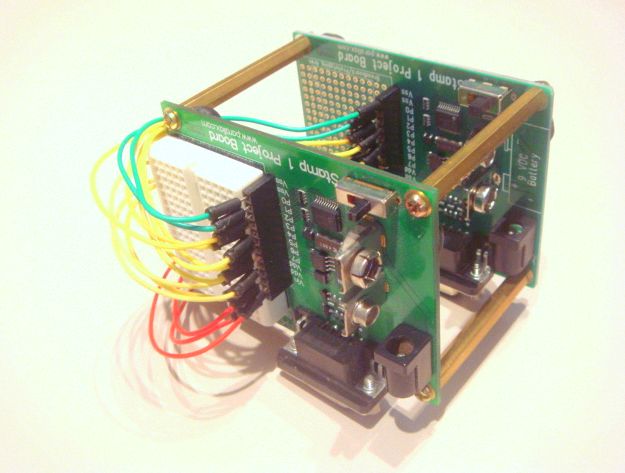
This view of AM - Algorithm Machine, shows a nearly cubical shape, wired in WIDE BUS mode. The solderless breadboard is used only on the top board. Wiring is made with the pin connectors. The bread- board is used for adding the Peizo speaker and LED outputs in other modes.

10-14-2010, 05:33 AM  AM Algorithm Machine BS1-IC Experiment
Instead of using two Stamp 1 Project Boards, this experiment uses a BS1-IC in SIP form. A BS1 module (Parallax part number BS1-IC) plugs into the solderless breadboard on one Stamp 1 Project Board and extends its buss connections directly to the board. The following features result.

    * Significantly Smaller
    * Improves Wiring Efficiency
    * Better Visibility
    * Maintains both Peizo & LED Outputs
    * Requires Only One Battery for Field Use
    * Rewiring is faster

BASIC Stamp 1 Module


BS1 Project Board
Boards setup before wiring.
Setup uses a Revision B Project Board and Revision C BS1-IC. The Project Board programs with a serial to USB converter, and has a choice of battery or power supply operation. Note, the on/off switch at lower right in the photo is especially handy for recycling power.


Schematic for rev. c was not found, however, the pinout of BS1-IC Rev. B can also be used for wiring Rev. C.

Note, this experiment is provided for pure academics. In actuality, to program the add-on BS1-IC SIP, add a small three pin programming port and a Parallax Serial Converter, then connect to the PC.