Showing posts with label recycle. Show all posts

Saturday, December 14, 2013

Extremely Powerful Telescopes Update

EXTREMELY POWERFUL TELESCOPES UPDATE
and introductory blog dates 

There's now 15 extremely powerful telescopes making new discoveries in the solar system and universe. All are working for the Big Brain.

Note: The ULT and NULT ended up being upgraded and renamed. This resulted in blogs with out-of-sync chronology. The ULT was the first invention, followed by the NULT.

It's expected the array of extremely powerful telescopes will grow and bump the OT telescope farther to the top. The ET Telescope (Extrapolation) has inspired the IT (Interpolation) Telescope which may be able to reconstruct views in the universe that have sections of obscurity. 

LIST OF EXTREMELY POWERFUL TELESCOPES
UPDATED DECEMBER 2013

1) ULT - Ultra Large Telescope - March 2012
http://humanoidolabs.blogspot.com/2012/03/nult-new-ultra-large-telescope-home.html
 

2) NULT - New Ultra Large Telescope - February 2012
http://humanoidolabs.blogspot.com/2012/02/new-ultra-large-telescope-nult.html
 

3) GT - Genius Telescope - June 2012
http://humanoidolabs.blogspot.com/2012/06/gt-genius-telescope.html
 

4) PGT - Paradigmic Genius Telescope - September 2012
http://humanoidolabs.blogspot.com/2012/09/paradigmic-gt-telescope.html
 

5) MGT - Molecular Genius Telescope - October 2012
http://humanoidolabs.blogspot.tw/2012/10/big-brains-new-paradigmic-molecular.html
 

6) PGT-ET - Paradigmic Genius Telescope - March 2013
http://humanoidolabs.blogspot.com/2013/03/pgt-telescope-new-look.html
 

7) PDT - Power Dynamic Telescope - April 2013
http://humanoidolabs.blogspot.com/2013/04/new-telescope-announcement.html
 

8) GGT - Gargantuan Gravatomic Telescope - May 2013
http://humanoidolabs.blogspot.tw/2013/05/next-telescope.html
 

9) SRT - Space Recycler Telescope - May 2013
http://humanoidolabs.blogspot.tw/2013/05/novel-space-junk-telescope.html


10) MMT - Molecular Mining Telescope - May 2013
http://humanoidolabs.blogspot.tw/2013/05/mgt-molecular-cradle-of-stars.html 

11) IET - Inference Engine Telescope - May 2013
http://humanoidolabs.blogspot.tw/2013/05/iet-interference-engine-telescope-first.html

12) M3T - Massive Molecular Mining Telescope - November 2013
http://humanoidolabs.blogspot.tw/2013/11/m3t-telescope-first-light-saturn.html

13) ET - Extrapolation Telescope - December 2013
http://humanoidolabs.blogspot.tw/2013/12/et-telescope.html

14) IT - Interpolation Telescope - December 2013
http://humanoidolabs.blogspot.tw/2013/12/it-interpolation-telescope.html

15) OT - Over the Top Telescope - January 2014
http://humanoidolabs.blogspot.tw/2013/12/ott-over-top-telescope.html

Saturday, July 27, 2013

Convert Old Computers Into Processors

CONVERT OLD COMPUTERS
INTO PROCESSORS

Left: The photo shows the MC computer which can add an additional 1008 processors and a Lenovo PC which can add a half million processors

The research department has found a way to convert "old" computers into vast numbers of individual and parallel processors. This could potentially increase the number of processors inside the Big Brain by a vast amount, perhaps well into the millions.

For example, the use of an extra Apple iMac could produce an additional 500,000 processors. The idea comes from the Propeller chip, which, as one chip, has eight cogs and eight instances of the Spin interpreter.

Left: This iBook could add over a quarter of a million processors.

A recycled computer can have many instances as well, with a placement of the interpreters into the main machine. The key will involve finding a low overhead interpreter and linking the repetition of interpreters from the computer to the remaining machines. This may be accomplished with cloning, and the new technique of spatial mapping used in our Monster Machine series as linked to Big Brain telescopes.

Left: one multiple processor micro controller board like this can add over 27,000 processors

The numerical limit of these new processors is unknown at this time when using all the Big Brain peripherals. It will likely depend on the computer's speed, memory, size of the interpreter, speed of the interpreter, display real estate, and other factors. An experiment is being conducted to determine the practicalities of speed and function, and the number of cloned processors that can co-exist on the latest iMac

Left: appending this BoeBot Brain project can add an additional 40,400 processors.


Monday, May 20, 2013

Space Recycler Telescope SRT

SPACE RECYCLER TELESCOPE 
The new SRT Recycler Telescope uses free recycled parts - and its level of simplicity can return surprising results!
 

If you’ve kept up with the progression of telescopes created and conducted by the Big Brain machine program initiative to explore space, you’ve see increasingly large, massive, and complex telescopes constructed with levels of mind boggling advanced controls, delivering breath-taking results beyond belief.

These telescopes, worth up to trillions of dollars, are built under the auspices of the Big Brain Machine Initiative with great development time invested, and they operate with clever often complicated techniques. Their scientific instruments often return many new discoveries about the Universe and beyond. However, the telescopes may be complicated, and likely will not have much simplification as their exploratory capacity levels and add-ons increase exponentially over time. The SRT, or Space Recycler Telescope, is a somewhat simple version of these more complicated telescopes. Currently the most powerful telescope in the continuing series is the GGT Gargantuan Gravatomic Telescope.

We all know there are tons of space items floating around in space. These are mostly used, spent, decrepid, decayed, broken space probes that have lost their life, expended their supply of coolant, moved past their targets, crashed into planets and moons, stopped functioning with dead batteries, became broken due to unresolvable anomalies, crashed their programs, failed to reach intended targets, and simply reached the end of their life spans. The SRT is capable of recycling this space equipment into a new telescope and produce new gains from their demise.

The SRT generally will use just one Adjunct and its data sets will be more time dependent, so the telescope will focus the attention on what to observe and when to observe. This SRT is the most simple telescope in the series - remaining powerful, it can have an aperture diameter exceeding the largest Earth-based telescopes. It has the most basic controls and the most simple operations. To keep things simple, telescope linking is unary and the process of data mining is fundamental. Refer to the Face Plate showing control icons.

The SRT is the ninth powerful telescope in the series created by the Big Brain Space Exploring Initiative. 

1) ULT - Ultra Large Telescope
http://humanoidolabs.blogspot.com/2012/03/nult-new-ultra-large-telescope-home.html
2) NULT - New Ultra Large Telescope
http://humanoidolabs.blogspot.com/2012/02/new-ultra-large-telescope-nult.html
3) GT - Genius Telescope
http://humanoidolabs.blogspot.com/2012/06/gt-genius-telescope.html
4) PGT - Paradigmic Genius Telescope
http://humanoidolabs.blogspot.com/2012/09/paradigmic-gt-telescope.html
5) MGT - Molecular Genius Telescope
http://humanoidolabs.blogspot.tw/2012/10/big-brains-new-paradigmic-molecular.html
6) PGT-ET - Paradigmic Genius Telescope
http://humanoidolabs.blogspot.com/2013/03/pgt-telescope-new-look.html
7) PDT - Power Dynamic Telescope
http://humanoidolabs.blogspot.com/2013/04/new-telescope-announcement.html
8) GGT - Gargantuan Gravatomic Telescope
http://humanoidolabs.blogspot.tw/2013/05/next-telescope.html

9) SRT - Space Recycler Telescope
http://humanoidolabs.blogspot.tw/2013/05/novel-space-junk-telescope.html

Thursday, February 9, 2012

Fake Prop

EXPERIMENTAL FAKE PROP MADE WITH BASIC STAMPS
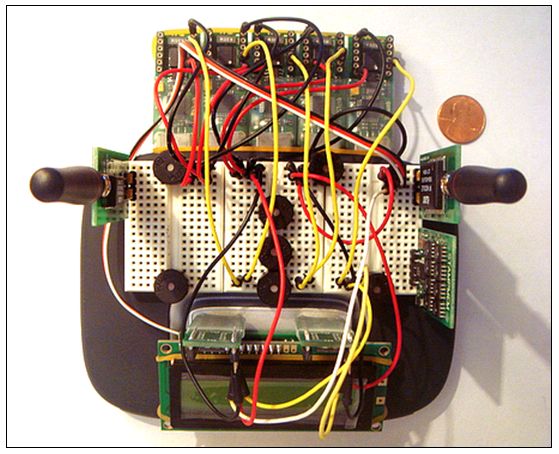
Fake Prop during assembly

Sometimes you need to recycle a project to get more fun out of it. This is what happened with the TSS.

This fun project emulates simple exampling parallel functions of a Propeller chip by connecting together a cluster of Basic Stamp processors. Each Stamp represents one Cog, has its own operating program and communicates through a common BUS using PBASIC programming language. Output is to a built-in green screen LCD monitor. Unlike the real Prop, the Fake Prop can be rewired in between its Cogs.

Fake Cog with 8 ports
Fake Prop Schematic


The Fake Prop (FP) has seven BS1 Stamp processors to experiment with Cog emulation, LCD monitor, radio transmitter, radio receiver and a 64K EEPROM memory board, interfaced to a Belkin USB Hub. The FP is larger than a Prop but still small enough to fit into a soup bowl or Parka coat pocket. The yellow wires are for the port-to-port one wire interface. The black wires are adjoining Vss and red wires are Vdd. White represents a serial signal wire. By comparison, the American penny shows size comparison. FP includes an optional serial “green screen” by Parallax.

Assembly
( ) Plug in seven Stamp computers to the Belkin 7-port hub
( ) Run wire from P0 Computer 1 to P0 Computer 2, repeat to 7
( ) Connect all grounds together with jumper wires (Vss)
( ) Connect all +5 volts together (Vdd)
( ) Consult the schematic to wire the peripherals

Assemble everything directly onto the Belkin HUB. USB Stamps are plugged into all available USB ports. The powered HUB has the ability to draw external power to supply the demand created by seven processors.

Parts List
R1 - 1K Resistor
R2 to R8 - 220 Ohm Resistor
Z1 - Z7 - Piezo Speaker
7 - USB BASIC Stamp

Peripherals Used in this Project, from Parallax
7 – Five Volt Piezo Speakers
1 – Green Screen Serial LCD
1 – 433 Mhz Radio Transmitter
1 – 433 Mhz Radio Receiver
1 – 64K EEPROM Memory Board

New Experiments
The Fake Prop is intended for academics and exampling study, and is primarily just for fun. However, one idea is to create a bunch of external fake props, using any processors which are available, and their native programming languages to create prop emulation software. Then radio transceivers link directly to a project like the Big Brain, which has the ability to receive downlink. This "Fake Brain" can operate alongside the real brain.

How does FP stack up against a real Prop?

     EEPROM  SPEED  MEMORY  COGS  SPEAKER  TX  RX  LCD  I/O
FAKE 1.75K   28MHz  64K+     7       7      1   1   1   56
REAL   32K   80MHz  32K      8       0      0   0   0   32

The Fake Prop costs more and is larger/heavier than the real Prop, roughly 2.5 times slower with EEPROM that's 21 times smaller. However, it has twice as much memory,  1.75 times more I/O, and tighter programming code.

FP has some things the real Prop does not have at all like the ability to rewire in between Cogs and access to 3 solderless breadboards for work space, seven speakers, a serial green screen, and full scale long range radio transceiver. For more comparisons, refer to the processor manuals and link. 

Links
Tiny Stamp Supercomputer
TSS

Friday, October 29, 2010

Recycle

You can recycle your Propeller chip projects from one to the next, exploiting green Earth technology in the process. This is an example list of starting small and increasing to progressively larger machines. However, as these machines become larger, it takes longer times to recycle and rebuild. (I'm still working on the Progression Machine, beyond the 40-Prop Barrier.) See the examples below.

List of Recycled Propeller Green Machines
This is simply to show that by recycling, it's possible to more economically build projects with increasingly larger numbers of prop chips. Not only are parts recycled, but technology too.

 
01) PEK 1
02) MC Computer
03) LED Machine
04) 2-Proper 2 props, 1 PEK, 1 on same breadboard, 2-Prop-Experiment
05) Spark 2
2 props, 1 Proto Board & 1 in parallel
06) PiggyTwins
2 props, 1 piggybacked on another
07) Dueling Breadboards
2 props, one on ea., f/interface tests
08) Spark 4 Tiny Tim, 4 props, two proto boards w/2 props on ea
09) Spark 5 5 props stacked Proto Boards
10) Spark 6 6 props 3 proto boards 2 props on each
11) Spark 8 Tertiary ADJUNCT, 8 props 4 proto boards 2 props on each
12) Propalot 10 props on solderless breadboard
13) Spark 10 10 props, 5 proto boards w/10 props total
14) TTB Test Bed of Ten
10 props single board
15) Twelvenator Board of Twelve, 12 props green board
16) UltraSpark 15 15 props, interrupted stack Proto Boards
17) Tertiary 20 20 props, 15 proto boards stacked 5 props
18) UltraSpark 20
20 props stacked
19) Boe-Bot Brain Project
20 props as Brain on Boe-Bot
20) MLEPS Super Language Machine 25 props
21) UltraSpark40 Supermicrocontroller 40 props 320 cores, 6,400/8,320 MIPS
22)
Smartest Boe0Bot Brain Temp Experiment40 props, US40, 1 BOE, 321C 

*This is a partial list of Propeller projects that were built leading up to the UltraSpark40 Machine. Some projects have lots of documentation and others not because of rapid development time. Photos were take of most projects in their unique configurations. There may be gaps in the Spark and UltraSpark series because some of indice were test beds existing a fleeting time for testing purposes.