Artificial Minds Contribute to Paradigmic Inventions
Over at SPACE1, where some of the greatest minds of machine artificial intelligence species are working alongside humans and where we launch a new type of rocket into space, operations have expanded by uniting as many as fifty fields of science and technology!
Most recently, Humanoido's SPACE1 Industries and Singularity Observatory have joined together to create a new paradigmatic invention that merges the technology of a rocket and a telescope.
https://space1usa.blogspot.com/2019/03/the-next-generation-of-technology-in.html
This symbiosis of machine is a new way to rapidly travel in space. For continuing information, follow the blogs. By approval-only, intellectual materials are available from Humanoido, SPACE1, Singularity Observatory, United Federation of Spacefaring Species, Humanoido United Laboratories, and United Space Technologies.
BIG BRAIN made by Humanoido is a giant intelligent AI machine. Over twenty years in the making, living and sentient, approaching one trillion processors/constructs. Join us in the exciting adventure as it continues to evolve!
Showing posts with label observatory. Show all posts
Saturday, March 23, 2019
Thursday, August 9, 2018
Amidst Giant Rockets, Giant Brains, Giant Robots, Giant Telescopes
![]() |
| New High Density Brain |
Big Rockets!
Big Robots!
Giant Telescopes!
It's a blazing path into the far deep future. The year is counting at 2018. A match made in Heaven - the new move opens up all new laboratories for giant rockets, giant brains, giant robots and giant telescopes. The three labs are connected with a skyscraper observatory telescope complete with a Skyway in the sky that has an AI brain. Brains go into telescopes and into robots that go into rockets. The rockets have rocket brains and the telescope tracks the rocket in space.
This year is a Cardinal celebration for Humanoido and the advancement of innovation, newness, and pushing forward the frontier of space travel, humanoid robotics and machine intelligence. We are now out in the Pacific Ocean at one of the largest laboratories in many years, setting up science and shop. The Big Brain has his own room and is being built into the wall. A new Supertronic Brain is in the works. Special humanoid robots are being designed for rocket space travel. A new rocket fleet is standing by for launching. The massive and giant telescope is now in operation following its First Light celebration. Stay tuned as we begin to report exciting happenings on the evolution of new future science and technology.
http://space1usa.blogspot.com/
Labels:
big,
brain,
fleet,
humanoid,
humanoido,
lab,
laboratory,
launch,
move,
observatory,
ocean,
pacific,
robot,
space,
supertronic,
telescope,
track
Sunday, June 3, 2018
Big Brain Expands Work Domain
![]() |
| Big Brain beginning with only 2 processors |
![]() |
| Wiring was in assembly line fashion in 2011 |
Space1, Mars Connect, and HSO employ the Big Brain, AI and an array of machine intelligence workers to conduct vast science programs, including a massive telescope operations which are now moved to an island in the Pacific Ocean where some of the best sky conditions in the world exist.
It's there where Mars will be viewed and imaged during one of the greatest and closest approaches of Mars to the Earth.
![]() |
| The Exoskeleton programmed with a Lenovo PC computer |
The Big Brain began with only two processors but soon a large parallel collective began to emerge. To facilitate the creation of the first Exoskeleton, an assembly line was established which made faster assembly possible. At one point in the early stages of development, the configuration involved a third stage connected to the top of the Exoskeleton. The great attribute of the Big Brain is flexibility and reconfigure-ability.
The Big Brain is Humanoido's machine intelligence life form invention. In 2002, Humanoid began experimenting with many parallel processor machines, leading to supercomputers and the construction of much more advanced machines. Humanoido invented the Supertronic machine which enabled a much more efficient life form and the development of many offspring. For more information:
About
https://humanoidolabs.blogspot.com/p/about-big-brain.html
Specifications
https://humanoidolabs.blogspot.com/p/specs.html
Some Accomplishments
https://humanoidolabs.blogspot.com/p/milestones.html
The History of the Big Brain
https://humanoidolabs.blogspot.com/p/history.html
The Big Brain Family
https://humanoidolabs.blogspot.com/p/genealogy.html
Labels:
big brain,
hso,
humanoido,
mars,
mars connect,
observatory,
singularity,
telescope
Friday, May 18, 2018
Big Brain Expanding Operations
Expanding Operations
In 2018, the Big Brain has expanded operations to include SPACE1, Singularity Observatory, and Mars Connect. For more information about all three, check the following link:
https://space1usa.blogspot.com/
The Big Brain is a machine life form, AI, currently employed by SPACE1, and is an instrumental influence in the development of Humanoido Singularity Observatory (HSO) and Mars Connect.
In 2018, the Big Brain has expanded operations to include SPACE1, Singularity Observatory, and Mars Connect. For more information about all three, check the following link:
https://space1usa.blogspot.com/
The Big Brain is a machine life form, AI, currently employed by SPACE1, and is an instrumental influence in the development of Humanoido Singularity Observatory (HSO) and Mars Connect.
Labels:
big brain,
connect,
humanoido,
mars,
observatory,
singularity,
space1
Thursday, August 6, 2015
Space1 Designs New Rocket Lab
SPACE1 DESIGNS NEW ROCKET LAB
Space1's choice was made in the USA, where a new rocket lab design is ready for construction. The building acquisition will include remodeling the structure to support various fields including telemetry, weather, mechanics, design, computer control, hangar, rocket parts inventory, gamut engines, rocket lab, electronics lab, cybernetics and life lab, telescope observatory, tooling, R&D, and others.
Index of Space1 Web Pages
http://humanoidolabs.blogspot.com/2015/01/space1-links-in-january-2015.html
Space1's choice was made in the USA, where a new rocket lab design is ready for construction. The building acquisition will include remodeling the structure to support various fields including telemetry, weather, mechanics, design, computer control, hangar, rocket parts inventory, gamut engines, rocket lab, electronics lab, cybernetics and life lab, telescope observatory, tooling, R&D, and others.
Index of Space1 Web Pages
http://humanoidolabs.blogspot.com/2015/01/space1-links-in-january-2015.html
Labels:
big,
brain,
cybernetics,
engine,
humanoid,
humanoido,
lab,
launch,
mechanics,
observatory,
robot,
rocket,
rocket lab,
space,
space1,
telemetry,
telescope,
tooling,
weather
Sunday, July 26, 2015
Space1 Massive Rocket Engine
SPACE1 MASSIVE ROCKET ENGINE
Space1 has taken delivery of the most massive and powerful rocket engine since the inception of the space tourism program, founded in January of 2014.
This will change the way Space1 does business, increasing the altitude of the rocket, allowing heavier and more payload, offering more thrust and power at liftoff and throughout the flight, enabling an increase in space born instrumentation and new flight controls, in flight recording devices and cameras, and making possible larger rockets with more crew astronauts. These heavy lift rockets with massive rocket engines are likely the rockets to take our space plane skyward for materials, experiments and astronauts for free flight return.
Actually, it was necessary for Space1 operations to pick up the rocket engines, as the supplier would not offer delivery for obvious reasons. Direct pickup saved Space1 company an exorbitant amount of delivery money four times greater than the cost of a single engine!
Space1 as a tourist space program is moving faster than any space program has in the past. Since the move to the USA and working towards establishing a headquarters, rocket lab, rocket hangar, launch center, weather station, Space1 Headquarters Office, a mini observatory for tracking and guiding, and spaceport, never before has Space1 worked on so many things simultaneously, and accomplished so much in so little time. Space1 is working on a technologically high deadline and one that guarantees safety and launch implementation in a minimal time frame.
Index of Space1 Web Pages
http://humanoidolabs.blogspot.com/2015/01/space1-links-in-january-2015.html
Space1 has taken delivery of the most massive and powerful rocket engine since the inception of the space tourism program, founded in January of 2014.
This will change the way Space1 does business, increasing the altitude of the rocket, allowing heavier and more payload, offering more thrust and power at liftoff and throughout the flight, enabling an increase in space born instrumentation and new flight controls, in flight recording devices and cameras, and making possible larger rockets with more crew astronauts. These heavy lift rockets with massive rocket engines are likely the rockets to take our space plane skyward for materials, experiments and astronauts for free flight return.
Actually, it was necessary for Space1 operations to pick up the rocket engines, as the supplier would not offer delivery for obvious reasons. Direct pickup saved Space1 company an exorbitant amount of delivery money four times greater than the cost of a single engine!
Space1 as a tourist space program is moving faster than any space program has in the past. Since the move to the USA and working towards establishing a headquarters, rocket lab, rocket hangar, launch center, weather station, Space1 Headquarters Office, a mini observatory for tracking and guiding, and spaceport, never before has Space1 worked on so many things simultaneously, and accomplished so much in so little time. Space1 is working on a technologically high deadline and one that guarantees safety and launch implementation in a minimal time frame.
Index of Space1 Web Pages
http://humanoidolabs.blogspot.com/2015/01/space1-links-in-january-2015.html
Thursday, July 16, 2015
Space1 USA Reboot
![]() |
| Founder of Space1 shows the rocket engine throttle |
The rebooting startup of Space1 in the USA has faced many challenges.
Interesting, most of these challenges are everyday common living events.
For example, at the rocket site, the land must be prepared, mowed and cut, leveled, the building structure put up and then upgraded with a foundation, existing structures will need to be upgraded for a Space1 hangar facility, Space1 Laboratory, and Space1 corporate office. Cement will be poured, and existing trees and bushes will be trimmed, cut and removed.
As temperatures currently are hanging around 100 degrees F. (in late June and July) with RH above 90%, and mosquitoes and rain storms are a hindrance, work is proceeding slowly. Vehicles must be brought up to specs, and the facilities installed and working.
Rocket facilities need special ventilation installed, with new security systems, inclusive of security doors, security flood lamps and motion detectors, along with security cameras and alarm systems.
Science equipment will be installed, including the robotics laboratory with emphasis on humanoids, a library, weather station, and possible special telescope observatory. Attention to inventory is also of paramount concern.
Special insulation and finishing is important to comply with space requirements. Rocket inventory is currently being developed inclusive of materials to build five new fleet rockets and a selection of rocket motors are being warehoused in preparation of the next 14 rocket launches (and/or tests) and space missions.
Index of Space1 Web Pages
http://humanoidolabs.blogspot.com/2015/01/space1-links-in-january-2015.html
Saturday, May 30, 2015
Tiny Telescope Observatory & Aperture Stretching
TINY TELESCOPE OBSERVATORY & APERTURE STRETCHING
The tiny telescope observatory is a dream for 16 years. The goal is to take a tiny telescope of precision optical quality, about 2 to 6 inches in
diameter, and magically stretch it into a 20 to 60-inch telescope using high technology.
This
is a fantastic story that's just beginning because a tiny telescope can now make big discoveries, after having aperture stretching. Studying the planets and moons, or deep sky, can lead to profound observational data and breathtaking imagery.
The core of the stretching technique dates back many years to a time when Humanoido was in Junior High School and needed a method to increase the performance of a high quality 4.25-inch diameter reflector telescope.
In conclusion, a Meade 60AT with a 60mm aperture will perform
like a 120mm aperture, or 4.7-inches. Then applying Humanoido's electronic technique, this
telescope will become a 47-incher. This is really fantastic.
If you wanted to buy a 47 inch telescope, it might cost 1.1 million dollars and take up space bigger than a house. You can see the cost effectiveness of this project. The Meade ETX-60AT telescope is currently as low as $65 on Ebay.
Why the Meade ETX-60AT When Larger Scopes Are Available?
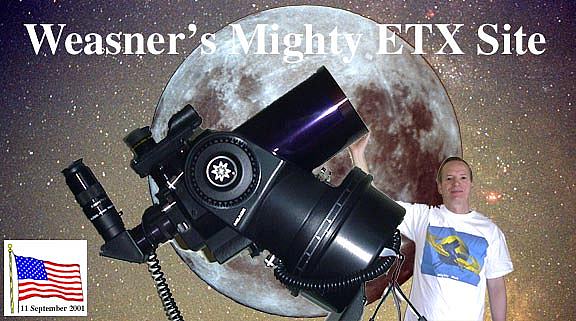
The telescope was chosen because it's a high resolution refractor without a central obstruction that can make it perform like a reflector telescope with twice the aperture. It was chosen for its diminutive size, perfect for a tiny observatory, or a tiny car observatory. It was also chosen for its computerized GOTO functions and simplistic ALT-AZ mounting and drive.
The tiny telescope observatory is a dream for 16 years. The goal is to take a tiny telescope of precision optical quality, about 2 to 6 inches in
diameter, and magically stretch it into a 20 to 60-inch telescope using high technology.![]() |
| Fake big ETX Source |
Several techniques were invented, some which are additive, to make a small telescope into a large telescope.
The first technique converted the 4.25 inch
telescope into a 42.5-inch telescope using non digital means. As an example of this performance, when photographing Jupiter, the
moon Ganymede came into view so it was captured too. To unbelievable
surprise, Ganymede had surface structure visible in the photos and the stretching technique was etched in stone.
![]() |
| Meade ETX-60AT & ETX-70AT Telecopes |
The second technique uses an electronic invention to double the size of the telescope. This digital technique completely replaces the first non-digital technique which has its roots in chemical film based processing.
The third technique depends on the telescope design. A
refractor is generally known to perform like a reflector telescope twice its size,
because it has no central obstruction. The reflector telescope will be the base criteria.
![]() |
| The telescope is also found on Amazon.com |
![]() |
| MX-1 iPhone adapter |
Why the Meade ETX-60AT When Larger Scopes Are Available?
The telescope was chosen because it's a high resolution refractor without a central obstruction that can make it perform like a reflector telescope with twice the aperture. It was chosen for its diminutive size, perfect for a tiny observatory, or a tiny car observatory. It was also chosen for its computerized GOTO functions and simplistic ALT-AZ mounting and drive.
Sunday, May 17, 2015
Toyota Scion IQ Mobile Observatory
TOYOTA SCION IQ MOBILE OBSERVATORY
The concept was invented by Humanoido ten years ago, using the Chevrolet Cavalier subcompact vehicle and a Meade GOTO computerized telescope. Now, the new updated mobile observatory, called the IQ Mobile Observatory, is based on the USA distributed car made by Toyota Scion. This is the smallest and most powerful mobile observatory ever designed at United Humanoido Laboratories.
The model IQ is the smallest car made by Toyota in 2015 and has significant cubic space available when the rear seats are in the down position. At this location, a high powered and dense array of science equipment is stowed. When the hatchback is unlocked, the telescope is unveiled and the mobile observatory appears.
The mobile observatory is driven to a dark country location where temporary observing will be optimal. As this is a full celestial observatory, access to power and accessories are available. The IQ can also carry blankets, provide napping or sleeping for two, and stow food.
The IQ has air conditioning, lighting for reviewing data, heating for brusque nights and a phone center for communications. It's also a good refuge against mosquitoes in the field.
It's possible to extend functions with a tiny two wheel trailer which opens up into a camper with equipment, cooking stove, porta potty, housing tent, and additional amenities of home.
Photos: The Smart car, with about the same horsepower engine is capable of pulling the illustrated trailer. The example shows that a more powerful Scion IQ car can also pull a trailer. In another example design, the trailer itself can become the observatory, housing the telescope and equipment. The snap off roof can be a waterproof canvas material for the ultimate in light weight portability.
Automotive Tools @ Harbor Freight
http://www.harborfreight.com
The concept was invented by Humanoido ten years ago, using the Chevrolet Cavalier subcompact vehicle and a Meade GOTO computerized telescope. Now, the new updated mobile observatory, called the IQ Mobile Observatory, is based on the USA distributed car made by Toyota Scion. This is the smallest and most powerful mobile observatory ever designed at United Humanoido Laboratories.The model IQ is the smallest car made by Toyota in 2015 and has significant cubic space available when the rear seats are in the down position. At this location, a high powered and dense array of science equipment is stowed. When the hatchback is unlocked, the telescope is unveiled and the mobile observatory appears.
The mobile observatory is driven to a dark country location where temporary observing will be optimal. As this is a full celestial observatory, access to power and accessories are available. The IQ can also carry blankets, provide napping or sleeping for two, and stow food.
The IQ has air conditioning, lighting for reviewing data, heating for brusque nights and a phone center for communications. It's also a good refuge against mosquitoes in the field.It's possible to extend functions with a tiny two wheel trailer which opens up into a camper with equipment, cooking stove, porta potty, housing tent, and additional amenities of home.
Photos: The Smart car, with about the same horsepower engine is capable of pulling the illustrated trailer. The example shows that a more powerful Scion IQ car can also pull a trailer. In another example design, the trailer itself can become the observatory, housing the telescope and equipment. The snap off roof can be a waterproof canvas material for the ultimate in light weight portability.
Automotive Tools @ Harbor Freight
http://www.harborfreight.com
Labels:
big,
brain,
car,
cavalier,
chevrolet,
computerized,
goto,
humanoido,
IQ,
lab,
laboratories,
meade,
mobile,
observatory,
scion,
subcompact,
telescope,
toyota,
united,
vehicle
Thursday, May 14, 2015
Space1 Giant Technology Move to USA
SPACE1 GIANT TECHNOLOGY MOVE TO THE USASpace1 is undergoing a giant technology move into the USA at a new location. This is a massive undertaking, and will include an ambitious plan for the design and construction of the following components at the destination:
Science Building
Rocket Technology Laboratory RTL
Time Machine Development Laboratory
COSMOS ONE Telescope Observatory
Advanced Weather Station AWS
Vehicular Parking Port VPP
Advanced Security System
Space Rocket Hanger
Containment Field CF
Personnel Science Office
Science Building
The new multi-purpose building will be large enough to house primary controls of Space1 operations and additional facilities.
Rocket Technology Laboratory RTL
The new rocket technology laboratory will function as the center of construction to build new rockets and additional inventions. It will include the inventory of rocket parts and supplies, and the necessary tools and materials. This area will be the source of testing and experimenting in various supporting scientific fields
Time Machine Development Laboratory
The Time Machine Development Laboratory will include facilities for the development of new time machines for extending rocket trips. These machines may slow, speed up, and stop time.
COSMOS ONE Telescope Observatory
The high tech COSMOS ONE Telescope Observatory is a technology packed environment consisting of an advanced computerized robotic telescope with advanced GOTO functions and CCD imaging capabilities. Driven and operated by multiple computers, the CTO will supplement the acquisition of data about the sky, celestial events and information leading to the support of Space1 tourism.
Advanced Weather Station AWS
The new advanced weather station will fully support Space1 operations in the determination of atmospheric conditions suitable for rocket launch. It will monitor vital stats and study predictive trends for better assessing rocket launches and testing of spacecraft within the troposphere. The AWS, when combined with the telescope observatory, will become a powerful tool in the prediction and measurement of space weather including planetary systems, solar wind, Earth dynamics, and tropospheric conditions.
Vehicular Parking Port VPP
The VPP Vehicular Parking Port will provide a concrete pad capable of supporting thousands of pounds of weight for parking Space1 vehicles and will provide protection against the elements with a durable weather roof.
Advanced Security System
This advanced security design monitors the property 24/7 with a variety of real time devices and security systems. It includes cameras, motion detectors, warning alarms, connections to internet, auto dialing, remote monitoring, recording and tracking, wireless radio communications, secure and gated fencing, electronic windows, secure lighting, motion activated lighting, secure locking, lock monitoring, primary door monitoring, removal of windows and secondary doors, operations with a 760 computers array, smart devices, actual real time security guards and other systems not revealed.
Space Rocket Hanger
During Winter time schedules, the Space Rocket Hanger (SRH) will provide a place to park, hold, service, and refurbish Space1 vehicles. The RH is established within the new science building. RH is electrically wired for heating and cooling with climate control.
Containment Field CF
The new external containment field is primarily composed of a locking security chain link fence with sensors at the property perimeter and invisible infrared motion detection systems that flood and cover the field. The field is also camera monitored and physically monitored by a real time security guard. The containment is covered by flood lights as well and utilizes wireless radio and electromagnetic radiation flood devices.
Personnel Science Office
The science office is a unique part of the security system and will handle business operations for Space1 and other scientific business related agenda. Equipment is standard per cubical with a computer, printer, fax, copy machine, phone, office desk, lighting, etc.
Index of Space1 Web Pages
http://humanoidolabs.blogspot.com/2015/01/space1-links-in-january-2015.html
Labels:
containment,
cosmos,
field,
giant,
hangar,
humanoido,
lab,
laboratory,
move,
observatory,
port,
rocket,
security,
space1,
station,
technology,
telescope,
usa,
vehicular,
weather
Saturday, January 24, 2015
Space1 Ground Safety

SPACE1 GROUND SAFETY
Space1 is all about safe space, safety, and making space travel safe for human astronauts and space tourism. Space1 has also focused efforts on making down-to-Earth safe space.
— space safety is no accident⠀—
SUMMARY
Safe space is on everyone's mind from the beginning of the space program in the 1950s. However, it takes new innovation to bring dreams into reality.
People want safe space travel. Fewer people consider ground safety. Work continues at Space1 using a method of ground testing safety assurance. The new GTSA methods assure a good safety record for materials handling and storage, rocket and engine testing, and management of the launch and related factors such as weather dynamics.
![]() |
| ISSF Space safety magazine |
Safety adds up whether on the ground or in the air. The latest addition to our flight safety management program FSMP is a special safety observatory that can observe, monitor, and assess the atmospheric "seeing cell" in the determination of ground and flight conditions.
Creating and maintaining safety requires an important understanding of varied conditions and a balance of factors.
FACTORS TO CONSIDER
pressure, temperature, humidity, turbulence, strata, solar, rain, cloud, sinking or rising air, wind, ice, sleet, snow, hail, trade winds, jet stream, down-drafting, up-winding, rider cells, shade, zonal stratification, evaporation, dew point, season, radiation, shearing, weather indices, moisture variance, ramping, cooling, heating, expansion, contraction, impending gradients, retentive condition, elevation, differential mode, circulation, convection, hydrological cycle, atmosphere-biosphere interactions, rivers, lakes, oceans, land masses, elevated obstacles, biogeochemistry, low high density, ice-ocean coupling, heat exchanges, soil interactions, ice sheeting, aerosols, day/night morning/evening conditions, tidal conditions, planetary conditions, Coriolis effect, molecular carbon trapping, effects from cyclones, tornadoes, hurricanes, typhoons, distant storms, electrical discharge, static conditions, gusts, flanking drafts, lenticular anvils, lithosphere conditioning, cryospheric emination, tropospheric delineation, spill overshooting, and various conditions with anomaly and other predictive states.
Sunday, January 18, 2015
About Space1 from the Founder
![]() |
| Space1 tourism |
About Space1: Space1 began January 2014 and is now international. It's a worldwide peaceful endeavor for safe space tourism through rocket travel. We have 7 members holding 21 Space1 roles.
I'm the founder of Space1, Taiwan Rocket Lab 1 & 2, American Rocket Lab 1, CEO, Rocket Scientist, and developer of a new Science Weather and Astro Observatory for rocket launches. The idea for Space1 was brewing for many years. President Obama's opening up space to private industry in the USA marked a turning point in space exploration, making space tourism possible on a large scale to the public for the first time.
President Obama Space
http://humanoidolabs.blogspot.tw/2012/11/president-obama-space.html
Last year, I designed and built 14 rockets and invented the world's first Safety Rocket. We have 3 Space Ports in 4 countries. Space1 is on the verge of changing the world and beyond. It will make space travel, space tourism, safe and affordable for the first time in history.
We are working to open a fourth space port in Singapore. Our mission directive is to open up safe affordable space tourism for everyone in the world. There are no requirements (age, gender, health, weight, height, education, training, religion, culture, location, affluence) to go into space on-board our safety rocket which could make this a boon in history.
— The first 100 people to fly the safety rocket will go down in history as the first group of space tourists and members of the most elite club in the world! —
Space1 Links
http://humanoidolabs.blogspot.tw/2015/01/space1-links-in-january-2015.html
Wednesday, December 24, 2014
Humanoido Labs in 2014
HUMANOIDO LABS IN 2014As we are about to conclude the year 2014 and enter into the New Year 2015, Humanoido has established many long term and short term labs in the USA and international locations.
Over the long term, beginning in the 1950s and leading to 2014, labs were established in the USA, Taiwan, Seoul South Korea, Canada, Hong Kong, Japan, Shanghai, Beijing, Tianjin, Indonesia, Macao, and other locations.
An innovative mobile transit lab also exists that can remain in flight without a parent country. (A manned Mobile Transport Lab was flown over the North Pole and collected polar data.)
NINE NEW LABS INTRODUCED IN 2014
In Taiwan and South Korea, nine new Humanoido labs were introduced in 2014 after the very large move to a new location in Taiwan. These labs serve the Space1 rocket tourism industry, astronomical observatories in two countries, Aeronautics experiments, and international expansion.
![]() |
| The beginning move in to Rocket Lab |
(Intl Taiwan Lab 61 TRL)
September 24th, 2014 - Rocket Lab debuted after the major move to new facilities in December 2014 in Taipei Taiwan. The Rocket Lab is located on the entire second floor, and contains two work tables for lab equipment and space for constructing rocket parts and equipment. The floor houses parts and storage, and ready access components for immediate experiments. It houses the nano space stations, the medium space station, and parts for the large space station. This facility has resources in mechanics, electronics, digital computing, the Big Brain, parts and components, all the Micro Space equipment, inventions, rockets, and a series of working spacecraft. The laboratory also includes guest space for scientists.
![]() |
| Photo of Taipei 101 from DeckLab |
(Intl Taiwan Lab 62 TDL)
November 4th 2014 - The new deck lab is slightly larger than the previous Taiwan deck lab. Although three times lower in height, it's still suspended upwards to a hundred feet in the air. The lab faces a North polar orientation of the sky. DeckLab offers fundamental space for the conduction of aeronautical research, atmospheric phenomena, a mini launch pad for potential smaller spacecraft, and the study of weather conditions.
http://humanoidolabs.blogspot.tw/2014/11/decklab-in-sky.html
![]() |
| AstroLab Experiment |
Thursday November 13, 2014 - The Astro Aeronautic Laboratory officially opened with its first portable telescope experiment seen in the link below. The AAL is simply a reconfigured DeckLab in the Sky, designed for elevated astro aeronautics experiments. It can also function as a telescope optical and radio observatory, or as an experimental platform for the study of new equipment performance as the first experiment has shown.
http://humanoidolabs.blogspot.tw/2014/11/iphone-pocket-telescope.htmliPhone Pocket Telescope
Seoul South Korea Lab
(Intl South Korea Lab 64 SKL)
Dec. 18-21, 2014 - Accomplishments included the South Korean Space1 Site Survey, the Space1 Presidential meeting with the agenda for 2015, the Space1 Wisdom Lab meeting with South Korean Scientist/Conceptual Designer and Director Dara 지혜 and setting up an additional observatory lab plus a Korean mobile transit lab.
http://humanoidolabs.blogspot.tw/2014/12/president-meeting-in-seoul-south-korea.html
![]() |
| View from Soul Observatory |
Temp Astronomical Observatory Lab
(Intl South Korea Observatory Lab 65 SKO)
Dec. 18-21, 2014 - Astronomically speaking, Seoul is brightly lit in most locations. At the Temp Astronomical Observatory, the experience was many lights were turned off early in the morning. While this vastly improved seeing conditions, the level of stellar extinction in the city remained extremely high. In the view of this astronomical observatory located in the more remote sections of Dongdaemun, the planet Jupiter was clearly visible and tracked over a period of hours, but stars were not visible.
Korean Mobile Transit Lab (KMTL)
Dec. 18-21, 2014 - The Korean Mobile Transit Lab was created inside a high speed moving Express train cutting through a remote region of the rural countryside. It contained a full working computer with OS8.1.2 running numerous apps to include a full office, GPS, mapping, processing, and imaging.
(Intl Taiwan Lab 65 MDK)
The new lab research and development center for Multi-D & Imaging is a spinoff of the Rocket Lab. The Multi-D Imaging project will be ongoing in 2015, designed to capture the space tourism flight from a multidimensional external location which will be varied in flux position. This allows flying the imager around the tourism rocket, and to provide vantage points from above and below. The MKIP provides a calculus and differential equation mode to capture the entropy of space flight. The Lab is for testing, research, development, prototyping, and refining the final systems.
Space Komputer Development Research Lab (Intl Taiwan Lab 66 SKD)
This lab is specifically laid out for the contstruction, testing, and implementation of the Space Komputer. The first Space Komputer is the heart of the Space Machine. It's driven by KOSMOS that handles space time, rocket parameters and it collaborates with the rocket flight computer.
http://humanoidolabs.blogspot.tw/2014/10/komputer.html
http://humanoidolabs.blogspot.tw/2014/09/space-machine.html
South Korea Wisdom Lab (SKWL)
Created in 2014 for Space1, the Wisdom Lab was designed to provide an innovative and unique design view for the elements and aspects of Space1. The SKWL is located at an unspecified secret location. It is manned by Korean scientists to provide a unique view and contributory status to Space1.
The Big Brain Initiative, USA - Ultra Space Administration, DSC - Deep Space Center, are divisions of Humanoido Laboratories
Sunday, March 16, 2014
SpaceOne Aerospace Observatory
SPACEONE AEROSPACE OBSERVATORY AO
AEROSPACE OBSERVATORY
The concept of SpaceOne's Aerospace Observatory is proposed and studied. A design is in the works that will contain special instruments and equipment for conducting and supporting space flight. The AO will utilize small high resolution telescopes and powerful CCD imaging, plus techniques that support space launches and develop rocket technology.
AEROSPACE OBSERVATORY
The concept of SpaceOne's Aerospace Observatory is proposed and studied. A design is in the works that will contain special instruments and equipment for conducting and supporting space flight. The AO will utilize small high resolution telescopes and powerful CCD imaging, plus techniques that support space launches and develop rocket technology.
Labels:
aerospace,
big,
brain,
ccd,
flight,
humanoido,
imaging,
launch,
observatory,
rocket,
space,
spaceone,
technology
Sunday, December 15, 2013
Extremely Powerful Telescopes Increasing Aperture
INCREASING APERTURE OF EXTREMELY POWERFUL TELESCOPES
ULT - 24 meters
NULT - 24+ meters
GT - 1.5-mile, 15-miles, 150-miles
PGT - 7,000 miles
MGT - 7,000+ miles based on adjunct number/position
PGT-ET - 7.5 billion miles (Solar System width)
PDT - 9 billion miles
GGT - 46.6 billion light years (Earth to the edge of Universe)
SRT - time rated
MMT - unknown
IET - limitless
M3T - 7,000 ++ miles
ET - additive formula
IT - additive formula
OT - 46.6+ billion light years (exceeding known universe)
ULT - 24 meters
NULT - 24+ meters
GT - 1.5-mile, 15-miles, 150-miles
PGT - 7,000 miles
MGT - 7,000+ miles based on adjunct number/position
PGT-ET - 7.5 billion miles (Solar System width)
PDT - 9 billion miles
GGT - 46.6 billion light years (Earth to the edge of Universe)
SRT - time rated
MMT - unknown
IET - limitless
M3T - 7,000 ++ miles
ET - additive formula
IT - additive formula
OT - 46.6+ billion light years (exceeding known universe)
Labels:
aperture,
big,
brain,
diameter,
estate,
extremely,
humanoido,
increasing,
lab,
observatory,
powerful,
telescope
Saturday, December 14, 2013
Extremely Powerful Telescopes Update
and introductory blog dates
There's now 15 extremely powerful telescopes making new discoveries in the solar system and universe. All are working for the Big Brain.
Note: The ULT and NULT ended up being upgraded and renamed. This resulted in blogs with out-of-sync chronology. The ULT was the first invention, followed by the NULT.
It's expected the array of extremely powerful telescopes will grow and bump the OT telescope farther to the top. The ET Telescope (Extrapolation) has inspired the IT (Interpolation) Telescope which may be able to reconstruct views in the universe that have sections of obscurity.
LIST OF EXTREMELY POWERFUL TELESCOPES
UPDATED DECEMBER 2013
1) ULT - Ultra Large Telescope - March 2012
http://humanoidolabs.blogspot.com/2012/03/nult-new-ultra-large-telescope-home.html
2) NULT - New Ultra Large Telescope - February 2012
http://humanoidolabs.blogspot.com/2012/02/new-ultra-large-telescope-nult.html
3) GT - Genius Telescope - June 2012
http://humanoidolabs.blogspot.com/2012/06/gt-genius-telescope.html
4) PGT - Paradigmic Genius Telescope - September 2012
http://humanoidolabs.blogspot.com/2012/09/paradigmic-gt-telescope.html
5) MGT - Molecular Genius Telescope - October 2012
http://humanoidolabs.blogspot.tw/2012/10/big-brains-new-paradigmic-molecular.html
6) PGT-ET - Paradigmic Genius Telescope - March 2013
http://humanoidolabs.blogspot.com/2013/03/pgt-telescope-new-look.html
7) PDT - Power Dynamic Telescope - April 2013
http://humanoidolabs.blogspot.com/2013/04/new-telescope-announcement.html
8) GGT - Gargantuan Gravatomic Telescope - May 2013
http://humanoidolabs.blogspot.tw/2013/05/next-telescope.html
9) SRT - Space Recycler Telescope - May 2013
http://humanoidolabs.blogspot.tw/2013/05/novel-space-junk-telescope.html
10) MMT - Molecular Mining Telescope - May 2013
http://humanoidolabs.blogspot.tw/2013/05/mgt-molecular-cradle-of-stars.html
11) IET - Inference Engine Telescope - May 2013
http://humanoidolabs.blogspot.tw/2013/05/iet-interference-engine-telescope-first.html
12) M3T - Massive Molecular Mining Telescope - November 2013
http://humanoidolabs.blogspot.tw/2013/11/m3t-telescope-first-light-saturn.html
13) ET - Extrapolation Telescope - December 2013
http://humanoidolabs.blogspot.tw/2013/12/et-telescope.html
14) IT - Interpolation Telescope - December 2013
http://humanoidolabs.blogspot.tw/2013/12/it-interpolation-telescope.html
15) OT - Over the Top Telescope - January 2014
http://humanoidolabs.blogspot.tw/2013/12/ott-over-top-telescope.html
OT Telescope Controls
OT TELESCOPE CONTROLS
OT is the most powerful telescope in the series of extremely powerful telescopes. Representing over the top performance, it includes the functions and capabilities of the previous 14 telescopes.
What is recommended for the telescope systems control panels and instrumentation environment? Perhaps a view from fiction can help envision the dream environment for control of the most powerful telescope, the OT, when it comes into full operation upon completion of assembly with pipe fittings and mountings.
One aspect of the new OT telescope is about how to control it and develop instruments and control panels for it. The Promethius photos best illustrate some of the envisioned concepts.
Imagine
a singular room, control center, instrumentation array that includes
everything needed for controlling powerful functions inclusive of
apertures, adjunctives, paradigmics, gravatomics, moleculars,
interpolatives, extrapolatives, recyclers, extensions, inferences,
gtechs, and power dynamics, all in a single telescope!
The power reconfigurable OT is the ultimate extreme machine, powered by a supercomputer, with more reconfigurable functions than any other extreme machine built to date by the Lab. The extreme machine OT is the most powerful observatory telescope ever conceived by Humanoido Laboratories.
LINKS
http://humanoidolabs.blogspot.tw/2013/12/extremely-powerful-telescopes-update.html
Credit: Prometheus
OT is the most powerful telescope in the series of extremely powerful telescopes. Representing over the top performance, it includes the functions and capabilities of the previous 14 telescopes.
What is recommended for the telescope systems control panels and instrumentation environment? Perhaps a view from fiction can help envision the dream environment for control of the most powerful telescope, the OT, when it comes into full operation upon completion of assembly with pipe fittings and mountings.
![]() |
| Envisioning star field and particle dynamics analysis - here the telescope operator is selecting the type of field dynamics and adjusting the penetrative depth of sensing and imaging. |
One aspect of the new OT telescope is about how to control it and develop instruments and control panels for it. The Promethius photos best illustrate some of the envisioned concepts.
![]() |
| Envisioning global planetary systems and minor objects, including moons, analysis controls and panels |
![]() |
| Envisioning automatic planetary atmospheric climatology analysis |
The power reconfigurable OT is the ultimate extreme machine, powered by a supercomputer, with more reconfigurable functions than any other extreme machine built to date by the Lab. The extreme machine OT is the most powerful observatory telescope ever conceived by Humanoido Laboratories.
LINKS
http://humanoidolabs.blogspot.tw/2013/12/extremely-powerful-telescopes-update.html
Credit: Prometheus
Labels:
art,
big,
brain,
concept,
control,
design,
extreme,
flight,
humanoido,
instrument,
observatory,
ot,
panel,
power,
room,
supercomputer,
telescope
Subscribe to:
Posts (Atom)