Showing posts with label technique. Show all posts

Saturday, May 30, 2015

Tiny Telescope Observatory & Aperture Stretching

TINY TELESCOPE OBSERVATORY & APERTURE STRETCHING


The tiny telescope observatory is a dream for 16 years. The goal is to take a tiny telescope of precision optical quality, about 2 to 6 inches in diameter, and magically stretch it into a 20 to 60-inch telescope using high technology.
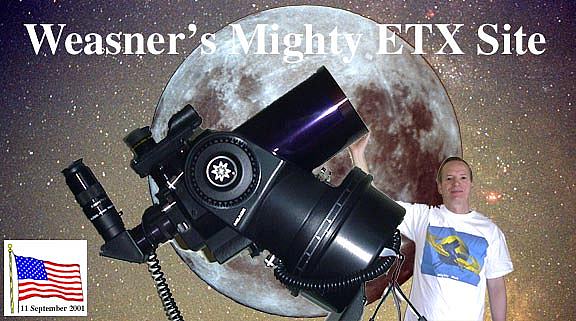
This is a fantastic story that's just beginning because a tiny telescope can now make big discoveries, after having aperture stretching. Studying the planets and moons, or deep sky, can lead to profound observational data and breathtaking imagery.
Fake big ETX Source
The core of the stretching technique dates back many years to a time when Humanoido was in Junior High School and needed a method to increase the performance of a high quality 4.25-inch diameter reflector telescope.
Several techniques were invented, some which are additive, to make a small telescope into a large telescope.

Meade ETX-60AT & ETX-70AT Telecopes
The first technique converted the 4.25 inch telescope into a 42.5-inch telescope using non digital means. As an example of this performance, when photographing Jupiter, the moon Ganymede came into view so it was captured too. To unbelievable surprise, Ganymede had surface structure visible in the photos and the stretching technique was etched in stone. 
The second technique uses an electronic invention to double the size of the telescope. This digital technique completely replaces the first non-digital technique which has its roots in chemical film based processing.
The third technique depends on the telescope design. A refractor is generally known to perform like a reflector telescope twice its size, because it has no central obstruction. The reflector telescope will be the base criteria.
The telescope is also found on Amazon.com
In conclusion, a Meade 60AT with a 60mm aperture will perform like a 120mm aperture, or 4.7-inches. Then applying Humanoido's electronic technique, this telescope will become a 47-incher. This is really fantastic.

MX-1 iPhone adapter
If you wanted to buy a 47 inch telescope, it might cost 1.1 million dollars and take up space bigger than a house. You can see the cost effectiveness of this project. The Meade ETX-60AT telescope is currently as low as $65 on Ebay.

Why the Meade ETX-60AT When Larger Scopes Are Available?
The telescope was chosen because it's a high resolution refractor without a central obstruction that can make it perform like a reflector telescope with twice the aperture. It was chosen for its diminutive size, perfect for a tiny observatory, or a tiny car observatory. It was also chosen for its computerized GOTO functions and simplistic ALT-AZ mounting and drive.

Monday, September 30, 2013

Brain Teleconferencing

Simultaneous teleconferencing blocks inside the Big Brain can communicate according to their virtualized presence through "sub interfacing" while the remainder of the brain continues to process its other functions.
BIG BRAIN MACHINE TELECONFERENCING
You may or may not be aware of numerous techniques developed for use inside the Big Brain, such as transforming, transposing, and teleportation. (see links below) What about utilizing the technique of Teleconferencing, where the projection of one entity particle can appear to reside at alternate locations for the co-exchange and intermingling of data, material, or parametric identities?

Does the human brain employ neural elements of teleconferencing visitations that can be modeled into the machine brain, or will the machine brain remain entirely unique with its implementation of functions? Can you "ghost in" teleconferencing and what are the techniques in doing so? 

— this is not the type of teleconferencing you might think... these are parts inside the brain that can meet up with other parts also inside the brain

How would one most effectively bring two discretely located brain modules together for teleconferencing and the exchange? In this method, we chose to attack the plan by the creation of two discrete modules in the brain, and give each their own unique communications net. The net enables sub communications, while the mains can continue on its routine duties of its own communications. Thus, in effect, teleconferencing is a sub effect within the bowels of the brain.

Teleconferencing, or Tele for short, involves the methodized projection of two entities within the Big Brain machine to a common focal point and reversing the conduit. The conduit reversal allows entity one to interact with entity two and the converse is true, i.e. entity two can interact with entity one. In this condition, the teleconferencing is virtualized, and not an actual transposition in the physical sense of teleportation. For all practical purposes, teleconferencing is like a simplified version of teleportation in the VR world.

For practical, simplified and demonstrative purposes, block unionizing, or the joining of two blocks, can be achieved on a one wire party line. This has the arrangement of one telecommunications channel in effect at one time. The great advantage is that any block can interactively communicate with any other block on a one-to-one fashion.

For bringing in the entire block to location, we recommend using the techniques of teleportation. For ascribing teleconferencing, it is recommended to transmit the parametric identities which define the block and reassemble the blocks at the primary and secondary locations.

LINKS 
Experimental Techniques Developed for Use Inside the Big Brain
http://humanoidolabs.blogspot.tw/2012/09/supertronic-brain.html

Sunday, August 18, 2013

Robot Mechanics - Downsize Your Big Hole

Static Ping Boe-Bot attachment using a skirt clip
ROBOT MECHANICS - DOWNSIZE YOUR BIG HOLE

In working with a chassis with pre-punched big holes, and when recycling projects, it's common sometimes to need extra components for parts mounting.

Sometimes the mounting hole is too large and little holes are in the wrong place. A big loose hole is a sloppy thing to have when mounting it with your small nuts. There's a small tip to downsizing your big holes.

In the photo, the bracket covers a large hole on the top of a Boe-Bot robot and holds the Ping bracket. This setup uses the existing battery bolt that retains the battery holder. It also allows easy adjustment of the Ping bracket. The side of the skirt clip has a connection tab for other hardware. Bend this tab to make it 90-degrees to the bracket.

Buy a bag of dress clips, the kind that mesh/clip together for wearing a woman's dress or skirt. These have two metal components, one of which is larger. The larger one has a prong which can be formed outward 90 degrees and serve as an extra mounting plate. Near the center is a small tight hole, perfect for a smaller bolt. The clip actually serves as a kind of washer covering the large hole, but with the added function.

The actual use example is for a static attachment of a Ping mount to the top of a Boe-Bot chassis, as shown in the photo. Go to the dollar store and pick up a package of twenty clip sets for, well, about a dollar.

Friday, November 2, 2012

Thought Object Action Amplifier

Big Brain Discoveries in Science
AMPLIFY A THOUGHT, OBJECT OR ACTION

HOW CAN YOU AMPLIFY A THOUGHT OR AN OBJECT?
* Can you make your thoughts more powerful?
* Increase the actions of medical technology?
* Do more with the actions of a machine?
* Amplify ideas? 


Using a special technique of amplification of something to create and gain more, or gain something totally new and unexpected, is an interesting concept - useful for many purposes.
 
Normally one thinks about amplifying the volume of sound or increasing an electronic signal in signal processing. Light is also amplified for astronomical and telescopic studies of deep space objects the Universe. Are there other unexplored uses of amplification? We think YES!

Opportunities exist for amplification
Traditionally one can push a person in a swing, each time imparting more momentum energy in the push to reach a higher level. One can amplify thought, by focus and concentration, and help from a machine. One can amplify the action of a computer program by enhancements with algorithms. The transmission of light can be amplified by dialectric coatings and the state of constructive interference of light waves. One can even amplify the action of a pill.

IMPARTING MOMENTUM
For example, let's say you're in the hospital and you're given a pill to help relax you. One of two conditions could result. 1) you could take the pill and continue to fight it and remain in a state of high excitability, or 2) you could help the action of the pill by meditating and relaxing and performing actions to supplement the pill's relaxant purpose. This would boost the intended purpose and action and final result of the pill. It makes the pill far more powerful and active than if one did nothing.

RANGE OF APPS

The same amplifying action of something to gain more can hold true for many things other than a pill. It's this venue the Big Brain is exploring. It has led to some things so remarkable, and this is the reason for defining the process and noting it with this blog.

Friday, October 5, 2012

Propeller Nano Pulsar

GMM Microscope image of a Nano Pulsar
PROPELLER CHIP NANO PULSAR
NANO Technology is here for the Propeller chip! Take a look at this Nano Pulsar created from Propeller SPIN code that operates inside a single Parallax Propeller chip!

This Nano Pulsar is a mere 10-ns to one side and represents the fastest machine inside the chip, currently known in the Propeller world!

Propeller aficionados may be aware of some techniques provided by Parallax to enable the programming of registers belonging to a configurable state machine. There are 32 different modes that program the most spectacular machines. There are two counter modules per Cog with eight Cogs to a single chip for a total of sixteen powerful state machines. The Brain has taken just one Propeller Counter Module and configured it to a powerful Nanotechnology 10-ns Machine.

{
      ************************************************************************
      ************************************************************************
      ***                                                                  ***
      ***                     Propeller Nano Pulsar 2                      ***
      ***                        Nano Result at Pin                        ***
      ***                        prop_pulsar2.spin                         ***
      ***                                                                  ***
      ***                                                                  ***
      ***                             V01.0                                ***
      ***                           Humanoido                              ***
      ***                                                                  ***
      ***                                                                  ***  

      ************************************************************************
}
CON

                 ' Declare constants, Feedback/PLL multiplier  
   _clkmode = xtal1 + pll16x 
                 ' External oscillator 6.25 MHz Crystal for 100MHz
   _xinfreq = 6_250_000     
                 ' 200MIPs, 25MIPs/Cog PUB Toggle3(Pin)
                 'Use cog's counter module, toggle at clock speed
dira[Pin]~~      'Set I/O pin to output
                 ' mode PLL BPIN APIN
ctra := 100_000 << 23 + 1 << 9 + Pin

                 'Establish mode and APIN (BPIN ignored)
                 'Set FRQA so PHSA[31] toggles every clock
frqa := $8000_0000
repeat           'infinity loop

Thursday, October 4, 2012

Accentuated Paradigmic Light

Accentuated Paradigmic Light shows over and under placement of stellar objects


ACCENTUATED PARADIGMIC LIGHT

A technique by graphical objective selection can produce an accentuated Paradigmic Light effect showing the over and under placement of stars and objects.

Generally the overall techniques strive for the placement of the largest objects at the bottom layer with progressively smaller objects having progressively higher level placements. As seen in the first accentuated version, a few objects did not follow this rule.

Saturday, August 11, 2012

Make Multiple Propeller Machines from One

PROPELLER SUPER COMPUTING
MAKE MULTIPLE PROPELLER MACHINES FROM ONE

You can adapt this technique to make many machines given just one machine to work with. There's no need to tear down a machine for recycling or build a new machine with hardware. The method algorithm, which is all in software, is to first make a large parallel machine using Parallax Propeller chips and set the hardware according to the standard supercomputing wiring established by the Big Brain project. This is a parallel wiring format of chips and Cogs. Next, clone a large number of internal processors, i.e. 50,000 processors in a fifty chip machine and 100,000 processors in a one hundred chip machine. Now, configure the processors to make new machines. For example, each new machine is software wired, i.e. cube computing is possible, vast array machines are possible, new versions of T-Series Massive Transposition Machines, and linear ramp software accelerators are possible. Another example is the Power Cube, a machine inside a machine wired with node software.

How to wire a Propeller super computing machine with software is a very interesting vast topic and encompasses many areas. The subject can be addressed by examining reconfigurations of mass enumerated processors as a starting point. There are many techniques involving parallelism computing and distributed methodology. Look for more about this topic in the future.

Thursday, January 19, 2012

Master Offloader Technique

Big Brain Uses Master Offloader Technique
The original Master Offloader Machine was developed for the BASIC Stamp Supercomputer in a hardware array of tandem processors. This technique is now in widespread use inside the Big Brain.

The Big Brain uses the Master Offloader technique (the technique is now upgraded to include hardware, software or both) which was developed for the BASIC Stamp Supercomputer in 2008 and 2009. Many techniques developed for the BSS are in place on the Propeller Big Brain platform. The M.O.M. is seen to the right of the BSS with ten battery operated green processor boards. Click the photo for a larger image. 

The machine brain is divided up into brain quadrants. The quad includes a Propellerized Left Brain and a Right Brain. The technique of the Master Offloader is used between the Left Brain and the Right Brain. It's also used in the Quad design of the Brain. Offloading allows the Big Brain to continue functioning if one or more quadrants are busy, idle, sleeping, dreaming, disabled, errored, occupied, in stasis or powered down.

New Word Definitions
Offloading - the technique (using hardware, software or both) of offloading duties to another Brain quadrant, which allows the Big Brain to continue to function when one or more quadrants are busy, idle, sleeping, dreaming, disabled, occupied, in stasis, errored or powered down. 

Original Posting
This new machine, the Master Offloader, is added to the Basic Stamp Supercomputer to offload the intensive duties and responsibilities of the Master. It holds the addition of ten layers of smaller microcontroller processors that can potentially access half a hundred flash drives for millions of files under the SSD format. It can also free up the primary workers for more intensive processing. Connection is by wire, although a wireless system is now developed and being tested. MOM (Master Offloader Machine) processing can now introduce simultaneous disk reads and writes - new paralleled clustered tasks that single drive driven processors cannot achieve. This opens up the potential for new worlds of applications never seen before, and a magnitude of unprecedented computing power at the hobby level.