Showing posts with label cog. Show all posts

Friday, October 5, 2012

Propeller Nano Pulsar

GMM Microscope image of a Nano Pulsar
PROPELLER CHIP NANO PULSAR
NANO Technology is here for the Propeller chip! Take a look at this Nano Pulsar created from Propeller SPIN code that operates inside a single Parallax Propeller chip!

This Nano Pulsar is a mere 10-ns to one side and represents the fastest machine inside the chip, currently known in the Propeller world!

Propeller aficionados may be aware of some techniques provided by Parallax to enable the programming of registers belonging to a configurable state machine. There are 32 different modes that program the most spectacular machines. There are two counter modules per Cog with eight Cogs to a single chip for a total of sixteen powerful state machines. The Brain has taken just one Propeller Counter Module and configured it to a powerful Nanotechnology 10-ns Machine.

{
      ************************************************************************
      ************************************************************************
      ***                                                                  ***
      ***                     Propeller Nano Pulsar 2                      ***
      ***                        Nano Result at Pin                        ***
      ***                        prop_pulsar2.spin                         ***
      ***                                                                  ***
      ***                                                                  ***
      ***                             V01.0                                ***
      ***                           Humanoido                              ***
      ***                                                                  ***
      ***                                                                  ***  

      ************************************************************************
}
CON

                 ' Declare constants, Feedback/PLL multiplier  
   _clkmode = xtal1 + pll16x 
                 ' External oscillator 6.25 MHz Crystal for 100MHz
   _xinfreq = 6_250_000     
                 ' 200MIPs, 25MIPs/Cog PUB Toggle3(Pin)
                 'Use cog's counter module, toggle at clock speed
dira[Pin]~~      'Set I/O pin to output
                 ' mode PLL BPIN APIN
ctra := 100_000 << 23 + 1 << 9 + Pin

                 'Establish mode and APIN (BPIN ignored)
                 'Set FRQA so PHSA[31] toggles every clock
frqa := $8000_0000
repeat           'infinity loop

Wednesday, September 26, 2012

City in a Propeller Chip

Houses/streets/trees appear inside the chip
Big Brain City Analogy
MICROSCOPIC CITY IN A PROPELLER CHIP ANALOGY

IT'S THE STRANGEST THING  YOU MAY EVER SEE!!! LOOK WHAT YOU CAN FIND INSIDE A PARALLAX PROPELLER MICROCONTROLLER CHIP!

You can reveal a fascinating world showing a complete city inside a P8X32A-D40 Parallax Propeller chip by using the powerful Microscope from the Microscopy Initiative and some simple "processing" of the chip's substrate.

First, establish one of three methods to reveal the microscopic inner workings of one Parallax Propeller chip.

LET'S TAKE A LOOK AT PROPELLER CITY
To obtain the photo shown of an actual Propeller chip, a fractional section of one COG inside one chip was processed using the Big Brain's Microscopy Initiative. An additional effectual  "electronic lens" was applied to increase enlargement and accentuate the city. In some sections of this City, we believe parked cars are just visible. Prior, we believed only the logic components were etched into the substrate with nothing out of the ordinary to see. But this project shows the truth to the old adage that Seeing is believing..."

WHAT IS SEEN
The captured Microscopy image in natural processing color appears to show laid out real estate with rows upon rows of tiny houses, streets and express ways, a business development section, various districts, parked cars and buses, a train, and even green trees, shrubs and landscaping.

Methods of Chip Processing
1) Chemical Acid Bath*
2) Sand off the substrate
3) Data

CHIP PROCESSING
For safety reasons, the Big Brain does not recommend using acid for chip processing. It's more safe, wearing a filter mask, to sand off the substrate and polish the remaining surface, carefully revealing a level of components. The level is then imaged into microscope data and processed with Big Brain's Microscopy Initiative. High resolution data can also be accumulated from sources and analyzed with the Big Brain's Microscope.

SHOCKING RESULTS!
It's rather shocking to open up the chip and discover a Tiny COSMOS world of microscopic and molecular, with appearances of streets and buildings! Come explore this Inner Space of multiple dimensions and fascinating objects within the Big Brain's New Frontier!

SKY INSIDE THE CHIP
Living the life of the P8X32A-D40 Propeller chip, zooming through its rich object filled silicon sky with the myriad motions of molecules, with varying levels of capacitance and inductance. The effervesce effects with elemental particles of Physics is not unlike the twinkling of stars strewn across the Earth's sky.

ON THE GROUND
At "ground level" components with dancing electrons liven up the streets and avenues of circuits. But what are these tiny objects? Possibly we have some things determined... Busy intersections are found with running athletic Cogs and busy transportation of Global Memory Buses, and plots of real estate packed with tall structures of HUB Logic, fields of sprouted RAM, neatly laid out rows of ROM, vast field arrays of mystic proportions and the obviously large affluent homes where COGs live and work. Trillions of electrons have a busy life in Propeller City..

Molecular Microscopy Initiative

Thursday, February 9, 2012

Fake Prop

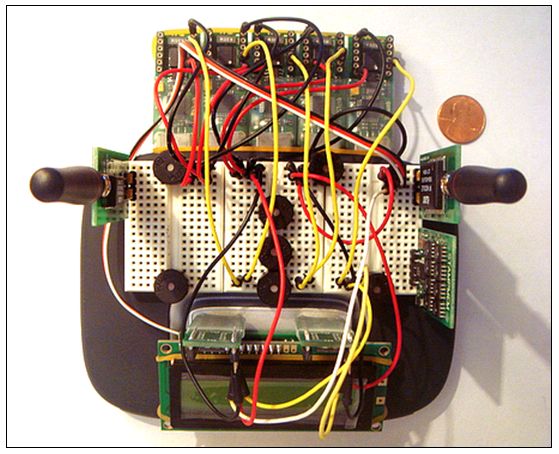
EXPERIMENTAL FAKE PROP MADE WITH BASIC STAMPS
Fake Prop during assembly

Sometimes you need to recycle a project to get more fun out of it. This is what happened with the TSS.

This fun project emulates simple exampling parallel functions of a Propeller chip by connecting together a cluster of Basic Stamp processors. Each Stamp represents one Cog, has its own operating program and communicates through a common BUS using PBASIC programming language. Output is to a built-in green screen LCD monitor. Unlike the real Prop, the Fake Prop can be rewired in between its Cogs.

Fake Cog with 8 ports
Fake Prop Schematic


The Fake Prop (FP) has seven BS1 Stamp processors to experiment with Cog emulation, LCD monitor, radio transmitter, radio receiver and a 64K EEPROM memory board, interfaced to a Belkin USB Hub. The FP is larger than a Prop but still small enough to fit into a soup bowl or Parka coat pocket. The yellow wires are for the port-to-port one wire interface. The black wires are adjoining Vss and red wires are Vdd. White represents a serial signal wire. By comparison, the American penny shows size comparison. FP includes an optional serial “green screen” by Parallax.

Assembly
( ) Plug in seven Stamp computers to the Belkin 7-port hub
( ) Run wire from P0 Computer 1 to P0 Computer 2, repeat to 7
( ) Connect all grounds together with jumper wires (Vss)
( ) Connect all +5 volts together (Vdd)
( ) Consult the schematic to wire the peripherals

Assemble everything directly onto the Belkin HUB. USB Stamps are plugged into all available USB ports. The powered HUB has the ability to draw external power to supply the demand created by seven processors.

Parts List
R1 - 1K Resistor
R2 to R8 - 220 Ohm Resistor
Z1 - Z7 - Piezo Speaker
7 - USB BASIC Stamp

Peripherals Used in this Project, from Parallax
7 – Five Volt Piezo Speakers
1 – Green Screen Serial LCD
1 – 433 Mhz Radio Transmitter
1 – 433 Mhz Radio Receiver
1 – 64K EEPROM Memory Board

New Experiments
The Fake Prop is intended for academics and exampling study, and is primarily just for fun. However, one idea is to create a bunch of external fake props, using any processors which are available, and their native programming languages to create prop emulation software. Then radio transceivers link directly to a project like the Big Brain, which has the ability to receive downlink. This "Fake Brain" can operate alongside the real brain.

How does FP stack up against a real Prop?

     EEPROM  SPEED  MEMORY  COGS  SPEAKER  TX  RX  LCD  I/O
FAKE 1.75K   28MHz  64K+     7       7      1   1   1   56
REAL   32K   80MHz  32K      8       0      0   0   0   32

The Fake Prop costs more and is larger/heavier than the real Prop, roughly 2.5 times slower with EEPROM that's 21 times smaller. However, it has twice as much memory,  1.75 times more I/O, and tighter programming code.

FP has some things the real Prop does not have at all like the ability to rewire in between Cogs and access to 3 solderless breadboards for work space, seven speakers, a serial green screen, and full scale long range radio transceiver. For more comparisons, refer to the processor manuals and link. 

Links
Tiny Stamp Supercomputer
TSS