MANUFACTURED BY HUMANOIDO LABS
CHERRY PIE: TINY SUPER COMPUTER WANNABE
It's finally here - Cherry Pie, a Tiny Super Computer Wannabe, for hobbyists and students who can't afford 55 million dollars for the real thing but want to build their own smaller working version for experimenting, learning, having fun and play.
The Cherry Pie attempts to use techniques to super-size your existing Propeller chips, multiply their "Cogs" and make a computing machine with more power, function and intrigue! Cherry Processors are less than a penny each!
INTRO & STATS
This is a cute tiny parallel platform almost like the big supercomputers on the Top 500 List. It has lots of parallel cores, multi-threaded processors, it's own fully functional real time operating system RTOS (for thousands of cherry processors) and interfaces galore for nearly every imaginable configuration (parallel, serial, full duplex, half duplex, party line, one wire, etc.). It's simple, homey, and a lot like cherry pie in likeability.
TECHNOLOGY
Cherry Pie is based on technology developed for the Spin Brain which has filtered down from the actual Big Brain that turned Supercomputer last year. These Tiny Wannabe Super Computers are fully operational, function in parallel, and have wee-tiny output monitors on each chip for experiments on a budget.
— We expect these will go like hotcakes once the schools discover they're a learning bonanza substitute for the real thing. —
— Educators state, switching to Cherry Pie <tiny super computer wannabe>, 55 million dollars or 55 dollars was an easy choice for students and the university' curriculum —
PRICING
They're almost a dime a dozen, though you'll still need to purchase from one to five Parallax Multi Core chips at about $7.99 each. But you can start with one chip and "supersize" its eight RISC cores to super computer stuffins classification, then add more chips as your wallet grows in increments of $7.99. This is about a dollar a hard core or CPU. Not bad! Throw in handful of common components from the electronic parts store and you should be ready to get started immediately! But wait! There's more! The cost of a single Cherry processor drops to less than a penny.
AMORTIZING
The amortized cost is far less. The enhanced Propeller chip rises from 8 RISC cores to a combined 1008 processors. Running five chips provides a total of 5,040 Cherry processors. As each chip is $7.99, the amortized cost per Cherry processor is only $.008 - not even a full penny per processor!
SPEED
The speed is also tiny. You'll need to pretend the actual thousand MIPs rating is thousands of times faster. But don't worry, we have several ways to load up the chips with enhancements that make this tiny machine "function" more like an actual supercomputer. With your hair flung back from hairspray and the fallout-wind of this tiny slick supercomputer wannabe, it's sure to be a win-win situation.
WANNABE
Wannabe is good - and not a bad thing, as proven by Daniel Hammer, professor of bioengineering at the University of Pennsylvania. He's reportedly working with artificial cells made from polymers, which can mimic the ease with which white blood cells travel through the body. These could deliver drugs directly where they're needed, making it easier and safer to fight off certain diseases, including cancer.
ADVANTAGES
Cherry Pie has advantages. It doesn't need the support team of a lunar landing. It doesn't need a large room or entire building to hold it. It doesn't result in a monthly electric bill more costly than purchasing a house.
LINKS
SPIN BRAIN
BIG BRAIN
PARALLAX
PROPELLER CHIP P8x32A-D40
PROP PLUG 32201
to be continued
BIG BRAIN made by Humanoido is a giant intelligent AI machine. Over twenty years in the making, living and sentient, approaching one trillion processors/constructs. Join us in the exciting adventure as it continues to evolve!
Showing posts with label fake. Show all posts
Sunday, June 23, 2013
Saturday, June 22, 2013
Fake Supercomputer
FAKE SUPERCOMPUTER
The Fake Supercomputer is an interim project that transitions one project to another. The idea is to construct a small low cost portable computer that has many of the functions and architecture of a supercomputer, for the purposes of learning the realm of the parallel world. The actual fake super computer is a fully working model that includes enhancements to the Propeller chip, adds more processors and speed, adds special software, and provides a powerful programming environment.
Initially, the FS was designed to have 1 to 25 Parallax Propeller chips in the Supertronic config. In the limit condition, the (25*2,720 MIPs) 68,000 MIPs machine would run in parallel and have a total of (25*32) 800 hard wired processors plus 25,000 VP processors for a total of 25,800 processors. The standard package would include the loader, enumerator, enhancer, parallel algorithm, and RTOS. In advanced versions, the RTOS is already incorporated with the enhancer.
By comparison, the Big Brain was measured at 100 Propeller chips before expansion. Speed enhancements apply with Supertronic giving 100 chips x 2,720 MIPs = 272,000 MIPs, and 100 chips x 32 hard processors = 3,200 hard wired processors + 100,000 VP processors, giving a total of 103,200 processors.
Thursday, February 9, 2012
Fake Prop
EXPERIMENTAL FAKE PROP MADE WITH BASIC STAMPS
![]() |
| Fake Prop during assembly |
Sometimes you need to recycle a project to get more fun out of it. This is what happened with the TSS.
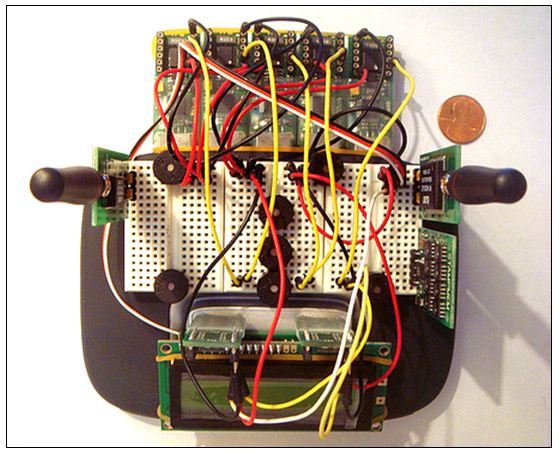
This fun project emulates simple exampling parallel functions of a Propeller chip by connecting together a cluster of Basic Stamp processors. Each Stamp represents one Cog, has its own operating program and communicates through a common BUS using PBASIC programming language. Output is to a built-in green screen LCD monitor. Unlike the real Prop, the Fake Prop can be rewired in between its Cogs.
![]() | |||
| Fake Prop Schematic |
The Fake Prop (FP) has seven BS1 Stamp processors to experiment with Cog emulation, LCD monitor,
radio transmitter, radio receiver and a 64K EEPROM memory board, interfaced
to a Belkin USB Hub. The FP is larger than a Prop but still small enough to fit
into a soup bowl or Parka coat pocket. The yellow wires are for the
port-to-port one wire interface. The black wires are adjoining Vss and
red wires are Vdd. White represents a serial signal wire. By comparison,
the American penny shows size comparison. FP includes an optional serial “green screen” by Parallax.
Assembly
( ) Plug in seven Stamp computers to the Belkin 7-port hub
( ) Run wire from P0 Computer 1 to P0 Computer 2, repeat to 7
( ) Connect all grounds together with jumper wires (Vss)
( ) Connect all +5 volts together (Vdd)
( ) Plug in seven Stamp computers to the Belkin 7-port hub
( ) Run wire from P0 Computer 1 to P0 Computer 2, repeat to 7
( ) Connect all grounds together with jumper wires (Vss)
( ) Connect all +5 volts together (Vdd)
( ) Consult the schematic to wire the peripherals
Assemble everything directly onto the Belkin HUB. USB Stamps are plugged into all available USB ports. The powered HUB has the ability to draw external power to supply the demand created by seven processors.
Parts List
R1 - 1K Resistor
R2 to R8 - 220 Ohm Resistor
Z1 - Z7 - Piezo Speaker
7 - USB BASIC Stamp
Peripherals Used in this Project, from Parallax
7 – Five Volt Piezo Speakers
1 – Green Screen Serial LCD
1 – 433 Mhz Radio Transmitter
1 – 433 Mhz Radio Receiver
1 – 64K EEPROM Memory Board
7 – Five Volt Piezo Speakers
1 – Green Screen Serial LCD
1 – 433 Mhz Radio Transmitter
1 – 433 Mhz Radio Receiver
1 – 64K EEPROM Memory Board
New Experiments
The Fake Prop is intended for academics and exampling study, and is primarily just for fun. However, one idea is to create a bunch of external fake props, using any processors which are available, and their native programming languages to create prop emulation software. Then radio transceivers link directly to a project like the Big Brain, which has the ability to receive downlink. This "Fake Brain" can operate alongside the real brain.
How does FP stack up against a real Prop?
EEPROM SPEED MEMORY COGS SPEAKER TX RX LCD I/O
FAKE 1.75K 28MHz 64K+ 7 7 1 1 1 56
REAL 32K 80MHz 32K 8 0 0 0 0 32
The Fake Prop costs more and is larger/heavier than the real Prop, roughly 2.5 times slower with EEPROM that's 21 times smaller. However, it has twice as much memory, 1.75 times more I/O, and tighter programming code.
FP has some things the real Prop does not have at all like the ability to rewire in between Cogs and access to 3 solderless breadboards for work space, seven speakers, a serial green screen, and full scale long range radio transceiver. For more comparisons, refer to the processor manuals and link.
Links
TSS
Subscribe to:
Posts (Atom)