Showing posts with label imaging. Show all posts

Saturday, May 30, 2015

Tiny Telescope Observatory & Aperture Stretching

TINY TELESCOPE OBSERVATORY & APERTURE STRETCHING


The tiny telescope observatory is a dream for 16 years. The goal is to take a tiny telescope of precision optical quality, about 2 to 6 inches in diameter, and magically stretch it into a 20 to 60-inch telescope using high technology.
This is a fantastic story that's just beginning because a tiny telescope can now make big discoveries, after having aperture stretching. Studying the planets and moons, or deep sky, can lead to profound observational data and breathtaking imagery.
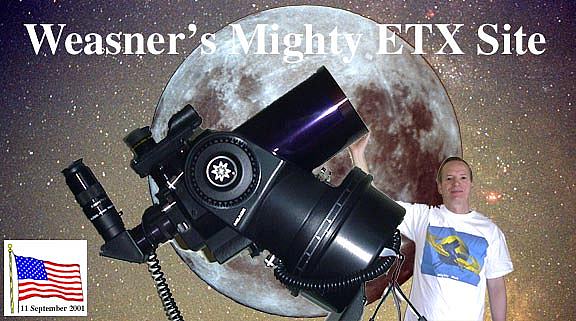
Fake big ETX Source
The core of the stretching technique dates back many years to a time when Humanoido was in Junior High School and needed a method to increase the performance of a high quality 4.25-inch diameter reflector telescope.
Several techniques were invented, some which are additive, to make a small telescope into a large telescope.

Meade ETX-60AT & ETX-70AT Telecopes
The first technique converted the 4.25 inch telescope into a 42.5-inch telescope using non digital means. As an example of this performance, when photographing Jupiter, the moon Ganymede came into view so it was captured too. To unbelievable surprise, Ganymede had surface structure visible in the photos and the stretching technique was etched in stone. 
The second technique uses an electronic invention to double the size of the telescope. This digital technique completely replaces the first non-digital technique which has its roots in chemical film based processing.
The third technique depends on the telescope design. A refractor is generally known to perform like a reflector telescope twice its size, because it has no central obstruction. The reflector telescope will be the base criteria.
The telescope is also found on Amazon.com
In conclusion, a Meade 60AT with a 60mm aperture will perform like a 120mm aperture, or 4.7-inches. Then applying Humanoido's electronic technique, this telescope will become a 47-incher. This is really fantastic.

MX-1 iPhone adapter
If you wanted to buy a 47 inch telescope, it might cost 1.1 million dollars and take up space bigger than a house. You can see the cost effectiveness of this project. The Meade ETX-60AT telescope is currently as low as $65 on Ebay.

Why the Meade ETX-60AT When Larger Scopes Are Available?
The telescope was chosen because it's a high resolution refractor without a central obstruction that can make it perform like a reflector telescope with twice the aperture. It was chosen for its diminutive size, perfect for a tiny observatory, or a tiny car observatory. It was also chosen for its computerized GOTO functions and simplistic ALT-AZ mounting and drive.

Wednesday, December 24, 2014

Humanoido Labs in 2014


HUMANOIDO LABS IN 2014

As we are about to conclude the year 2014 and enter into the New Year 2015, Humanoido has established many long term and short term labs in the USA and international locations.

Over the long term, beginning in the 1950s and leading to 2014, labs were established in the USA, Taiwan, Seoul South Korea, Canada, Hong Kong, Japan, Shanghai, Beijing, Tianjin, Indonesia, Macao, and other locations.

An innovative mobile transit lab also exists that can remain in flight without a parent country. (A manned Mobile Transport Lab was flown over the North Pole and collected polar data.)

NINE NEW LABS INTRODUCED IN 2014
In Taiwan and South Korea, nine new Humanoido labs were introduced in 2014 after the very large move to a new location in Taiwan. These labs serve the Space1 rocket tourism industry, astronomical observatories in two countries, Aeronautics experiments, and international expansion.

The beginning move in to Rocket Lab
Rocket Lab
(Intl Taiwan Lab 61 TRL)
September 24th, 2014 - Rocket Lab debuted after the major move to new facilities in December 2014 in Taipei Taiwan. The Rocket Lab is located on the entire second floor, and contains two work tables for lab equipment and space for constructing rocket parts and equipment. The floor houses parts and storage, and ready access components for immediate experiments. It houses the nano space stations, the medium space station, and parts for the large space station.
This facility has resources in mechanics, electronics, digital computing, the Big Brain, parts and components, all the Micro Space equipment, inventions, rockets, and a series of working spacecraft. The laboratory also includes guest space for scientists.

Photo of Taipei 101 from DeckLab
DeckLab in the Sky 
(Intl Taiwan Lab 62 TDL)
November 4th 2014 - The new deck lab is slightly larger than the previous Taiwan deck lab. Although three times lower in height, it's still suspended upwards to a hundred feet in the air. The lab faces a North polar orientation of the sky. DeckLab offers fundamental space for the conduction of aeronautical research, atmospheric phenomena, a mini launch pad for potential smaller spacecraft, and the study of weather conditions.
http://humanoidolabs.blogspot.tw/2014/11/decklab-in-sky.html

AstroLab Experiment
Astro Aeronautics Lab (Intl Taiwan Lab 63 TAL) 
Thursday November 13, 2014 - The Astro Aeronautic Laboratory officially opened with its first portable telescope experiment seen in the link below. The AAL is simply a reconfigured DeckLab in the Sky, designed for elevated astro aeronautics experiments. It can also function as a telescope optical and radio observatory, or as an experimental platform for the study of new equipment performance as the first experiment has shown.
 

http://humanoidolabs.blogspot.tw/2014/11/iphone-pocket-telescope.htmliPhone Pocket Telescope


Seoul South Korea Lab
(Intl South Korea Lab 64 SKL)
Dec. 18-21, 2014 - Accomplishments included the South Korean Space1 Site Survey, the Space1 Presidential meeting with the agenda for 2015, the Space1 Wisdom Lab meeting with South Korean Scientist/Conceptual Designer and Director Dara 지혜 and setting up an additional observatory lab plus a Korean mobile transit lab.
http://humanoidolabs.blogspot.tw/2014/12/president-meeting-in-seoul-south-korea.html


View from Soul Observatory
Seoul South Korea
Temp Astronomical Observatory Lab
(Intl South Korea Observatory Lab 65 SKO)
Dec. 18-21, 2014 - Astronomically speaking, Seoul is brightly lit in most locations. At the Temp Astronomical Observatory, the experience was many lights were turned off early in the morning. While this vastly improved seeing conditions, the level of stellar extinction in the city remained extremely high. In the view of this astronomical observatory located in the more remote sections of Dongdaemun, the planet Jupiter was clearly visible and tracked over a period of hours, but stars were not visible.

Korean Mobile Transit Lab (KMTL)
Dec. 18-21, 2014 - The Korean Mobile Transit Lab was created inside a high speed moving Express train cutting through a remote region of the rural countryside. It contained a full working computer with OS8.1.2 running numerous apps to include a full office, GPS, mapping, processing, and imaging.


Multi-D & Imaging Lab
(Intl Taiwan Lab 65 MDK)
The new lab research and development center for Multi-D & Imaging is a spinoff of the Rocket Lab. The Multi-D Imaging project will be ongoing in 2015, designed to capture the space tourism flight from a multidimensional external location which will be varied in flux position. This allows flying the imager around the tourism rocket, and to provide vantage points from above and below. The MKIP provides a calculus and differential equation mode to capture the entropy of space flight. The Lab is for testing, research, development, prototyping, and refining the final systems.

Space Komputer Development Research Lab (Intl Taiwan Lab 66 SKD)
This lab is specifically laid out for the contstruction, testing, and implementation of the Space Komputer. The first Space Komputer is the heart of the Space Machine. It's driven by KOSMOS that handles space time, rocket parameters and it collaborates with the rocket flight computer.
http://humanoidolabs.blogspot.tw/2014/10/komputer.html
http://humanoidolabs.blogspot.tw/2014/09/space-machine.html

South Korea Wisdom Lab (SKWL)
Created in 2014 for Space1, the Wisdom Lab was designed to provide an innovative and unique design view for the elements and aspects of Space1. The SKWL is located at an unspecified secret location. It is manned by Korean scientists to provide a unique view and contributory status to Space1.

The Big Brain Initiative, USA - Ultra Space Administration, DSC - Deep Space Center, are divisions of Humanoido Laboratories

Sunday, March 16, 2014

SpaceOne Aerospace Observatory

SPACEONE AEROSPACE OBSERVATORY AO

AEROSPACE OBSERVATORY
The concept of SpaceOne's Aerospace Observatory is proposed and studied. A design is in the works that will contain special instruments and equipment for conducting and supporting space flight. The AO will utilize small high resolution telescopes and powerful CCD imaging, plus techniques that support space launches and develop rocket technology.

Sunday, April 28, 2013

Tiny Telescope for Near Space

Telescope photo showing the Moon
TINY TELESCOPE FOR NEAR SPACE FLIGHT
The next Near Space flight will carry a small telescope up into the fringes of space, and will be capable of imaging planned celestial objects during the day and night. The first time telescope will be equipped with a battery operated CCD camera imager capable of single integration color or black and white at ISO 28,000 or more.

NODAL POINTS
Short term integration
The initial tests will be unguided, i.e. accepting the motions of the spacecraft. We will study the best spacecraft orientations for particular telescopic data collecting and imaging with the greatest points of stability and least angular rotation and linear motion.

This will occur at nodal points established during the flight.

IMAGE STABILIZER
The telescope will include an Image Stabilizer to reduce imaging motion and produce more clear and less trailed images.

Solar imaging
PIXELS
With over 10 million pixels, the telescope can produce fine resolution shots.

CCD
This is an electronic telescope with a built in CCD Charge Coupled Device.
 
TIMED INTEGRATIONS
The telescope is equipped to do integrations of up to 15 seconds to capture faint objects and possible star fields during flight. Solar integrations can be as short as 1/1,600th of a second.

FOCAL LENGTH
Atmospheric effects
The small telescope is variable at f/2 to F/4.9 with a focal length from 28mm to 105mm. Part of the telescope is electronic, thus capable of FL modification.

MONITOR
A 3-inch color monitor is attached to the telescope for focus, framing and viewing in various modes.

Storage Media
STORAGE
Deep Sky M57 on storage

iPhone 5 support with Siri AI
Free iPhone app supplements telescope data


Image storing is available in the following formats: RAW 3648 x 2736, JPEG 3648 x 2736, JPEG 2816 x 2112, JPEG 1600 x 1200, JPEG 640 x 480, JPEG 3648 x 2048, JPEG 2816 x 1584, JPEG 1920 x 1080, JPEG 640 x 360, JPEG 3648 x 2432, JPEG 2816 x 1880, JPEG 1600 x 1064, JPEG 640 x 424, JPEG 2736 x 2736, JPEG 2112 x 2112, JPEG 1200 x 1200, JPEG 480 x 480, JPEG 2192 x 2736, JPEG 1696 x 2112, JPEG 960 x 1200, JPEG 384 x 480.

M1 integration
HIGH TECH TELESCOPE
The high technology telescope supports HD recording and uses a folded lens design. This is specifically designed for Near Space flight and has low profile compacted folded dimensions of approximately 4-inches x 2 x  1. The folding design extends another one inch to the 1-inch dimension. It can do continuous auto timed repeated imaging at about 2 FPS running on Lithium Ion batteries. Images are saved to a multi media card which can be retrieved after the flight.

SUPPORT
Small telescopes can be supported with iPhone 5 functions, including the built in talk-to artificial intelligence SIRI when the sound environment is relatively quiet.

Monday, October 15, 2012

M42 PGT Paradigmic Genius Telescope

BIG BRAIN SUPERCOMPUTER
PGT PARADIGMIC GENIUS TELESCOPE VIEWS M42

MONDAY OCTOBER 15TH 2012 - STUNNING VIEWS! were obtained using the Big Brain's PGT Super Telescope. Observations were completed on Monday, driven with a new portal window designed to show a wider view FOV (thanks to the experimental FR) with more visible detail and less cluttering of telescope controls.


M42 is the birthplace of stars and shows a wealth of detail in expanding hydrogen dust and filamentary detail. Glowing nebulosity is lit up by nearby and embedded stars. The PGT is an experimental telescope that's performing beyond all expectations.

The successful new portal version is functional though still under construction - it appears it will be chosen for primary use. This is the second image captured with the PGT. The previous observation did focusing on a Black Hole at the center of galaxy with a massive Event Horizon and a Relativistic Space Time Jet.


EXPANSION
One possible future expansion of the PGT may include the GMM's (Genius Molecular Microscope) Stage Cascader to zoom in to highly detailed portions of a wide FOV Cosmic View. This will ride atop the ocularic section for amplification and permit highly detailed magnified enlargement of selected areas much like results obtained from refinement stages within the GMM.

THE EXPERIMENT
It will be an exciting experiment to attach the Molecular Cascader atop the PGT Telescope and view the results. If permanently used, it could usher in a new age of telescope. One proposal is Molecular PGT or MPGT for Molecular Paradigmic Genius Telescope. This may be shortened to MGT Molecular Genius Telescope.

Friday, October 12, 2012

Human Journey into Near Space

Near Space
HUMAN JOURNEY INTO NEAR SPACE
Yesterday, Friday October 12th, marks two spectacular journeys into Near Space made on the same day. Two flights were made, each lasting about 2.75 hours going up to a distance of 7.4 aeronautical miles.


Levels of Space According to the Big Brain
The launch was a little rough, passing through a layer of pollution, smog, and fog, creating varying air density pockets of turbulence, then rising up above the strata, meeting a second layer of clouds, which then dissipated, then rising up above smoothly to meet a very clear sky which then turned from light blue to dark blue marking the beginning of atmospheric thin-out and finally the subtle curvature of the Earth at the apex of the flight path. It was a fantastic flight!

This was a well equipped journey into space. Equipment carried aloft included 17 Special cameras, Accelerometer, Compass, Data Recorder, Sound Recorder, a fully charged Battery Power Distribution System, Automatic Battery Monitor, Cellular 2-Way Communications Equipment, Data Logger, Clock & Date Stamper, Theodolite, Heads-Up Display, Geo Angle Determinator Machine, Night Vision Unit, GPS, gauges for Speed in MPH, Heading Indicator, Acceleration Gauge, Vertical Speed Indicator, Altitude Meter, Roll-Pitch-Yaw Unit, and other machines. Data is currently being analyzed. Unlike launches into Micro Space and Next Space, the craft compartment capsule required a containment of some pressurized air.

This marks the second highest human "astronaut" flight into the Big Brain's defined space domain, the previous was a flight up .3-mile into Next Space from China with a Mega Project. Prior, astronauts were launched into Micro Space aboard compressed O2 rockets.

LIST OF BIG BRAIN SPACE PROGRAM ASTRONAUTS
2011 Micro Space Ant Insectronauts (10-feet)
2011 Next  Space Humanoido Astronaut (1,555-feet or .3-mile)
2012 Near  Space Humanoido Astronaut (7-miles)

Next Space
LINKS
Next Space

My Journey Into Space - Part 1 of 3
Introduction, Flight Photos, Safety Considerations
http://forums.parallax.com/showthread.php?124495-Fill-the-Big-Brain&p=1033782&viewfull=1#post1033782

Part 2 of 3 - Experiences

http://forums.parallax.com/showthread.php?124495-Fill-the-Big-Brain&p=1033994&viewfull=1#post1033994

Part 3 of 3 - From Micro Space to Mega Space
http://forums.parallax.com/showthread.php?124495-Fill-the-Big-Brain&p=1034358&viewfull=1#post1034358  

Micro Space
Meet the Micronauts
Selecting the Next Crew to Go Up Into Micro Space

http://forums.parallax.com/showthread.php?124495-Fill-the-Big-Brain&p=1045284&viewfull=1#post1045284 

The Micronaut Space Program
http://forums.parallax.com/showthread.php?124495-Fill-the-Big-Brain&p=1041494&viewfull=1#post1041494

The MSR-01A Rocket - Launching Micronauts Into Space
http://forums.parallax.com/showthread.php?124495-Fill-the-Big-Brain&p=1041513&viewfull=1#post1041513

PURPOSE
As usual, these flights are designed to gather information for the Big Brain's Space Program. The Big Brain's exact purpose for exploring space is unknown but it's rumored the Brain is going on some kind of journey -  one of great adventure and exploration. Sending live astronauts into Micro Space, Next Space, and Near Space is highly interesting and sets a trend of reaching for deeper and deeper space.

SPACE DEFINED
The attainment of Near Space is a marvelous revelation. Near Space goes up 50 miles. The ISS Space Station orbits the Earth from 205 miles to 255 miles and the Hubble Space Telescope orbits at 355 miles. There is a range of "orbital space" which may be added to the space domain as defined by the Big Brain, if and when the project expands into this region. The commonly accepted definition for Low Earth Orbit LEO is between 160 kilometers (99 mi) and 2,000 kilometers (1,200 mi) above the Earth's surface.

PROJECT DIRECTION
Recent projects involve the edge of the Universe, the study of and formulation of new theories of the Universe and the connections between the EXO Space beyond the Universe and the Quantum Space connected to the Universe. Investigations and projects encompass Inner Space which includes nanotechnology. Quantum space involves a universe microcosm smaller than nanotechnology.

Thursday, October 4, 2012

Accentuated Paradigmic Light

Accentuated Paradigmic Light shows over and under placement of stellar objects


ACCENTUATED PARADIGMIC LIGHT

A technique by graphical objective selection can produce an accentuated Paradigmic Light effect showing the over and under placement of stars and objects.

Generally the overall techniques strive for the placement of the largest objects at the bottom layer with progressively smaller objects having progressively higher level placements. As seen in the first accentuated version, a few objects did not follow this rule.

Thursday, July 26, 2012

Venus Meets 101

SPECTACULAR VIEWS OF VENUS AT TAIPEI 101
THE CONTINUING  SAGA OF THE VENUS JUPITER ALDEBARAN CONJUNCTION AT 101

Photo 1 - Panorama


Photo 2 - Wide View

Friday July 27th 2012 

Photo 3 - Zoom
Photo 1 The panoramic view in photo 1 was shot in the early morning of July 27th, 2012 at 3:22:06 am, with a Canon Powershot S95 at 1 second exposure (2 EV) with a 28mm f/2 lens and ISO 1,600 shows a rich field of celestial sky objects - from top: the Pleiades star cluster, the planet Jupiter, the Hyades star cluster, Aldebaran in the constellation Taurus the Bull, Capella in the constellation Auriga. Note the position of very bright Venus to the immediate right of Taipei 101. Click on the photo to see the full panorama. 

Photo 2 The next photo shows a wide view shot in portrait format obtained earlier at 3:20:12 am. These first two images were at 1080 x 1920 1.2MB and screen shot for reduction.


Photo 3 The zoom is highly detailed at f/4... and perhaps the most dramatic with Jupiter, Aldebaran, and Venus poised immediately next to Taipei 101 (at the right side aboub 3/4th of the way towards the top).


Tuesday, July 24, 2012

Jupiter Venus Conjunction Widens

JUPITER VENUS CONJUNCTION WIDENS

Along with more stars and the return of another UFO!

All observations made at Humanoido Lab Number 50.

Wednesday July 25th 2012 3:53:18 am

Clear skies returned this morning to reveal the stunning Jupiter Venus Aldebaran conjunction above the Taipei 101 skyscraper.

The event was double spectacular as another UFO buzzed the surrounding sky for a short time. This time, the UFO made a wide sweeping pass and did not appear to land behind the Skyscraper 101 as some UFOs did in the past. It's believed some type of landing strip is located there, although it was confirmed that the conventional airport is located in another direction.
 
The earlier time at 3:53:18 revealed a darker sky and more stars, thus showing constellations Taurus the Bull and Auriga with the bright star Capella (to the left) more clearly. The small cluster of stars located about three fourths of the way toward the top is the Pleiades, also known as the Seven Sisters. In the photo with trailed star images, clearly the elongation of the UFO follows the path of a different angle.


The favorite imaging settings for this type of view are Program, ISO 1,600, 2 EV, f/2, no zoom, 1-second exposure, 1064 x 1600 727K image format with AWB in JPEG setting. A 28mm lens was used for this hand held shot. The first photo does not show the UFO.

The second image shows the UFO located directly above the 101 Tower. It appears elongated or saucer shaped on its North-bound trek. Numerous images were obtained showing the object moving across the sky.


Photos have no guiding from the hand-held camera. To capture these images, the author must hang out of the skyscraper several hundred feet above the open ground to avoid the building obstruction to the south. The entire process is a bit risky but result in very good images. Pieces of the this obstruction are visible in some photos at the right side.

The third photograph shows the unidentified object changing position again, moving from right to left. This shows the elongation of the object most clearly as the stars are not trailed. Photos were pre-processed with Apple iPhoto using enhancements: Exposure, Definition, Sharpness, and De-noise. The fourth photo shows another UFO change in position towards the North.

The final photo shows an enlargement of the UFO with saucer shape and a plume appearance directly to the top. The visual view of the craft exhibited some noted red color lights at times, not seen here in this photo.


Thursday, December 29, 2011

Wax Eye

Big Brain Gets a Wax Eye
Now don't say "ewe" too quickly as this simple eye uses technology from optics (a single double convex lens) and a piece of waxed paper from a local grocery store. The wax paper is the image forming element and the lens projects the image onto the paper. A sensor or camera is placed behind the paper and photos the image in real time using macro mode. It works well on brighter objects, terrestrial, the Moon and brighter Planets, depending on the diameter of the lens.