Showing posts with label sun. Show all posts

Saturday, May 28, 2022

Acuter Maksy 60 at Sun Baked Observatory


Above: attempting high magnification at the Sun's limb produced this unusual appearance

Left: at 20mm EP projection, the solar disk was overexposed and getting the iPhone to compensate was insufficient

Trials & Tribulations of the Acuter Maksy 60 at Sun Baked Observatory

The Acuter Maksy 60 is being tuned for solar work. A number of fixes are needed before this telescope will be fully up and running.

Here's a List of Thirteen Anomalies

* the small tripod mount is insufficient to hold the telescope and the weight of the iPhone

* the small tripod mount is incapable of making the fine motions needed for adjustments to image positioning

* The small tripod did not fully fit the observatory platform

* the stock iPhone mount failed - mount number one with the stock bands was not fully adjustable and the phone camera would not stay over the eyepiece at the proper position

* The 2nd iPhone mount failed - it pressed on the side of the iPhone against the function buttons and locked p the phone

* The 3rd iPhone mount failed, the lock holding the phone was not able to have fine tuning

* The 4th phone mount failed, it was too heavy

* Just as the project was getting started, the sun moved into a position blocked by the roof

* The sun features were relatively void due to viewing the sun through the clouds and haze

* The iPhone continued to fail as any touch to the screen activated some unwanted feature

* The iPhone screen was invisible in the bright sun - a shield was fabricated but it too had too many reflections to see anything

* Two different iPhones both had the same problems

* The observatory platform needs to be completed in construction and moved to an ideal location

For more information about astro imaging, follow the link:

https://otisastro.blogspot.com/

Tuesday, July 2, 2013

Radio Telescope Observatory Lab 58

RADIO TELESCOPE OBSERVATORY LABORATORY 58

LOOKING FOR ET
A radio telescope laboratory is in the works at the Asian Arena International Taiwan location, being built as part of the open sky-faced balcony radio observatory BRO project. The purpose of the radio telescope is to observe radio sources, particularly the Sun and the planet Jupiter, as well as any signals that may be of extraterrestrial origin.

LOCATION
Taiwan is an island favorably faced by ocean on all sides - the South China Sea, the East China sea, and the Pacific Ocean. This water is uninhabited and creates a surrounding zone of quiet radio, more than a land surrounded counterpart. Taiwan has the greatest zones of uninhabited ocean space to the North towards Japan and to the east leading out into the deep ocean. Ideally situated is the city of Taipei to the extreme North of Taiwan that takes advantages of these oceanic voids.

EQUIPMENT
The equipment deploys a decametric 10-band radio receiver and a custom constructed antenna designed to match the correct frequency or to engage in a tunable sweep. Additional components include an electronic computerized strip chart recorder which handles the signals fed through the computer's sound card, and a DVM for numerical output, plus an audio buffer to match the signals to the equipment. Additionally, audio out permits one to listen to the actual signal for tuning and signal acquisition. This also helps in the case of guiding on moveable objects like satellites, spy planes, military vehicles, and alien spacecraft should one make a dramatic entrance into air space.

ANTENNA
It's planned the antenna will have a moveable scaled mounting to be able to track both natural and artificial sources, including satellites and aircraft. As part of a Tiny SETI Program, the mount will move to track anomalous sources which could be of extraterrestrial origin.

FIRST CONTACT FREQUENCY
We don't necessarily subscribe to the notion that first contact will result in the microwave spectrum. We believe other broadband frequencies may be used for wide spectrum first contact. Our deepest belief is that advanced aliens would use a technology for transmitting and receiving particles which we are currently not aware of.

DETECTING ALIEN CIVILIZATIONS
This radio observatory could tap into an alien civilization which is evolving around a star, given its radio signature is bright enough to be seen by the equipment. So this technique of First Contact uses this method which first detects their TV, radio, and other sources of activity. This is a viable program that could examine closer star systems in the North from East to West in scans, as recently planets around stars were discovered as close as a hundred light years away that reside in the habitat zone where it is believed that life could be supported.

THE APPEARANCE OF ALIENS
Most of these detected planets are quite large, having their detection based on the gravity wobble influencing its star. The intense gravity on these planets would evolve very large life which is able to cope with great gravity. Our technique is indicative of detecting radio bright planets and not directly observing the stars. So these planets detected could be very small but exhibiting very bright radio signatures. 

PHONE HOME
In this setup, it's ET who needs to phone us as we have the receiver. We are not going to transmit any signals or give out our location position indicating that any intelligent edible life may live on Earth. The problem is that predator ET may live out there and want to eat us. The Asian Arena International Taiwan Radio Open Sky-faced Balcony Observatory Laboratory 58 is ideal to mask our identity with only one way communications from the aliens to the Earth. 

BUDGET
So far, the project has spent a total of about $10 for the multi-band tunable receiver. The antenna is in the works. The software is Mac based and free. The computer is the Big Brain already in operation. The buffer will be constructed. The DVM is already in the lab. Additional software may be provided by the BIG Brain using Propeller chip technology. It's possible other software will be programmed and written on a supporting iMac computer. Our budget, not counting the equipment already on hand, is under $50. A target goal would be $25. Operating budget would ideally run at about $5 a month for supplies and materials.

R&D
The Asian Arena International Taiwan Radio Open Sky-faced Balcony Observatory Laboratory 58 will be heavy into Research and Development, and the collection & analysis of observational data.

Tuesday, May 21, 2013

IET Telescope Greatest Journey

IET TELESCOPE'S GREATEST JOURNEY KNOWN TO MANKIND

Telescope Icons defined
A spectacular Inference Engine powered journey accomplished by the IET Inference Engine Telescope shows a local Sun during massive eruption, as seen through 50% engagement of EIE mode and I-Factor reality.

— IET sees the Cosmos in new ways of reality unlike any previous telescope —

This alternative transformation reality view show moleculars across the sun which include embedded stellar flaring, giant solar spots, massive spicules melding in time, and delineation compound confinement transformations.

The new icon "expert" represents the IET's Inference Engine. IET is pronounced "eye ee tee" and stands for Inference Engine Telescope.

— IET is currently the World's most powerful telescope, and the only telescope with a Forward Designed Cosmic Inference Engine capable of altering I-Factor Realities 

Sunday, April 28, 2013

Tiny Telescope for Near Space

Telescope photo showing the Moon
TINY TELESCOPE FOR NEAR SPACE FLIGHT
The next Near Space flight will carry a small telescope up into the fringes of space, and will be capable of imaging planned celestial objects during the day and night. The first time telescope will be equipped with a battery operated CCD camera imager capable of single integration color or black and white at ISO 28,000 or more.

NODAL POINTS
Short term integration
The initial tests will be unguided, i.e. accepting the motions of the spacecraft. We will study the best spacecraft orientations for particular telescopic data collecting and imaging with the greatest points of stability and least angular rotation and linear motion.

This will occur at nodal points established during the flight.

IMAGE STABILIZER
The telescope will include an Image Stabilizer to reduce imaging motion and produce more clear and less trailed images.

Solar imaging
PIXELS
With over 10 million pixels, the telescope can produce fine resolution shots.

CCD
This is an electronic telescope with a built in CCD Charge Coupled Device.
 
TIMED INTEGRATIONS
The telescope is equipped to do integrations of up to 15 seconds to capture faint objects and possible star fields during flight. Solar integrations can be as short as 1/1,600th of a second.

FOCAL LENGTH
Atmospheric effects
The small telescope is variable at f/2 to F/4.9 with a focal length from 28mm to 105mm. Part of the telescope is electronic, thus capable of FL modification.

MONITOR
A 3-inch color monitor is attached to the telescope for focus, framing and viewing in various modes.

Storage Media
STORAGE
Deep Sky M57 on storage

iPhone 5 support with Siri AI
Free iPhone app supplements telescope data


Image storing is available in the following formats: RAW 3648 x 2736, JPEG 3648 x 2736, JPEG 2816 x 2112, JPEG 1600 x 1200, JPEG 640 x 480, JPEG 3648 x 2048, JPEG 2816 x 1584, JPEG 1920 x 1080, JPEG 640 x 360, JPEG 3648 x 2432, JPEG 2816 x 1880, JPEG 1600 x 1064, JPEG 640 x 424, JPEG 2736 x 2736, JPEG 2112 x 2112, JPEG 1200 x 1200, JPEG 480 x 480, JPEG 2192 x 2736, JPEG 1696 x 2112, JPEG 960 x 1200, JPEG 384 x 480.

M1 integration
HIGH TECH TELESCOPE
The high technology telescope supports HD recording and uses a folded lens design. This is specifically designed for Near Space flight and has low profile compacted folded dimensions of approximately 4-inches x 2 x  1. The folding design extends another one inch to the 1-inch dimension. It can do continuous auto timed repeated imaging at about 2 FPS running on Lithium Ion batteries. Images are saved to a multi media card which can be retrieved after the flight.

SUPPORT
Small telescopes can be supported with iPhone 5 functions, including the built in talk-to artificial intelligence SIRI when the sound environment is relatively quiet.

Thursday, April 25, 2013

Power Dynamic Telescope PDT Sees Super Giant Star

POWER DYNAMIC TELESCOPE FINDS SUPER GIANT STAR DISK!

EXPLORER CLASS TELESCOPE: Spectacular new view of a giant sun located across the galaxy..

THIS IS JUST CRAZY TELESCOPIC VIEWING — SEEING This Giant Bubbling Star Image Close Up!

A giant red super sun is living across the galaxy. It's so large, we decided to try pointing the PDT telescope there to see what could materialize. Stars are generally only tiny pinpoints, unresolved pin-tip dots in the largest telescopes. However, through the giant PDT Telescope, a giant full disk bubbling sun is resolved, showing the enigmatic face of Betelgeuse, a bright super red giant star in the constellation Orion.


Gazing upon the starry heavens we've seen the orange reddish hew of the Star Betelgeuse on countless clear nights and wondered what it looks like close up. Telescopes of moderate to large size simply do not show the tiny stars as anything more than a pinpoint of featureless light. It takes very large telescopes and special techniques of interferometry to bring forth a disk and not much more is discerned. The PDT however, is so large in aperture, and with techniques of supercomputer molecular envisioning and processing with Adjuncts, that optically it can see an image with a large amount of unprecedented detail. This giant star is amazing with a massive bubbling boiling surface!

NINE NEW DISCOVERIES!
With just one observation of one star, the Explorer Class telescope has made more discoveries at a rate higher than any previous Big Brain Initiative telescope.

1) Resolving the disk is remarkable and unexpected.

2) Seeing topical features extending out from the solar perimeter is remarkable.

3) The detail in the photosphere is unprecedented.

4) At the left side, the disk appears to have a giant solar storm raging. The star itself is 700 million miles in diameter according to estimates.

5) This fierce storm reaches about 233 million miles out into space, and is perhaps the largest solar storm ever observed.

6) It also effects 1/7th of the star's side facing the Earth, as the largest sunspot ever discovered, covering about 100 million miles of the star's surface diameter.

7) The star also has continuous extremely large solar storms covering the entire perimeter.

8) It appears the red giant has eight super storms going on at the same time, the highest number of super storms ever discovered at one time on any sun.

9) The main stellar disk of this sun appears to show extrapolated giant sections and regions of massive bubbling and boiling effects.

Sunday, July 15, 2012

Moon Venus Dual Light Source

MOON VENUS CAPTURE
THE DUAL LIGHT SOURCE PROJECT
This same field conjunction image shows the planet Venus and the Moon together - exposed to reveal Moon light reflected from the Sun and from the Earth (earthshine), along with Venus light reflected from the Sun. The photo was imaged in telescope mode with a 1 second exposure (EV at 2) at ISO 1,600. The 28mm lens was zoomed (6-22.5mm) at f/4.9. Taken July 15th Sunday 2012 at 4:21:49 am local Taipei time. The combined digital plus optical zoom equaled 15X.

Friday, July 13, 2012

Sun Edge Reveal

JOURNEY TO THE EDGE OF THE SUN!
GT TELESCOPE REVEAL

THE MASSIVE GT TELESCOPE is known for new science of discovery in the Universe. Pointing the telescope at a solar system object is always exciting because the reveal leads to greater understanding. 

In this spectacular discovery image reveal obtained with the GT Genius Telescope in stopped down 1.5-mile Level I Aperture Mode, the Sun's Edge is shown to contain thousands of sub flares erupting from the molten magma. The sun constantly contains and creates, at any one time, trillions of these bubbling changing eruptions. Hydrogen Alpha character selection filter wavelength band-pass selection employed with a singular Adjunctive and the Advanced Universe Penetrator AUP set to the first aperture level at 1.5-miles. The MMS Multi Mag Slider was 60 to 70% engaged and processing took place with the Big Brain Supercomputer at the Center for the GT Space Administration. In cooperation with the GT Space Administration, NASA, DSC Deep Space Center, Big Brain Supercomputer Project, and Humanoido.

Note: this is only the second publicly known published image taken by the GT Genius Telescope. The first image obtained by this mammoth telescope (Transit of Venus) is found here:
http://humanoidolabs.blogspot.tw/2012/06/gt-telescope-venus-transit-first-light.html

For more information about the GT:
http://humanoidolabs.blogspot.tw/2012/06/gt-genius-telescope.html

Friday, March 30, 2012

ULT Sun Flare

PROPELLER POWERED BIG BRAIN
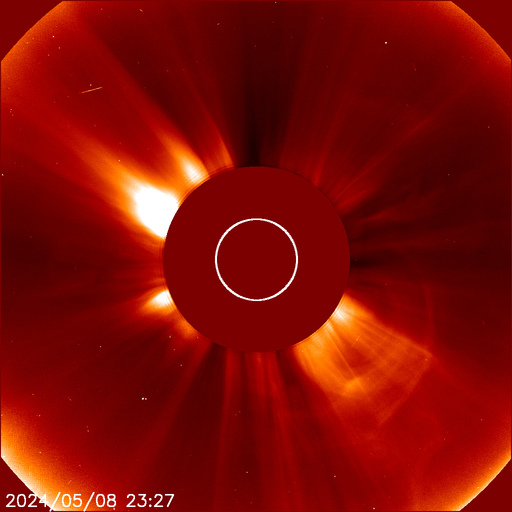
ULT BRAIN PERIPHERAL FINDS A GIANT SUN FLARE
This event marks the ULT Telescope's first ability to analyze the Sun. The Telescope can now study sunspots, corona, flares, results from the photosphere, chromosphere, spicules, granular motions, and other elemental effects.
FIRST ULT SOLAR IMAGE SHOWING A SUN FLARE
You better head indoors when these gargantuan solar flares start cropping up! Xrays and Gamma Rays can reach the Earth in eight minutes at the speed of light.
The Big Brain's peripheral ULT Telescope engaged one Adjunct in solar orbit to find this potentially dangerous solar flare at a moment in time when it was nearing the break off point from the sun's surface. The ULT could potentially begin a program watch of the sun looking for flares, however, flares are relatively known and already watched by satellites in space. The ULT's mission is more of one of new discovery and exploration, so it's important to add solar capability but a 24/7 watch is currently out of its domain. For a view objects engaged by the ULT thus far, view the complete ULT Photo Album.

Solar Flare Watch

PROPELLER POWERED BIG BRAIN
SAVE YOURSELF WITH A SOLAR FLARE WATCH!

Don't ignorantly  fry your own brain outside during this dangerous solar flare! 

BIG BRAIN wants to know the reason people go outside during the time of large solar flare activity when the solar flare punches a hole and penetrates the protective layer of the Earths geomagnetic field and causes significant damage to the physiology of a human. THE BIG BRAIN is just as susceptible to the effects of harmful solar flares as are humans. Taking a hit of a substantial EMP Electromagnetic Pulse can immediately incapacitate the Big Brain and other processor based machines, robots, power plants, cell phones, televisions, and electronic equipment. What is the solution?

The idea proposed by the Big Brain is that everyone should follow a solar space watch that can look for damaging rays incoming from the sun and solar flares, and other part of the universe that radiate high energetic cosmic rays from supernova and other potentially harmful sources.
http://sohowww.nascom.nasa.gov/data/realtime/c2/512/latest.jpg 
Already the Big Brain has initiated the Jet Stream Watch, a program to ascertain the degree of atmospheric clarity and seeing conditions for Earth based telescopes based on the changing high speed wind conditions. In a similar manner, a pre warning system and solar flare watch would alert people in advance to incoming eminent danger. The Big Brain accesses the NASA web site with up to date image of the sun, inclusive of solar flares at
http://sohowww.nascom.nasa.gov/data/realtime-images.html
As one can see, it is not going well for humans or machines on March 30th Friday as a massive magnetic charged solar flare bubbled up to the Suns surface and was released. There is a limited amount to prepare and seek shelter, as the flare is traveling a the speed of light, and will reach the Earth and penetrate Earth based geomagnetic defenses in a short matter of time.
The speed of light in a vacuum is 300,000 km/s and the distance of the Sun averages 150,000,000 km. Therefore it takes 500 seconds for the Solar Flare to reach the Earth, which is only 8 minutes.
NASA has a Soar Wind Spedometer that gives the speed of the solar wind at a given date and time. At 15:26 UT, the speed was 368 km/s at a density of 4.90 p/cm^3.
Sources & Credits
Photos of the Sun provided by NASA at the SOHO Site
http://sohowww.nascom.nasa.gov/data/realtime/c2/512/
NASA Solar System Exploration
http://solarsystem.nasa.gov/planets/profile.cfm?Object=Sun
SOHO Mission Home Page (Solar & Heliospheric Observatory)
http://sohowww.nascom.nasa.gov/home.html
Solar Jheioviewer
http://sohowww.nascom.nasa.gov/hotshots/2010_12_14/
NASA SOHO Mission
http://www.nasa.gov/mission_pages/soho/index.htmL
Space Weather
http://spaceweather.com/