Showing posts with label telescopic. Show all posts

Thursday, October 4, 2012

Accentuated Paradigmic Light

Accentuated Paradigmic Light shows over and under placement of stellar objects


ACCENTUATED PARADIGMIC LIGHT

A technique by graphical objective selection can produce an accentuated Paradigmic Light effect showing the over and under placement of stars and objects.

Generally the overall techniques strive for the placement of the largest objects at the bottom layer with progressively smaller objects having progressively higher level placements. As seen in the first accentuated version, a few objects did not follow this rule.

Teleportation of Paradigmic Light

Paradigmic stellar origin light, seen at top, is transported from top to bottom off the grid of space time, thus facilitating a transformation, for example, with the subtraction of various dimension such as space time, and objective fields such as galaxies and nebulae. The academic study of transported Telescopic Paradigmic Light can advance study of the Universe, isolate regions of mater space time, show shifting of paradoxical time travel, and host new studies employing the advanced features of the massively powerful Adjunctive PGT Telescope.

TELEPORTATION OF PARADIGMIC LIGHT

Telescopic Paradigmic Light can now be isolated and transported - teleported off the space time grid onto an alternate dimension, thus eliminating non stellar objects such as the background galaxy and nebulae, even space time itself in a hypothetical planar vial.

This may be useful in the isolation of stellar specific regions, clarifying the matter of space and time, and juxtaposing the data incurred during the processing and transformations for verification and intellectual matter studies.

Thought Processing Dimension

BIG BRAIN ESTABLISHES A NEW KIND OF PROCESSING
THOUGHT PROCESSING DIMENSION

Now, for the first time, the Big Brain can explore the Universe with Space, Time and Thought - the Fifth Dimension!

What can you do with thought - the fifth dimension? Unlike the implementation of standard image processing, TELESCOPIC PARADIGMIC LIGHT is achieved by the invention of the added dimension of Thought - referred to here as Thought Processing.

Heretofore, old methods of processing which used computers and software, which lacked methods of AI intelligence and acted upon FOVs in "across the board" applications, are not the primary engine within the domains of Telescopic Paradigmic Light machine. PL now engages Thought Processing for a high level of ascertainment.

Thought Processing as applied in this manner is a new concept and will take the massive Paradigmic Genius Telescope and the Big Brain beyond limits imposed by standard imaging of the Universe. It goes beyond factors only related to a machine's sensors. It adds to the dimensions of space and time. Now the Big Brain, with the tools of massive giant telescopes like the Paradigmic Genius Telescope, and the amazing Genius Molecular Microscope can explore new worlds with dimensions of space, time and thought. 

HOW TO USE THOUGHT PROCESSING
Thought Processing does not use chemicals of film processing or electronics for image processing as its sole engine, but rather a thought and thinking inference engine to find, locate, and ascertain the nature of the edge of light limits in a given data set of "astronomical observational results from deep space."

Thought, and other elements of thought engagement as applied to space time, can result from a machine process or a human process. This process can be applied automated or manual. Both methods, one or the other, are perfectly suitable. In processing, a thought element can apply a determination. In the example of PL, the determination applies to the dimmest magnitude star in the FOV. Due to the variation in the background base, variations in background noise, uneven bases, spurious elements, and other anomolies, TP will excel in this area. Therefore the power of thought, as applied to Paradigmic Light, is a very powerful tool. Combining thought with these dimensions of space and time can further impact a study not only in Ultra Space, but for scientific experiments here on Earth.

Thought Processing can be applied to not only TPL but rather a large range of other applications pertaining to the methods and techniques used in exploration of new realms.

Paradigmic Light

A New Breakthrough in Big Brain Telescope Science & Technology
BIG BRAIN AT HUMANOIDO LABS INVENTS Telescopic Paradigmic Light

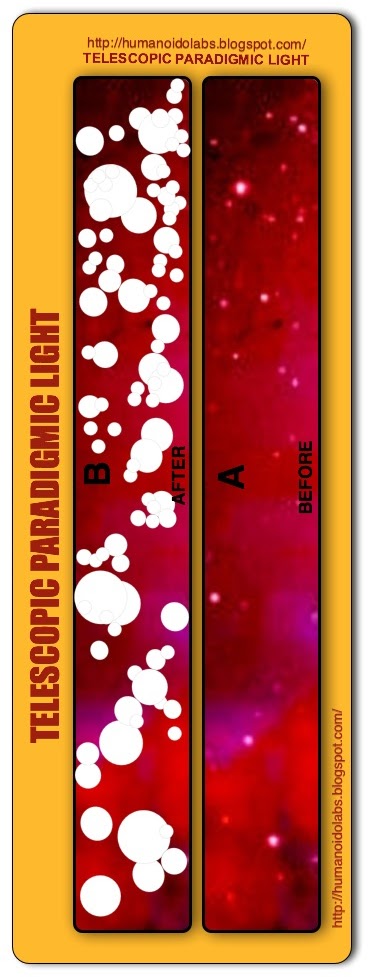
A PGT Telescope image, before view and after with Paradigmic Light

THE FIRST TELESCOPIC PARADIGMIC LIGHT
At left view shows two image views of data acquired with the Paradigmic Genius Telescope PGT. The right image shows the standard view. The left view is with Paradigmic Light. Note that all original stellar light is has undergone a transformation. The PL view shows over twice as many stars! This is the first processed telescopic paradigmic light image and all representations are approximate. PL processing can show an enormous wealth of detail brought out from the original image. The achievement of PL light uses thought processing.

This is the story of the discovery of Paradigmic Light, the process of Paradigmic Light Imaging, or PI for short, and detail about the new Paradigmic Light Machine. PI has changed the face of light imaging with the massive PGT Telescope, offering a new device that increases the value of astronomical imaging and data collection. It makes telescopes more powerful with a new kind of process and its interpreted result. Note: the length of time of applied thought to achieve PL affects results. As time increases, space become more dense and the point of stellar extinction is eliminated. If applied thought time is too minimal, results will overpass the true stellar extinction level. In the illustrative example, applied thought was not allowed to complete the result in order to produce a result within minimal time thought processing.

In the long term, Paradigmic Light can extend an actual or academic space journey of stellar proportions into a very deep and new section of space and time by the obviating definitive results of NOD New Object Discovery and Identification in terms of new baselines and positional elements. In short, the clarifying features of PL as a new form of light can supplement and significantly add to the Big Brain's aggressive program of Ultra Space exploration.

With PL,  the object density of a given star field is typically doubled. Currently PL works with stars and not irregular objects. This is the first image created with PL and may not have exact scalar representations.

BEFORE: the image is unprocessed for Telescopic Paradigmic Light. Many very faint and dim images are lost in the media of presentation, not easy to see and map, and objects at limits of detection, including stars, remain hidden from effective scientific study.

AFTER: the Paradigmic Light processed image has amplified results completely across the image’s FOV. PI processing changes the face of telescopic imaging and offers a new way to look at and increase the value of astronomical images and ultra deep space imaging. PL is currently in use at the USA Ultra Space Administration at Humanoid Labs and with the massive PGT Telescope and observatory. 


INTRODUCTION
In a typical astronomical image, a number of stars are visible. These stars range from a variety of great distances, colors, positions and magnitudes. For film, as the brightness of a star increases, so does its apparent diameter on the film as with the emulsions latent image spread to adjacent particulates of silver halide. For digital imaging with CCD detectors, brightness can also effect the sensor overload causing star images to enlarge and undergo a process of machine blooming. The relative brightness of the star, or object, does not indicate its distance, i.e. brighter stars are not always closer, even if some are. It also does not indicate it’s actual size even though brighter objects may appear bigger on an astronomical image.

MASKING & UNMASKING
Bright stars can block out and mask the image of nearby dim stars within the FOV. The same holds true of other bright objects either circular or irregular in shape. Masking of one astronomical object by another can limit the value of the image within the masked region. White out, haze, glow can all obstruct portions of the image field. Unmasking is possible by employing exposure to gain multiple data for a wider range of object visibility, and then a process of recalibrating the objects can occur.

GOING DEEP
Sometimes the only way to capture faint objects is to go deep with the exposure and time integration. Multiple image integrations may be additive and assembled. This still does not preclude the masking of an object.

HYPERING AND CONTRAST
For several decades, many methods were tried to bring out faint objects from film and digital imaging. Various methods of Hypering including pre flashing with light, baking, and bathing with hydrogen and other hypersensitizing agents took place. Film such as Kodak High Contrast Copy and developers such as Metol offered gains in gamma to bring out low contrast objects and capture detail that may otherwise remain hiddent. For digital media, this included various forms of digital image processing and digital masking.

STELLAR AMPLIFICATION
So a way to amplify those objects that emit radiative or reflective light, such as stars or galaxies, at the limit of the astronomical image was needed. Paradigmic Imaging does just that. PI searches the field of view FOV for the dimmest objects and performs analysis and correlates this to all objects. Accuracy is multiplied by the number of integrated exposures and data. It creates an OA or Object Avatar, a representation of the object from the limit of the original image and performs a clarifying substitution with the original object.

STELLAR & OBJECT PLACEMENT
PL Processing rearranges the order of the stars, and some objects, in terms of their imaging Paradigmic Light diameters. The PI processing rule is the largest diameter objects are first in first served and the smallest Paradigmic Light diameters are last out last served. This prevents overwriting and over placement of the smaller objects by the larger objects, thus preserving the objects in the FOV.


THOUGHT PROCESSING 
TELESCOPIC PARADIGMIC LIGHT is achieved by Thought Processing. Heretofore, old methods of processing used computers and software which lacked methods of intelligence and acted upon FOVs in "across the board" applications. PL now engages Thought Processing for a high level of ascertainment.

It does not use chemicals of film processing or electronic image processing but rather a though and thinking inference engine to find, locate, and ascertain the nature of light in a given data set of astronomical observational results from deep space.

CONTRADICTIONS
Note, this is not a map, though it may resemble a star chart due to the appearance of the light altered stellar diameters. 

INCREASING ACCURACY WITH MUTUAL DATA IDENTIFICATIONS
The accuracy of the Telescope Paradigmic Light machine is increased by technique of mutual data identification. For example, across three image data sets, if a dim star appears in one but not the other one or two, it is considered an inflected anomaly and discarded. This avoids spurious results from in-homogenous graining, incongruent blooms, manifestations of recalcitrants such as reflections, processing anomalies, and other.


THE PROCESS OF LIGHTING UP SPACE
PL light is created by transformation methods of establishing a background base from which limit discernment magnitude objects are found and discovered, as well as non-limit objects. Non-limit objective defining is the easiest in star fields where automation of light sensors can detect objects, measure their diameter extent and create transformations from data into PL light views. The process is complicated by wisps and knots of interstellar nebulae and requires an intellectual process of discernment, so it would seem. The overall process can of course use the one for three rule, where one object is confirmed in three data sets to maintain viability and accuracy. Even a one for two rule may be all that's necessary. But one technique treats such things as objects and previous obviated delineation is discarded to obtain a more simplistic base. In the first attainment image of PL light, the focus is obviously stellar in nature and the juxtaposition of object avatars is performed on stellar objects only, though it may be increased to include galaxies and other objects in the future.

PL Light Expansion
This is a light technology that can expand to indicate the following:
  • Magnitude
  • Position
  • Spectral Characteristics
  • Objective Classification (Object Type)
  • Cartographic Reference Number
On the other hand, the FOV is kept simple and free of any cartographic notations, as this can remain in design as close as possible to a new kind of space imaging result with the largest world telescope - the PGT.

Note that in the limits of deep Ultra Space, no cartographic results or numerical indices may be available for comparison, as this is a new exploratory device taken to the limits of time and space, and beyond.