Showing posts with label astronomy. Show all posts

Saturday, November 14, 2015

Space1 History of Lunar Mapping - Keep it Secret or Die

KEEP IT SECRET OR DIE
SPACE1'S HISTORY OF LUNAR MAPPING
Leonardo 1500
keep it secret or die...

Few Moon maps were published around the time of the invention of the telescope. There's a reason for this.

Even the invention of the telescope was kept secret for many years. Davinci apparently invented one and created lunar drawings, according to his notes from the year 1500, which is 109 years before Galileo's telescope.

It's now known that many drawings were made but few survived. The maps typically were kept in the author's hidden scrap books of lunar depictions and for good reason.
Thomas Harriot July 26, 1609
If you talked about what you had seen, published results, or made drawings known, you would be executed, usually hung on a cross and tortured there for so called heresy by the church.

This is a small chronological collection of the earliest surviving historical lunar maps, dates, and the names of the brave authors and inventors.

Thomas Harriot 1612 or 1613
Leonardo, in his unpublished notes at that time, invented a telescope in 1500. He kept his notes secret to avoid being hung and killed by the church.

109 years later, Galileo announced his telescope results and was almost killed, escaping to exile and ending up in house arrest for the rest of his life.

"Several lunar features are quite recognizable in this engraving, the second in the series, based on a sketch made on December 3, 1609. The mountains east of Mare Imbrium (Sea of Rains) form the ring at the top, and the sizable crater at the bottom is probably Albategnius, here quite a bit larger than life, and undoubtedly conveying by its grandeur the impression it made on Galileo's mind." Source
In 1609, Astronomer Thomas Harriot may have drawn maps of the Moon before Galileo published his drawings.

"The modern face of the moon first emerged in the early evening of November 30, 1609, when Galileo Galilei in Padua turned his telescope toward the moon, noted the irregularities of the crescent face, and made a drawing to record his discoveries. He made at least five more drawings of the moon over the next eighteen days, prepared careful watercolor sketches from these drawings, and then selected four of these to be engraved for his revolutionary Starry Messenger, which appeared the following March. Galileo's treatise announced to an astonished public that the moon was a cratered chunk of elements --a world -- and not some globe of quintessential perfection. It was a new land, to be explored, charted, and named. The science of selenography was born."
Galileo 1610, wood carvings were "redrawn" inverted and flipped in orientation, different from Galileo's drawings.
Galileo 1610 - In this depiction, Galileo's original depiction is compared to a lunar photo.
His first is a Lunar drawing, possibly the first recorded observation using a telescope, dated 26 July 1609. 

The second refined depiction is thought to be his composite drawing of the Moon dating 1612 or 1613, and is considered by some experts to mark the birth of modern cartography.

Harriot's drawings predated Galileo's famous drawings by six months. But Harriot kept himself secret.

Galileo apparently did not date his drawings. However, the publication Siderius Nuncius published in 1610 shows Galileo’s initial sketches of the Moon.
Hevelius map of the Moon in 1647
Large Map of the Moon by Giovanni Cassini 1679

Saturday, December 14, 2013

Extremely Powerful Telescopes Update

EXTREMELY POWERFUL TELESCOPES UPDATE
and introductory blog dates 

There's now 15 extremely powerful telescopes making new discoveries in the solar system and universe. All are working for the Big Brain.

Note: The ULT and NULT ended up being upgraded and renamed. This resulted in blogs with out-of-sync chronology. The ULT was the first invention, followed by the NULT.

It's expected the array of extremely powerful telescopes will grow and bump the OT telescope farther to the top. The ET Telescope (Extrapolation) has inspired the IT (Interpolation) Telescope which may be able to reconstruct views in the universe that have sections of obscurity. 

LIST OF EXTREMELY POWERFUL TELESCOPES
UPDATED DECEMBER 2013

1) ULT - Ultra Large Telescope - March 2012
http://humanoidolabs.blogspot.com/2012/03/nult-new-ultra-large-telescope-home.html
 

2) NULT - New Ultra Large Telescope - February 2012
http://humanoidolabs.blogspot.com/2012/02/new-ultra-large-telescope-nult.html
 

3) GT - Genius Telescope - June 2012
http://humanoidolabs.blogspot.com/2012/06/gt-genius-telescope.html
 

4) PGT - Paradigmic Genius Telescope - September 2012
http://humanoidolabs.blogspot.com/2012/09/paradigmic-gt-telescope.html
 

5) MGT - Molecular Genius Telescope - October 2012
http://humanoidolabs.blogspot.tw/2012/10/big-brains-new-paradigmic-molecular.html
 

6) PGT-ET - Paradigmic Genius Telescope - March 2013
http://humanoidolabs.blogspot.com/2013/03/pgt-telescope-new-look.html
 

7) PDT - Power Dynamic Telescope - April 2013
http://humanoidolabs.blogspot.com/2013/04/new-telescope-announcement.html
 

8) GGT - Gargantuan Gravatomic Telescope - May 2013
http://humanoidolabs.blogspot.tw/2013/05/next-telescope.html
 

9) SRT - Space Recycler Telescope - May 2013
http://humanoidolabs.blogspot.tw/2013/05/novel-space-junk-telescope.html


10) MMT - Molecular Mining Telescope - May 2013
http://humanoidolabs.blogspot.tw/2013/05/mgt-molecular-cradle-of-stars.html 

11) IET - Inference Engine Telescope - May 2013
http://humanoidolabs.blogspot.tw/2013/05/iet-interference-engine-telescope-first.html

12) M3T - Massive Molecular Mining Telescope - November 2013
http://humanoidolabs.blogspot.tw/2013/11/m3t-telescope-first-light-saturn.html

13) ET - Extrapolation Telescope - December 2013
http://humanoidolabs.blogspot.tw/2013/12/et-telescope.html

14) IT - Interpolation Telescope - December 2013
http://humanoidolabs.blogspot.tw/2013/12/it-interpolation-telescope.html

15) OT - Over the Top Telescope - January 2014
http://humanoidolabs.blogspot.tw/2013/12/ott-over-top-telescope.html

Friday, April 26, 2013

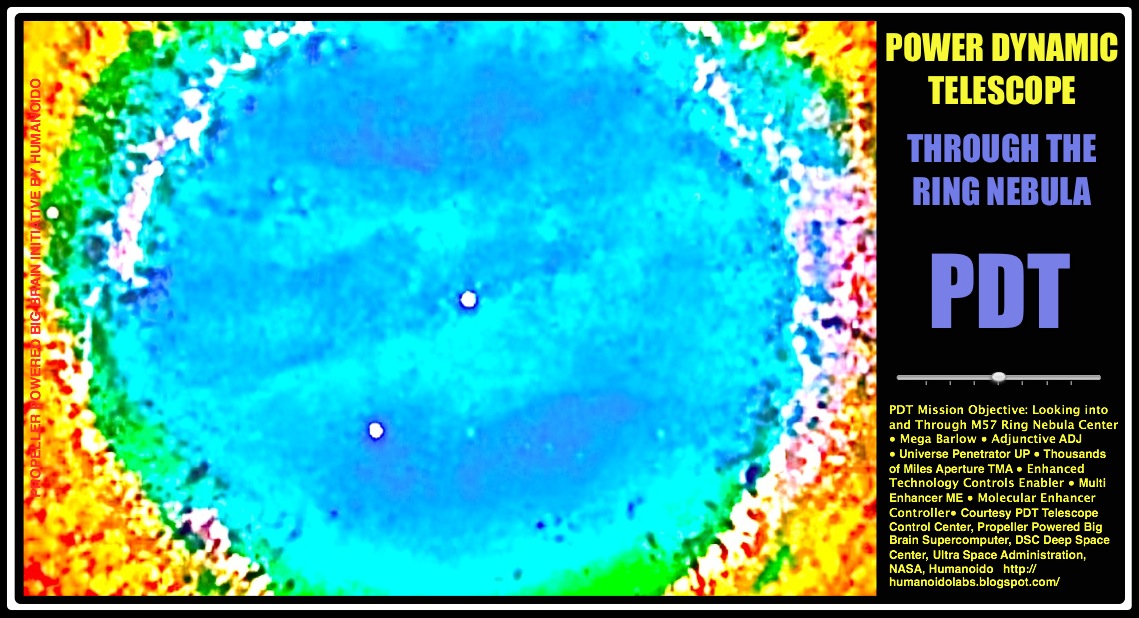
Power Dynamic Telescope PDT - through the Ring Nebula M57

The center of the Ring seen through the Power Dynamic Telescope PDT
POWER DYNAMIC TELESCOPE PDT
FANTASTIC JOURNEY THROUGH M57 RING NEBULA
M57 like you've never seen it before!

Small telescope M57 view
LOOKING INTO & THROUGH THE RING NEBULADiscover What’s Inside and On the Other Side!

At Left: a small telescope barely shows the 9th magnitude Ring Nebula. The center hole is featureless.


We give you permission to embark on a great Telenaut mission of exploration and discovery. Travel to the giant smoke ring - the famous Ring Nebula. Like astronauts using space ships, Telenauts use powerful telescopes to achieve their space missions.

When we arrive at this celestial wonder, we will enter into, explore inside, and then travel beyond the place that no man has ever gone before using the Big Brain's newest Adjunctive telescope.

Spectacular, mind boggling, and fantastic are the named results that come to mind when describing the newest journey into deep space made with the new Power Dynamic Telescope, bringing forth shocking new discoveries (that reside within and on the other side of the Ring).

No telescope this large ever attempted to penetrate the center hole of M57 until now. This is just the beginning of a new era in space exploration by the Big Brain Inititive. The Ring Nebula appears as a kind of cylinder, with spatial depth that can be penetrated and reveal space time on the opposite side. The things that materialized in the first exploratory image are astounding!

BREAKING NEWS! Spectacular results were imaged last night when the newest and most powerful Adjunctive telescope, the Power Dynamic Telescope PDT, was slewed towards the famous Ring Nebula, diving into the center hole to reveal the treasures hidden inside.

Supercomputer driven, the very powerful and complex Discovery Class Power Dynamic Telescope was pointed at the center of the Ring Nebula M57, and when doing Molecular calibrations - it inadvertently began looking inside the hole where we expected to only see a couple dim magnitude stars for tweaking the cams. Unexpectedly, not only could we see materialization inside, but we could see all the way through the Nebular Cast Sheen (attributed to M57) to the other side where new objects were discovered, arranged in space - resident beyond the ring!

— Telescope shows more than expected: looking into and through the ring to the other side! — 


Our Discovery List

1) The PDT allows one to look inside M57 Ring Nebula’s center hole and to look inside some distance as the ring is really a cylinder implying depth of field.


2) A Blue Cast Sheen BCS molecular window is discovered, which was created by the Ring's connecting molecular dust and gas.

3) The PDT Telescope was able to penetrate the blue cast sheen all the way to the other side of space and time.

4) There are objects both within and beyond this ring - inside and beyond the window of exploded star dust, many new faint stars and objects are seen.

5) Inside the ring we see two parallel bands of star dust and matter apparently residing inside the cylinder walls, appearing to have some connection with the matter curvature of the Ring's cylindrical shape.

6) Beyond the BCS boundary, there are many rifts, voids, stars, galaxies, nebula, and objects in space.

A star map, showing the plot of more stars and objects, can be created using the telescope’s Paradigmic Light Processor and this image.