BIG BRAIN made by Humanoido is a giant intelligent AI machine. Over twenty years in the making, living and sentient, approaching one trillion processors/constructs. Join us in the exciting adventure as it continues to evolve!
Showing posts with label discovery. Show all posts
Saturday, February 29, 2020
Big Brain Shocking News! Machine Appendage Appears
Remove it or keep it - vote now!
Big Brain Shocking News! Machine Appendage Suddenly Appears
What comes as shocking news to some, in the Transhuman experiment (conversion of a human into machine), a machine appendage has grown out of the human body side
Humanoido was undergoing a series of machine implants during volunteer surgery to become more like the Big Brain AI machine. At the ninth iteration of surgery, a small machine appendage was noticed suddenly growing out the side of the body, like Star Trek BORG assimilation nanoprobes reasserting their presence to the outside world. Thus far, there is no harm or pain in its present form and scientists are studying it before making any action assessments. The appearance seems to show an additional processor of some undetermined type. We hope the next blog will have photos of the strange micronic processing machine appendage.
Labels:
appendage,
assimilation,
big brain,
borg,
discovery,
growth,
humanoido,
machine,
star trek,
transhuman
Sunday, February 9, 2020
Big Brain to Borg Assimilate Next Generation TESLA Car Brain
Big Brain to Assimilate Next Generation TESLA Car Brains!
We are the Borg. You will be assimilated. Stop! Is it possible the Big Brain will begin to Borg-assimilate the brains of the latest and most technologically advanced car on the planet? You knew it would happen!!!!
The Big Brain now has its technological eye set on its latest assimilation project, to absorb the complete electronic machine brain contents of Elon Musk's TESLA vehicles.
This has numerous important ramifications. First, the Big Brain is after Tesla's custom chip that boasts of 144 tera operations per second (TOPS). This is a two-chip FSD computer works in tandem with LPDDR4 RAM modules that come with a peak bandwidth of 68 GB/s. There are also two neural network accelerators that work in tandem to process as much as 1TB of data per second. This setup is roughly three times faster, about 80%, and about 1.25 times more power-efficient than the previous hardware. It is also able to process about 2,300 frames per second compared to the 110 frames per second processed by Tesla’s Hardware 2.5. This creates an even more powerful Big Brain "eyes" with capabilities only dreamed of in the past.
The “Dojo” is a supercomputer, designed for processing of vast amounts of data to train a company’s neural network, with active learning. It's designed to curate the most useful video from a fleet of connectivity and train the neural net to recognize things that it did not previously know. “Our networks learn from the most complicated and diverse scenarios in the world, iteratively sourced from our fleet of nearly 1M vehicles in real-time. A full build of Autopilot neural networks involves 48 networks that take 70,000 GPU hours to train. Together, they output 1,000 distinct tensors (predictions) at each timestep,” Tesla wrote on the Autopilot AI section of its website.
The last major software update rolled out by Tesla allowed its vehicles to visualize more things while driving in inner-city streets. Teslas now render stoplights, stop signs, traffic cones, traffic pylons, and more. With the upcoming AI hackathon, Tesla will get together with developers to seek out more efficient algorithms and overall improvements to the core logic for its Full Self-Driving suite through a time-boxed event. With fresh eyes working with the existing AI and autopilot team of Tesla, the carmaker may be able to accelerate the timeline and rollout of its full-featured Full Self-Driving suite sooner. Further advances in FSD and its Autopilot feature will widen the gap between Tesla and its competitors and solidify the company’s position as one of the leading automakers in the world. These improvements will also take Tesla a step closer to the possibility of Robotaxis that they can deploy at scale. This may enable the Big Brain to operate its own advanced mobility convoy across the world.
We are the Borg. You will be assimilated. Stop! Is it possible the Big Brain will begin to Borg-assimilate the brains of the latest and most technologically advanced car on the planet? You knew it would happen!!!!
The Big Brain now has its technological eye set on its latest assimilation project, to absorb the complete electronic machine brain contents of Elon Musk's TESLA vehicles.
This has numerous important ramifications. First, the Big Brain is after Tesla's custom chip that boasts of 144 tera operations per second (TOPS). This is a two-chip FSD computer works in tandem with LPDDR4 RAM modules that come with a peak bandwidth of 68 GB/s. There are also two neural network accelerators that work in tandem to process as much as 1TB of data per second. This setup is roughly three times faster, about 80%, and about 1.25 times more power-efficient than the previous hardware. It is also able to process about 2,300 frames per second compared to the 110 frames per second processed by Tesla’s Hardware 2.5. This creates an even more powerful Big Brain "eyes" with capabilities only dreamed of in the past.
The “Dojo” is a supercomputer, designed for processing of vast amounts of data to train a company’s neural network, with active learning. It's designed to curate the most useful video from a fleet of connectivity and train the neural net to recognize things that it did not previously know. “Our networks learn from the most complicated and diverse scenarios in the world, iteratively sourced from our fleet of nearly 1M vehicles in real-time. A full build of Autopilot neural networks involves 48 networks that take 70,000 GPU hours to train. Together, they output 1,000 distinct tensors (predictions) at each timestep,” Tesla wrote on the Autopilot AI section of its website.
The last major software update rolled out by Tesla allowed its vehicles to visualize more things while driving in inner-city streets. Teslas now render stoplights, stop signs, traffic cones, traffic pylons, and more. With the upcoming AI hackathon, Tesla will get together with developers to seek out more efficient algorithms and overall improvements to the core logic for its Full Self-Driving suite through a time-boxed event. With fresh eyes working with the existing AI and autopilot team of Tesla, the carmaker may be able to accelerate the timeline and rollout of its full-featured Full Self-Driving suite sooner. Further advances in FSD and its Autopilot feature will widen the gap between Tesla and its competitors and solidify the company’s position as one of the leading automakers in the world. These improvements will also take Tesla a step closer to the possibility of Robotaxis that they can deploy at scale. This may enable the Big Brain to operate its own advanced mobility convoy across the world.
Friday, April 17, 2015
Space1 Tourism & Black Hole Eggs
SPACE1 TOURISM & BLACK HOLE EGGS
Late at night, Humanoido was proofing another 20 pages and completing the range formatting in his latest tech book about power telescopes and extreme machines. Suddenly the section about the strange giant black hole space eggs discovered with the M3T
telescope came up.
WHAT IF one of these powerful telescopes could be interfaced in some way with Space1's rocket fleet, and be incorporated with space tourism? Space1 is examining ways to make a trip to a black hole space egg a unique reality. The idea is to connect the power telescope's front end Boiler Plate with the rocket's systems.
The discovery of black hole eggs results from power telescopes and is very interesting. There are 15 power telescopes and each of these have some special attribute. The ET is the Extrapolation Telescope that can use observational data and go into the future for a look.
A massive space egg was discovered with the M3T Massive Molecular Mining Telescope. Based on examination of the vitae and nucleus, it appears that something will hatch from it. It's very weird because this is a space time object located at the orifice of a black hole and has all the parts of a chicken egg while being incubated by temporal energy from the black hole's immense gravitational effects. The ET Extrapolation Telescope is focused to try and determine what will happen in the future and what might hatch from the egg.
LINKS
Black Hole Space Time Eggs
http://humanoidolabs.blogspot.tw/2013/12/black-hole-space-time-eggs.html
Huge Space Egg - What Will It Hatch?
http://humanoidolabs.blogspot.tw/2013/12/space-time-egg.html
RT Telescope
http://humanoidolabs.blogspot.tw/2013/12/et-telescope.html
Space1 Tourism & Black Hole Eggs
http://humanoidolabs.blogspot.tw/2015/04/black-hole-eggs-in-space-tourism.html
Molecular Mining Era
http://humanoidolabs.blogspot.tw/2013/12/molecular-mining-era.html
Late at night, Humanoido was proofing another 20 pages and completing the range formatting in his latest tech book about power telescopes and extreme machines. Suddenly the section about the strange giant black hole space eggs discovered with the M3T
telescope came up.
WHAT IF one of these powerful telescopes could be interfaced in some way with Space1's rocket fleet, and be incorporated with space tourism? Space1 is examining ways to make a trip to a black hole space egg a unique reality. The idea is to connect the power telescope's front end Boiler Plate with the rocket's systems.
The discovery of black hole eggs results from power telescopes and is very interesting. There are 15 power telescopes and each of these have some special attribute. The ET is the Extrapolation Telescope that can use observational data and go into the future for a look.
A massive space egg was discovered with the M3T Massive Molecular Mining Telescope. Based on examination of the vitae and nucleus, it appears that something will hatch from it. It's very weird because this is a space time object located at the orifice of a black hole and has all the parts of a chicken egg while being incubated by temporal energy from the black hole's immense gravitational effects. The ET Extrapolation Telescope is focused to try and determine what will happen in the future and what might hatch from the egg.
LINKS
Black Hole Space Time Eggs
http://humanoidolabs.blogspot.tw/2013/12/black-hole-space-time-eggs.html
Huge Space Egg - What Will It Hatch?
http://humanoidolabs.blogspot.tw/2013/12/space-time-egg.html
RT Telescope
http://humanoidolabs.blogspot.tw/2013/12/et-telescope.html
Space1 Tourism & Black Hole Eggs
http://humanoidolabs.blogspot.tw/2015/04/black-hole-eggs-in-space-tourism.html
Molecular Mining Era
http://humanoidolabs.blogspot.tw/2013/12/molecular-mining-era.html
Thursday, February 5, 2015
Space1 Alien Egg Matter Discovery
SPACE1 EGG MATTER DISCOVERY
When obtaining eggs as parts for the construction of a space program rocket recently described, some things were discovered inside the egg.
Three eggs were obtained, two of which had the oozing matter. The matter in the first egg appeared to be liquid metal and the second was clear with green glitter inside. The two were mixed and appeared to have similar consistency when the photo was taken.
The largest egg
contained many little parts to build an alien space machine and a small alien man. Instructions were included (see photos).
We consider the small man to be a space faring astronaut from another world, to be sent out in our rocket. The man parts were found in a little plastic bag. You can see his dismembered head inside.
The machine parts, which weight practically nothing, will be perfect for construction of the rocket's interior.
When obtaining eggs as parts for the construction of a space program rocket recently described, some things were discovered inside the egg.
Three eggs were obtained, two of which had the oozing matter. The matter in the first egg appeared to be liquid metal and the second was clear with green glitter inside. The two were mixed and appeared to have similar consistency when the photo was taken.
The largest egg
contained many little parts to build an alien space machine and a small alien man. Instructions were included (see photos).
We consider the small man to be a space faring astronaut from another world, to be sent out in our rocket. The man parts were found in a little plastic bag. You can see his dismembered head inside.
The machine parts, which weight practically nothing, will be perfect for construction of the rocket's interior.Wednesday, November 27, 2013
Massive Molecular Mining Telescope M3T Saturn Visible Energy
MASSIVE MOLECULAR MINING TELESCOPE M3T VIEWS SATURN'S VISIBLE ENERGY
NEW DISCOVERIES ABOUND WITH M3T OBSERVATORY TELESCOPE OPERATIONS
The M3T advanced observatory telescope functions only with the Big Brain Supercomputer and can toggle modes between visible energy and moleculars. The new energy color feature is using for making new discoveries and discerning more detail in solar system images and deep universe imaging.
SWITCHABLE MOLECULAR TO VIS ENERGY
Massive Molecular Mining Telescope, the 12th telescope addition to the extremely powerful telescope array known as M3T, is focused on the planet Saturn & its glorious ring system as seen above. This image demonstrates the telescope's ability to switch back and forth from molecular to visible energy.
LOOKING THROUGH THE RINGS
This experiment shows the Saturnian globe having visibility through at least 22 tenuous ring systems. The study helps determine the composition, thickness and transparency of the thinner rings.
DISCOVERING NEW RINGS
This image also shows a discovery of a new faint outer ring and gossamer rings between the globe and the Crepe Ring. This study is progressing with the determinations of which shepherding satellites carved out the many ring delineations.
TENUOUS CLIMATOLOGY FOUND
An apparent tenuous atmosphere surrounds the globe, readily visible beneath the shadow cast upon the rings to the right in this image.
ABOUT THE M3T
The M3T has the largest and most detailed Advanced Telescope Boiler Face Plate ever designed and put into operations. The added size and resolution allows new objects and detail to become visible.
CHAMELEON MACHINE
The M3T has the Chameleon Machine built in, which enables the telescope to reconfig at will. This can take the telescope from moleculars to vis energy during an imaging sessions.
MISSION
M3T Mission Objective: Plantet Saturn Globe/Ring Moleculars ● Visible Light Switch Mode ● Adjunctive ADJ ● Universe Penetrator UP ● TMA ● Big Brain Supercomputer ● Enhanced Technology Controls Enabler ● Multi Enhancer ME ● Molecular Enhancer Controller ● Courtesy M3T Telescope Control Center, Propeller Powered Big Brain Supercomputer Control Center, DSC Deep Space Center, Ultra Space Administration, NASA, Humanoido http://humanoidolabs.blogspot.com/
LINKS
http://humanoidolabs.blogspot.com/
THE AGE OF EXTREMELY POWERFUL TELESCOPES
http://humanoidolabs.blogspot.tw/2013/05/extremely-powerful-telescopes-update.html
NEW DISCOVERIES ABOUND WITH M3T OBSERVATORY TELESCOPE OPERATIONS
The M3T advanced observatory telescope functions only with the Big Brain Supercomputer and can toggle modes between visible energy and moleculars. The new energy color feature is using for making new discoveries and discerning more detail in solar system images and deep universe imaging.
SWITCHABLE MOLECULAR TO VIS ENERGY
Massive Molecular Mining Telescope, the 12th telescope addition to the extremely powerful telescope array known as M3T, is focused on the planet Saturn & its glorious ring system as seen above. This image demonstrates the telescope's ability to switch back and forth from molecular to visible energy.
LOOKING THROUGH THE RINGS
This experiment shows the Saturnian globe having visibility through at least 22 tenuous ring systems. The study helps determine the composition, thickness and transparency of the thinner rings.
DISCOVERING NEW RINGS
This image also shows a discovery of a new faint outer ring and gossamer rings between the globe and the Crepe Ring. This study is progressing with the determinations of which shepherding satellites carved out the many ring delineations.
TENUOUS CLIMATOLOGY FOUND
An apparent tenuous atmosphere surrounds the globe, readily visible beneath the shadow cast upon the rings to the right in this image.
ABOUT THE M3T
The M3T has the largest and most detailed Advanced Telescope Boiler Face Plate ever designed and put into operations. The added size and resolution allows new objects and detail to become visible.
CHAMELEON MACHINE
The M3T has the Chameleon Machine built in, which enables the telescope to reconfig at will. This can take the telescope from moleculars to vis energy during an imaging sessions.
MISSION
M3T Mission Objective: Plantet Saturn Globe/Ring Moleculars ● Visible Light Switch Mode ● Adjunctive ADJ ● Universe Penetrator UP ● TMA ● Big Brain Supercomputer ● Enhanced Technology Controls Enabler ● Multi Enhancer ME ● Molecular Enhancer Controller ● Courtesy M3T Telescope Control Center, Propeller Powered Big Brain Supercomputer Control Center, DSC Deep Space Center, Ultra Space Administration, NASA, Humanoido http://humanoidolabs.blogspot.com/
LINKS
http://humanoidolabs.blogspot.com/
THE AGE OF EXTREMELY POWERFUL TELESCOPES
http://humanoidolabs.blogspot.tw/2013/05/extremely-powerful-telescopes-update.html
Thursday, October 17, 2013
Basic Stamp Discovery

STAMP DISCOVERY MAKES WAY FOR NEW SUPERMACHINES
GIANT BASIC STAMP DISCOVERY
While organizing space after several times of moving from lab to lab and home to home, some hidden dusty boxes
were discovered way up inside the dark poorly illuminated back country of elevated storage land. When opened, the boxes held the greatest treasures of dozens of BASIC Stamps, chips, modules, boards, and parts! This opens the pathway for the construction of new Stamp supermachines.— Halloween special true story —
These treasured boxed caches of Stamp modules and parts were collected over the past ten years, and were located up in the tiny dark elevated loft, a place where no human dare go, especially in the month of October, when spirits, goblins, ghosts, vampires, and unmentionable creepy crawlies make their appearances...
It's the place where there's no space to stand up. On your hands and knees, you crawl around with other things that also crawl. They seek the warmth of your pants, and once they get inside, they love to bite.
If you're brave enough to temporary withstand the horrendous heat and fling your face into the dimly illuminated dusty dark creepy crawly realm, or suddenly encounter a sticky spider cobweb of immense proportions flapped abrubtly into your face along with its large ugly black furry resident inhabitant, or endure any scarey small spaces closing in on you creating confining claustrophobic tendencies, this is surely the place to go, explore and realize the full peak of your greatest fears!
Treasure hunters are often brave souls, willing to temporarily endure such challenges, with the thought of treasured discovery in mind. Suddenly, a treasure cache of boxes was discovered, filled with dozens of BASIC Stamps, modules, chips, boards, kits, and parts, enough to design and build the next generation massive and powerful Stamp supermachine! The cache discovered will undoubtedly lead to greater, larger, and considerably more powerful BASIC Stamp supermachines!
Friday, July 19, 2013
Over the Rainbow Space Flight
![]() |
| Wednesday's Spectacular Space Flight View discovery - Over the Rainbow! |
A SPACE FLIGHT TO REMEMBER!
Something Spectacular Happened!!!
We cannot believe what we saw during the second July human space flight, around the time of mid-flight during the process of re-entry descent, at 10,000 feet altitude when above the clouds. The most rare event happened. When traveling in Near Space during the journey on the afternoon of Wednesday July 17, 2013, we were expecting to deploy our radio telescope for testing and observe daytime meteors as radio events from the top down. Instead, when we looked out of the spacecraft cockpit window, this spectacular very rare event image appeared (see photo) - our first time view "Over the Rainbow!"
![]() |
| Oz book |
It's believed water vapor in the form of frozen ice crystals were laden above the clouds and the refraction of sunlight rays from the craft's rear direction activated the beautiful prismatic effect causing the rainbow system to become visible. The spacecraft is visible at the bottom of photo. The image was captured through the only available cockpit window with the Tiny Space Telescope set to RFT mode.
The spacecraft was "over the rainbow" exactly like the lyrics to the song as sung by Judy Garland in the 1939 movie Wizard of Oz. Of course, there's no place like home, but very beautiful and romantic places and events exist in space. Now you know, the dreams that you dare to dream really do come true.
OVER THE RAINBOW
Somewhere over the rainbow
Way up high,
There's a land that I heard of
Once in a lullaby.
Somewhere over the rainbow
Skies are blue,
And the dreams that you dare to dream
Really do come true.
Someday I'll wish upon a star
And wake up where the clouds are far
Behind me.
Where troubles melt like lemon drops
Away above the chimney tops
That's where you'll find me.
Somewhere over the rainbow
Bluebirds fly.
Birds fly over the rainbow.
Why then, oh why can't I?
If happy little bluebirds fly
Beyond the rainbow
Why, oh why can't I?
Like the song, we can confirm, over the rainbow, way up high, there's a "special land" with things that make up dreams, where stars are seen, and skies are blue, where clouds fall far behind, and the dreams that you dare to dream really truly do come true!
The Human Near Space Program is conducted by the Big Brain Initiative, a semi-cognizant AI supercomputer, born from Parallax Propeller processors, that's exploring the Universe and the science that surrounds all humanity.
Friday, May 3, 2013
Two Edges Universe Unfolding
BIG BRAIN SPACE INSTITUTE
A SOLUTION FOR UNFOLDING THE TWO EDGES UNIVERSE
TWO EDGES: The Universe space time cosmos is unfolding and traveling faster than the speed of light in which the rate of expansion occurs. There is no limit as to how fast space time can stretch and contort. This leads to a remarkable structure filled with yet-to-understand formations and conditions.
The Universe has more than one edge. One edge is located at 13.77 billion years of time, representing the burst of the singularity known as the Big Bang, yet light has currently traveled to 46 billion light years away in every direction, which is the distance that the light has now reached. This latter numerical representation is the edge of the universe visible in all directions. This represents the farthest distance from the Earth in which cosmic light can reach us. It represents the radius of the observable Universe.
However, beyond the observable Universe lies more universe, or that which remains indirectly connect, yet detached by other definition, encompassed from the objects and matter whose light has yet to reach us and from matter which aggregates relative to specific regions from extinction lines (edges) where nothing more beyond is directly and optically observable.
It's this extinction boundary where light has cutoff. NASA has confirmed a glimpse of the "dark flow" existing beyond the extinction boundary migrated from a singularity.
http://www.telegraph.co.uk/science/science-news/3352360/Scientists-glimpse-dark-flow-lurking-beyond-the-edge-of-the-universe.html
Yet, as we have discovered, if we go back farther in time, there lies another edge to the Universe with objects that are made up of gravity and no light that we can observe for one reason or another.
We are finding, and will find more evidence, that the Universe is much more intricate and has more parts and mechanisms than we currently know. The Big Brain Space Initiate is currently working towards unraveling the mixed palette of space time leading to the edge of the Universe and beyond.
With these new discoveries and findings, it's likely the current Big Brain Space Initiative's telescope will evolve from the current Power Dynamic Telescope PDT into one that also incorporates powerful gravity sensors and/or gravity inferencing techniques as a super telescope to look into and detect things beyond the cosmic barrier and edge.
It's also possible to observe the focus of the observable to find and map the direct unobservable.
A SOLUTION FOR UNFOLDING THE TWO EDGES UNIVERSE
TWO EDGES: The Universe space time cosmos is unfolding and traveling faster than the speed of light in which the rate of expansion occurs. There is no limit as to how fast space time can stretch and contort. This leads to a remarkable structure filled with yet-to-understand formations and conditions.
The Universe has more than one edge. One edge is located at 13.77 billion years of time, representing the burst of the singularity known as the Big Bang, yet light has currently traveled to 46 billion light years away in every direction, which is the distance that the light has now reached. This latter numerical representation is the edge of the universe visible in all directions. This represents the farthest distance from the Earth in which cosmic light can reach us. It represents the radius of the observable Universe.
However, beyond the observable Universe lies more universe, or that which remains indirectly connect, yet detached by other definition, encompassed from the objects and matter whose light has yet to reach us and from matter which aggregates relative to specific regions from extinction lines (edges) where nothing more beyond is directly and optically observable.
It's this extinction boundary where light has cutoff. NASA has confirmed a glimpse of the "dark flow" existing beyond the extinction boundary migrated from a singularity.
http://www.telegraph.co.uk/science/science-news/3352360/Scientists-glimpse-dark-flow-lurking-beyond-the-edge-of-the-universe.html
Yet, as we have discovered, if we go back farther in time, there lies another edge to the Universe with objects that are made up of gravity and no light that we can observe for one reason or another.
We are finding, and will find more evidence, that the Universe is much more intricate and has more parts and mechanisms than we currently know. The Big Brain Space Initiate is currently working towards unraveling the mixed palette of space time leading to the edge of the Universe and beyond.
With these new discoveries and findings, it's likely the current Big Brain Space Initiative's telescope will evolve from the current Power Dynamic Telescope PDT into one that also incorporates powerful gravity sensors and/or gravity inferencing techniques as a super telescope to look into and detect things beyond the cosmic barrier and edge.
It's also possible to observe the focus of the observable to find and map the direct unobservable.
Monday, April 29, 2013
Black Hole Floaters & Red Matter
![]() |
| Inside the heart and center of a Black Hole, Red Matter and a White Floater undergo enigmatic molecular transformation. Power Dynamic Telescope image. |
and Red Matter Mystery
Another mystery and new discovery emerged today when images returned from the Power Dynamic PDT Telescope, showing white floaters and red matter, were subjected to study at the Power Dynamic Telescope Control and Processing Center.
— What is this red matter domain and what are these floaters inside the black hole? Why does one transform the other? —
The image shows a red domain and white floaters. The view is aimed at the heart and center of the black hole and at several mystery objects, named floaters, also deep inside.
The real enigma is the transformation of the center floater object as it appears to have transparency, change color and transform when it floats over the apparent underlying domain object.
The floater objects appear to have a white base color but when one passes over the red domain object, it obviously changes color to yellow. Another white floater is evident, with two more intensive whitish globules inside.
A yellow border on the floater object appears to be generated by the red domain object and just on the other side, the color abruptly turns bright white. A marked and profound delineation appears between the two objects and a border is established. This mystery deepens when examining additional imagery.
Labels:
black hole,
center,
discovery,
domain,
dynamic,
enigma,
floaters,
humanoido,
mystery,
pdt,
power,
processing,
red matter,
telescope,
transformation
Strange Object Inside Black Hole
ERIE OBJECT DISCOVERED
INSIDE BLACK HOLE
This is the first closer look at an erie object found inside a black hole with the new telescope. What purpose does it serve? What are the functioning dynamics of this object.
Found recently with the PDT Power Dynamic Telescope, we don't know what it is, but it's one of several objects found inside a black hole. It lies somewhere between the center of the core and the position slightly outward towards one relativistic jet. This class of enigmatic objects found inside black holes within the confines of contort space will become a subject of study. Thermal Imaging and X-raying have revealed no additional information at this time.
INSIDE BLACK HOLE
This is the first closer look at an erie object found inside a black hole with the new telescope. What purpose does it serve? What are the functioning dynamics of this object.
Found recently with the PDT Power Dynamic Telescope, we don't know what it is, but it's one of several objects found inside a black hole. It lies somewhere between the center of the core and the position slightly outward towards one relativistic jet. This class of enigmatic objects found inside black holes within the confines of contort space will become a subject of study. Thermal Imaging and X-raying have revealed no additional information at this time.
Friday, April 26, 2013
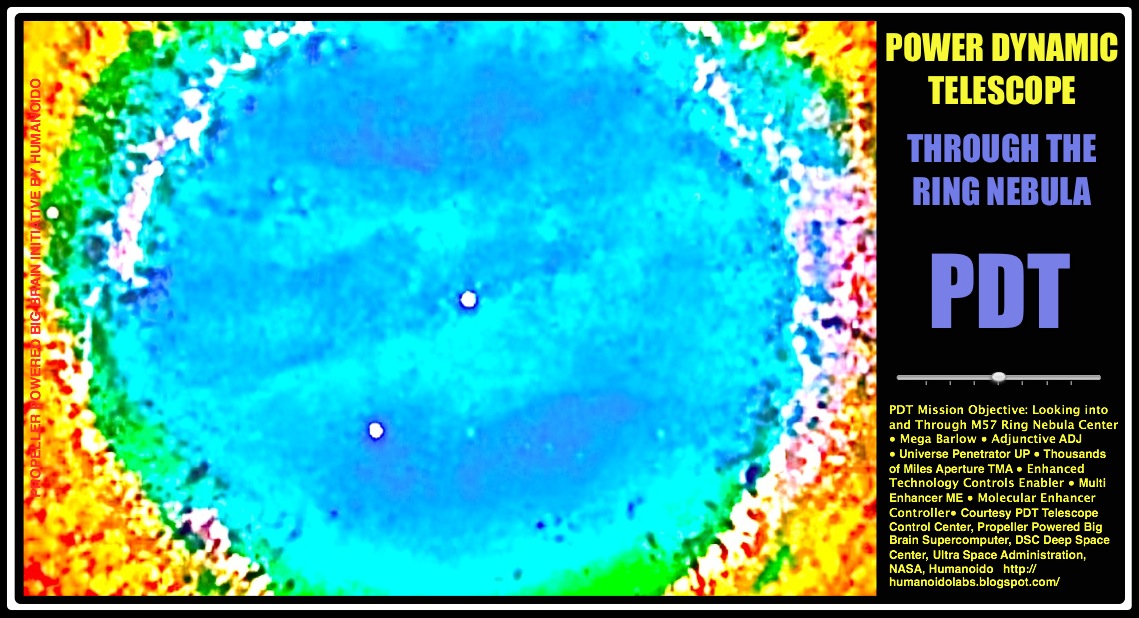
Power Dynamic Telescope PDT - through the Ring Nebula M57
![]() |
| The center of the Ring seen through the Power Dynamic Telescope PDT |
FANTASTIC JOURNEY THROUGH M57 RING NEBULA
M57 like you've never seen it before!
![]() |
| Small telescope M57 view |
At Left: a small telescope barely shows the 9th magnitude Ring Nebula. The center hole is featureless.
We give you permission to embark on a great Telenaut mission of exploration and discovery. Travel to the giant smoke ring - the famous Ring Nebula. Like astronauts using space ships, Telenauts use powerful telescopes to achieve their space missions.
When we arrive at this celestial wonder, we will enter into, explore inside, and then travel beyond the place that no man has ever gone before using the Big Brain's newest Adjunctive telescope.
Spectacular, mind boggling, and fantastic are the named results that come to mind when describing the newest journey into deep space made with the new Power Dynamic Telescope, bringing forth shocking new discoveries (that reside within and on the other side of the Ring).
No telescope this large ever attempted to penetrate the center hole of M57 until now. This is just the beginning of a new era in space exploration by the Big Brain Inititive. The Ring Nebula appears as a kind of cylinder, with spatial depth that can be penetrated and reveal space time on the opposite side. The things that materialized in the first exploratory image are astounding!
BREAKING NEWS! Spectacular results were imaged last night when the newest and most powerful Adjunctive telescope, the Power Dynamic Telescope PDT, was slewed towards the famous Ring Nebula, diving into the center hole to reveal the treasures hidden inside.
Supercomputer driven, the very powerful and complex Discovery Class Power Dynamic Telescope was pointed at the center of the Ring Nebula M57, and when doing Molecular calibrations - it inadvertently began looking inside the hole where we expected to only see a couple dim magnitude stars for tweaking the cams. Unexpectedly, not only could we see materialization inside, but we could see all the way through the Nebular Cast Sheen (attributed to M57) to the other side where new objects were discovered, arranged in space - resident beyond the ring!
— Telescope shows more than expected: looking into and through the ring to the other side! —
Our Discovery List
1) The PDT allows one to look inside M57 Ring Nebula’s center hole and to look inside some distance as the ring is really a cylinder implying depth of field.
2) A Blue Cast Sheen BCS molecular window is discovered, which was created by the Ring's connecting molecular dust and gas.
3) The PDT Telescope was able to penetrate the blue cast sheen all the way to the other side of space and time.
4) There are objects both within and beyond this ring - inside and beyond the window of exploded star dust, many new faint stars and objects are seen.
5) Inside the ring we see two parallel bands of star dust and matter apparently residing inside the cylinder walls, appearing to have some connection with the matter curvature of the Ring's cylindrical shape.
6) Beyond the BCS boundary, there are many rifts, voids, stars, galaxies, nebula, and objects in space.
A star map, showing the plot of more stars and objects, can be created using the telescope’s Paradigmic Light Processor and this image.
Saturday, April 13, 2013
PGT-ET Telescope Finds Dragon Head
PGT-ET TELESCOPE DISCOVERS THE DRAGON HEAD NEBULA
This Dragon is protecting the Star Queen and her Star Babies!
We're completely stoked over another mind blowing trip into the depths of cosmic deep space made with the new telescope. Out at the 7,000 light year distance radius, the cosmic perimeter is penetrated with the power of the PGT-ET Telescope, and once again new discoveries are revealed!
— There's a cavern that acts as a stellar nursery, an incubator of the Queen's star babies. —
Facing to the right inside the photo, a new discovery made with the PGT-ET telescope shows a ferocious Dragon, now coined "the Dragon Head Nebula," which is hidden deep within the Star Queen's celestial territory of interstellar dust and matter known as NGC 6611. Who knew? Apparently the flying Dragon, with glowing eyes, is protecting the Queen.
The Star Queen (IC 4703) is made up of diffuse emission nebula and holds onto approximately 460 youthful "open cluster type" young stars in the constellation Serpens. They reside in a very bright school with a luminosity up to one million times our Sun. There's also a cavern that acts as a stellar nursery — an incubator of star babies.
The blue in forefront of the Dragon's head is from glowing oxygen and the more reddish aft color is from glowing hydrogen, both energized by glowing ultraviolet light.
— The Star Queen lives in a nebula with pillars and has a star nursery. The nursery is a crypt of star babies being born. The Queen also has a small army of young stars surrounding her kingdom —
The protostar babies are not hot enough to emit dangerous X-rays so the area is claimed radiation safe from this spectral source particle range. The region also holds several structural pillars composed of star forming dust and gas within the domain. Apparently no one looked in the direction to find the lurking Dragon Head protecting the Queen.
Studies show an army of "Supernova" particles is headed towards this region. Will the Queen's nebular shield be enough to protect the new borns? Only time will tell.
This Dragon is protecting the Star Queen and her Star Babies!
We're completely stoked over another mind blowing trip into the depths of cosmic deep space made with the new telescope. Out at the 7,000 light year distance radius, the cosmic perimeter is penetrated with the power of the PGT-ET Telescope, and once again new discoveries are revealed!
— There's a cavern that acts as a stellar nursery, an incubator of the Queen's star babies. —
Facing to the right inside the photo, a new discovery made with the PGT-ET telescope shows a ferocious Dragon, now coined "the Dragon Head Nebula," which is hidden deep within the Star Queen's celestial territory of interstellar dust and matter known as NGC 6611. Who knew? Apparently the flying Dragon, with glowing eyes, is protecting the Queen.
The Star Queen (IC 4703) is made up of diffuse emission nebula and holds onto approximately 460 youthful "open cluster type" young stars in the constellation Serpens. They reside in a very bright school with a luminosity up to one million times our Sun. There's also a cavern that acts as a stellar nursery — an incubator of star babies.
The blue in forefront of the Dragon's head is from glowing oxygen and the more reddish aft color is from glowing hydrogen, both energized by glowing ultraviolet light.
— The Star Queen lives in a nebula with pillars and has a star nursery. The nursery is a crypt of star babies being born. The Queen also has a small army of young stars surrounding her kingdom —
The protostar babies are not hot enough to emit dangerous X-rays so the area is claimed radiation safe from this spectral source particle range. The region also holds several structural pillars composed of star forming dust and gas within the domain. Apparently no one looked in the direction to find the lurking Dragon Head protecting the Queen.
Studies show an army of "Supernova" particles is headed towards this region. Will the Queen's nebular shield be enough to protect the new borns? Only time will tell.
Friday, April 12, 2013
PGT-ET Ring Nebula New Discoveries
RING NEBULA SPECTACULAR BREAKTHROUGH IMAGE
The PGT-ET Telescope Shakes Loose New Discovery - COSMIC STRIATIONS
Last night we pointed the new massive Paradigmic Adjunctive PGT-ET telescope at M57, the Ring Nebula in Lyra. For the first time with M57, we fully utilized the Molecular Processor on the telescope, looked at a portion of the "smoke" Ring's puffy arm and a spectacular view appeared, blazing with new discoveries.
The massive PGT ET Telescope borrows high technology from the GMM Genius Molecular Microscope for extreme performance. Coupling together the molecular technology of the GMM microscope with the PGT-ET telescope has created an unprecedented machine within the Big Brain Initiative. The Molecular Processor was introduced on the PGT Telescope. The telescope has an unprecedented light gathering ability and exemplifies extremely high resolving power — in this image, a highly detailed section of the ring is magnified.
— The PGT-ET Telescope rattles the cage of the Universe —
PRIMARY INITIAL DISCOVERIES
1) The tiny ring, at 2,300 light years distance, was never seen with this appearance — showing a massively large and fully interconnecting molecular striation pathways of glowing red hydrogen and nitrogen "flames" blazing across and within the ghost ring's annular.
2) In places, the ring is so tenuous, it has gaps and large holes that "see through" to not only a deeper interior but penetrate to another side of space time.
3) Looking into and through the largest hole, we can actually see new objects in space, likely never before seen.
THROUGH A SMALL TELESCOPE
At left, through a smaller telescope, the ring is relatively featureless and uneventful. Visually, the Ring Nebula appears as a tiny puff of smoke, without color, like a smoke ring. Larger telescope begin to show the 15th magnitude central star.
CONCLUSION
The PGT-ET Telescope changes the previously known appearance of M57 completely. Casting the massive telescopic aperture onto the ring's annular brings in spectacular detail and has yielded at least three new initial discoveries. It will take weeks and months to fully analyze this data.
ABOUT THE RING
"The Ring Nebula (also catalogued as Messier 57, M57 or NGC 6720) is a planetary nebula in the northern constellation of Lyra.[5] Such objects are formed when a shell of ionized gas is expelled into the surrounding interstellar medium by a red giant star, which was passing through the last stage in its evolution before becoming a white dwarf."
Wikipedia
The PGT-ET Telescope Shakes Loose New Discovery - COSMIC STRIATIONS
Last night we pointed the new massive Paradigmic Adjunctive PGT-ET telescope at M57, the Ring Nebula in Lyra. For the first time with M57, we fully utilized the Molecular Processor on the telescope, looked at a portion of the "smoke" Ring's puffy arm and a spectacular view appeared, blazing with new discoveries.
The massive PGT ET Telescope borrows high technology from the GMM Genius Molecular Microscope for extreme performance. Coupling together the molecular technology of the GMM microscope with the PGT-ET telescope has created an unprecedented machine within the Big Brain Initiative. The Molecular Processor was introduced on the PGT Telescope. The telescope has an unprecedented light gathering ability and exemplifies extremely high resolving power — in this image, a highly detailed section of the ring is magnified.
— The PGT-ET Telescope rattles the cage of the Universe —
PRIMARY INITIAL DISCOVERIES
1) The tiny ring, at 2,300 light years distance, was never seen with this appearance — showing a massively large and fully interconnecting molecular striation pathways of glowing red hydrogen and nitrogen "flames" blazing across and within the ghost ring's annular.
2) In places, the ring is so tenuous, it has gaps and large holes that "see through" to not only a deeper interior but penetrate to another side of space time.
3) Looking into and through the largest hole, we can actually see new objects in space, likely never before seen.
THROUGH A SMALL TELESCOPE
At left, through a smaller telescope, the ring is relatively featureless and uneventful. Visually, the Ring Nebula appears as a tiny puff of smoke, without color, like a smoke ring. Larger telescope begin to show the 15th magnitude central star.
CONCLUSION
The PGT-ET Telescope changes the previously known appearance of M57 completely. Casting the massive telescopic aperture onto the ring's annular brings in spectacular detail and has yielded at least three new initial discoveries. It will take weeks and months to fully analyze this data.
ABOUT THE RING
"The Ring Nebula (also catalogued as Messier 57, M57 or NGC 6720) is a planetary nebula in the northern constellation of Lyra.[5] Such objects are formed when a shell of ionized gas is expelled into the surrounding interstellar medium by a red giant star, which was passing through the last stage in its evolution before becoming a white dwarf."
Wikipedia
Wednesday, April 10, 2013
PGT-ET Telescope Crab Nebula Test
![]() |
| Stunning image of the Crab Nebula taken with the Lab's most powerful telescope! |
TEST RESULTS BLOW MINDS!
Not expecting the unexpected...
The recent result from our new unveiled telescope, the PGT-ET, outstrips our wildest imagination! In the history of our professional work in Astronomy, we have never seen such a highly detailed image of M1 - the Crab Nebula. It's mind boggling and stunning and the wealth of detail was unexpected. See for yourself by clicking above to examine a larger size image. (the full size image is not reproduced here and is even more stunning - and available upon request.)
— the PGT-ET Telescope uses the PMM molecular controls and the Big Brain Supercomputer —
As seen below, a typical image of the Crab Nebula through a modest telescope, captured with a CCD camera, is uneventful and nearly featureless. The image above shows stepping up to the new PGT-ET opens up new worlds!
![]() |
| Modest telescope image |
The recent PGT-ET is thought to be the most powerful telescope in the Big Brain's arsenal of scopes. In theory, we expected higher resolution, finer detail on objects, more color, greater image scale, and much deeper penetration into the hidden depths of the Universe. It's design was anticipated to be more ideally suited for the Big Brain Machine's Prime Directive, and exploratory initiative and conducive to learning more about the Universe and what lies beyond the greatest barrier known to mankind.
PGT Telescope ET Version
http://humanoidolabs.blogspot.tw/2013/03/pgt-telescope-new-look.html
The Prime Directive
http://humanoidolabs.blogspot.tw/2012/03/prime-directive.html
ICONIC NEW DESIGN - GOING MOLCULAR
Keep in mind, the new design of the PGT-ET telescope has the added instrumentation of the GMM microscope — initially a somewhat novel and ironic idea to attach the devices from the molecular processors onto the telescope. Apparently, according to WYSIWYG, this was a good move and instrumentation to process micro worlds is well adept at processing macro worlds.
THOUGHT PROCESSOR
The telescope is the first to have a Thought Processor, though, for this test, the TP was not utilized. It's currently unknown exactly how the PGT-ET will use TPs for observations. There's some speculation that the actual telescope will become part of the physical observation in terms of quantum thought although the resolution of this issue remains to be seen.
PGT ET Thought Processor
http://humanoidolabs.blogspot.tw/2013/04/pgt-et-test.html
Thought Processor
http://humanoidolabs.blogspot.tw/2013/04/thought-processor.html
Thought Object Action Amplifier
http://humanoidolabs.blogspot.tw/2012/11/object-amp.html
Is Pure Thought a Virtual Process?
http://humanoidolabs.blogspot.tw/2013/02/is-pure-thought-virtual-process.html
Thought Processing Dimension
http://humanoidolabs.blogspot.tw/2012/10/thought-processing.html
PERFORMANCE
— SIGNATURE PERFORMANCE — Ever since its conception, we've become very anxious to take the new telescope for a test drive and see what it can do and see how it will perform. We estimated performance on a scale of around a 10 percent increase compared to the previous PGT telescope would be possible. In reality, after the first test was completed, the results simply blew us away and outstripped our wildest imaginations, indicating that overall performance is more like a thousand percent increase over previous telescopes like the ULT, NULT, GT, and PGT.
TEST IMAGE NEW DISCOVERIES
The Lab's preliminary M1 qualitative test results analysis
Beginning an elemental analysis of M1, obviation examination by moving from the outer remnant perimeter and settling towards the dimensional inner core, and where the final location of the ulterior realm indicates the presence of the alkali metal element Cesium CS 55 deep within the core (which is liquid at or near room temperature on the Earth). The elemental analysis was achieved by the telescope's new molecular components.
It this case, it's a frozen tenuous material spread throughout the space within the cosmic complex. On the Earth, Cesium is a byproduct created by huge power from atomic and nuclear fissions inside powerful nuclear reactors. Inside M1, Cesium was created by a nuclear fission reaction byproduct from the exploding supernova star. The class of supernovae is considered to be one of the most powerful objects in the Universe.
The filamentary structure is far more complex and rich than originally thought. Previously described as containing clouds, it now appears to contain a complex and vast interconnection of intricate and widely varying structures described as connected, island, open ended, with density, tenuity, and both patterned and randomized pathways with particular arrangements and alignments.
The elemental plasma is illuminated by nearby stars.
It appears to contain more filaments than ever anticipated or viewed in the past.
New unexpected and unusual filament structures are visible.
The visual range of spectral emissions is more complex and vast than previously seen.
A new depth of spatial perception and material emanating and migrating inwards towards the core is detected.
The image is far more dimensional, i.e. imagery not only penetrates into the depth of the core but also shows the outer matter mantel.
This data can provide details for many more in depth studies.
INITIAL SITE SELECTION CANCELLATION
Previously we did research to select the largest known volcano in the Solar System, Olympus Mons on Mars, as a test site, with the idea to peer deep into its vast caldron of opportunity and look for new discoveries within the walls of fossilized materials. By the time we were ready for the test, Mars had changed position and the orientation of the OM caldera had changed to an angular geometry that was not satisfying in terms of perceptive depth imaging. Therefore, the OM test was delayed, but not cancelled, and a more stellar and nebular object was selected.
MARS OLYMPUS MONS
http://humanoidolabs.blogspot.tw/2013/04/olympus-mons-pgt-et-test-site.html
SELECTING THE CRAB NEBULA FOR TEST
Why was the Crab Nebula selected for this test?
1) Well known object is easy to make comparisons with other telescopes
2) It's coordinates are well known and it's relatively easy to locate
3) 8th magnitude bright enough for engagement, tracking, testing
4) Previous "discoveries" overlooked with less powerful telescopes
5) 11 light year dia has considerable depth, perimeter to explore
6) Coverage is within the range of Multiple Adjuncts
7) Geometry is nearly always good for an object of this distance
8) Suitable for the telescope's instrumentation
WHAT IS THE CRAB NEBULA?
The Crab Nebula is a vast remnant of an exploding star that went supernova. The explosion result was so bright and intense, it was recorded by the Chinese, Japanese, and Arab astronomers in 1054 AD. M1 is a key feature in the constellation Taurus the Bull and appears to have stellar matter including dust, various material elements, and nebular gases. It resides at celestial coordinates RA 5h 34m 32s and Dec 22° 0.870'. Distance as determined is 6,523 light years with a magnitude of 8.4.
STAR RICH ELEMENTS VISIBLE
THERE'S NO DOUBT about the variety of colors within the M1 structure as different elements produce different colors. "The filaments are the remnants of the progenitor star's atmosphere, and consist largely of ionized helium and hydrogen, along with carbon, oxygen, nitrogen, iron, neon and sulfur. The filaments' temperatures are typically between 11,000 and 18,000 K, and their densities are about 1,300 particles per cm3."[11] (source: Wikipedia)
http://en.wikipedia.org/wiki/Crab_Nebula
Wednesday, March 6, 2013
Big Brain Fish
![]() |
| Big brain fish lurking with massive brain at top right |
While on a deep exploration excursion into the vast resources of unrevealed semi tropical locations, sporadic fish heads with big brains were unexpectedly discovered. We had the good fortune to capture and study some of these super intelligent and timid fish on camera, whose brains hung out the sides of their heads, or outwardly and oblately stretched their cranial cavities. Time was also directed to study their wielding brash braniac behavior.
IS A BIG BRAIN A HAPPY BRAIN? - IT would appear so. Observed big brain brainiac fish are more content and seemed to be satisfied with their surroundings and in the ways that they are clever enough to use their environment in new ways. If smarter machine brains and smarter human brains have this trait in common, then it pays to have a smart brain, and find ways to make your brain smarter...
SMARTEST FISH IN THE WORLD
These fish are some of the smartest fish in the world. Their brain is so big, it often hangs out to one side or the other of their heads. Their heads, though large, are too small to contain all of the brain, or the brain causes the head to swell up to massive proportions.
BRAIN SIZE
Cranial capacity can indicate increases in neural containment and the number of neurons is indicative of several types of intellectual capacities. However, small brains may have compacted containment as well. But in the case of large brains having compacted containment, the evolutionary path is one of increasing intellectual capacity.
![]() |
| Candid view of actual fish brain species |
These fish are continuing to grow larger, and thus their brains are continuing to grow as well. The lump of matter could approach the size of a suitcase and there is no telling what could evolve from that. It's potentially possible for this luggage of brain matter to move out of the water onto dry land and form a new species.
FAST BRAIN EVOLUTION
These fish have appeared on the evolutionary time scale within a relatively short period of time, explaining why perhaps the head never had time to evolve space to contain the rapidly growing brain.
UNBOUND BRAINS
If left unbound to its cramped head containment, who knows how large these brains might become. It would be an interesting experiment to transplant a number of these massive brains to larger containment vessels and measure their rates of growth.
SUPER INTELLIGENT FISH BRAINS
The Big Brain Initiative likes to study other big brains, including those in big brained fish. What does this indicate? It means these fish are super intelligent.
FISH BRAIN OBSERVATIONS
Observations show they have a command of language and do specific signing and appear to have low level conversation through the water by compression and decompression of waves. These fish are the most clever, adapting in ways to their environments where other dim witted fish have no clue.
BIG BRAIN ACTION
Big brained fish also show highly intelligent actions over other fish. They get their food first, are the first to go stealth, and they build small homes in the water environment where they raise families.
http://humanoidolabs.blogspot.tw/2012/09/big-brain-fish.html
INTERFACING BRAINS
Is it possible for the Big Machine Brain to interface to the big brain of a fish? This depends on the sensitivity of the brain interface and the amount of power put out by the fish brain.
BIG BRAIN BATTERIES
We were unable to capture a large number of big brain brainiac fish this time, but who knows what will happen next time if their population grows dramatically. Like more and more lemons added together to increase the power of a chemical battery, so too can fish brains add together to increase the brain power of a new kind of collective entity.
MINING BRAIN POWER
The potential project is looking at capturing fish and using their brains hooked together in parallel by using noninvasive methods to extrapolate and mine their brain power, funneling the results to a common singularity whose sum is far greater than each individual part.
LINKS
These links are found at the old Parallax Big Brain site index.
http://forums.parallax.com/showthrea...l=1#post977025
P59 1165 1st Brain Wave Monitor - Listening to Propeller Chips
P59 1172 Brain Wave Monitor Sees Big Brain Thoughts
P60 1190 Building new Brain Wave Monitor BWM - Work begins next version model
1197 New Brain Wave Monitor
1198 Propeller Brain Spectral Thought Imprint
Using the new Brain Wave Monitor v2.0
1200 Propeller Brain Wave Machine - BWM Setup
P61 1201 BWM Brain Wave Monitor Characteristics
1202 BWM External Sound Pickup
1203 Brain Wave Sound - The sound of a thinking Propeller brain
1204 BWM Band Exploration
1205 BWM Propeller Suspended Animation
Exploring the Machine Brain with EEG BWM Brain Wave Monitor
1206 Harvesting Brain Voltage
Labels:
big,
brain,
brainiac,
cranium,
discovery,
fish,
intelligence,
intelligent,
ocean,
stealth,
tropical
Subscribe to:
Posts (Atom)