Showing posts with label kepler. Show all posts

Wednesday, June 25, 2014

Alien Life in the Galaxy and Universe

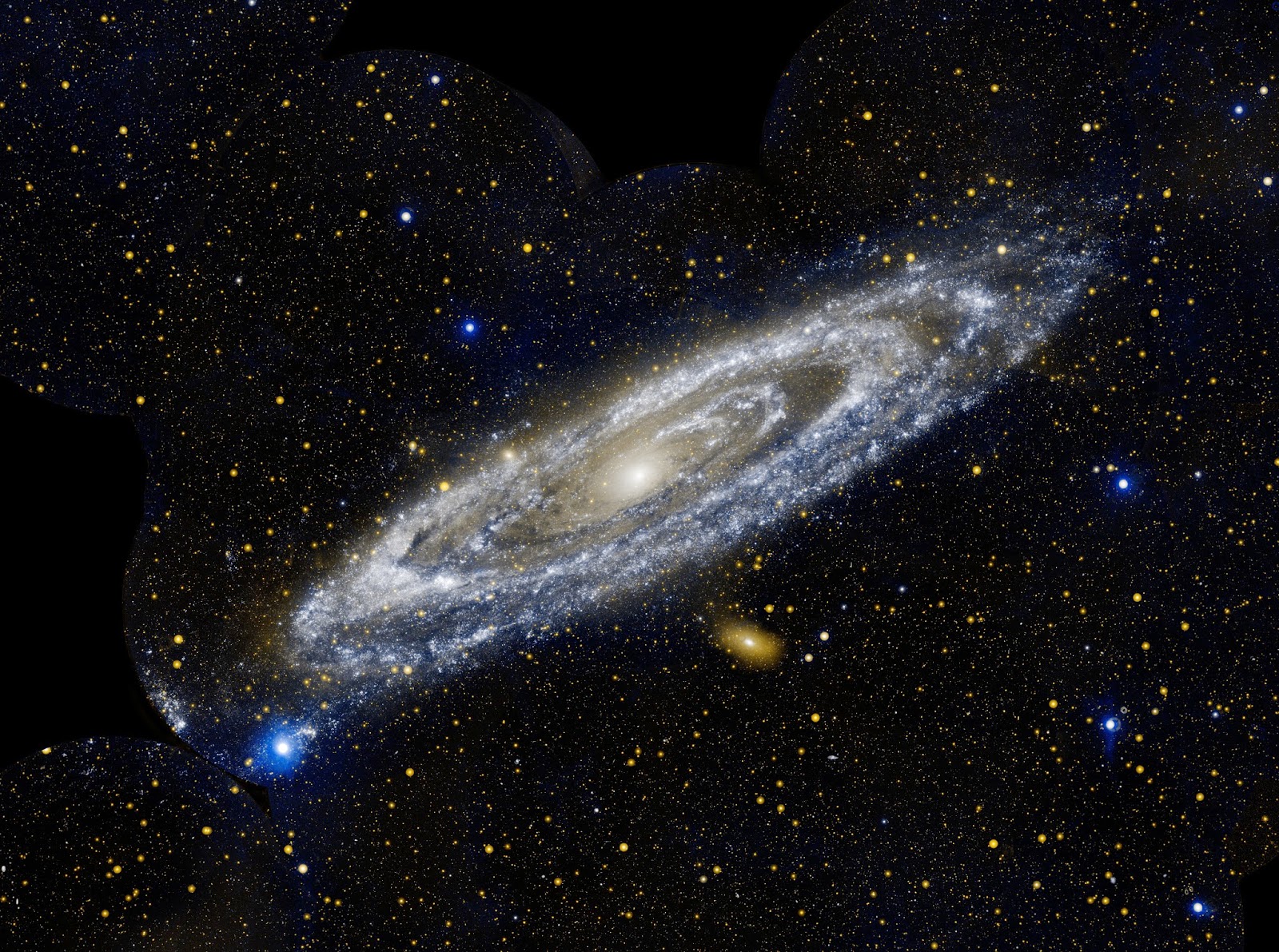
M31 galaxy in the constellation Andromeda contains billions of planets with life according to new data.
ALIEN LIFE IN THE GALAXY AND UNIVERSE
SETI gets a boost recently by news released from astronomers working with the Kepler spacecraft. Minimum, there are tens of billions of planets in our galaxy that are likely to contain life. Moreover, the entire Universe is likely to hold a minimum of 100 billion times 10 billion or a thousand billion billion planets with life.

However, the vastness of the space inside the galaxy and Universe is so great, that many civilizations with warp speed capability would still have great challenges in finding us. For example, if their technology allows warp 10, or travel that's 10 time the speed of light, it will still take 100/10 = 10 million years to reach those galaxies that are 100 million light years distant.

Sunday, December 29, 2013

Life in the Galaxy

Stars in the galaxy
LIFE IN THE GALAXY
Way back when astronomer Drake formulated the famous Drake equation for life in the galaxy, he determined the number of intelligent civilizations in our galaxy alone to be around one million.

This week, astronomers recalculated that there are 11 billion possibly habitable planets in our galaxy, greatly upping the odds that we're not alone in the universe. Researchers used four years of data from NASA's orbiting Kepler telescope to compute how many planets lie in their solar systems' "Goldilocks zone," where surface temperatures support liquid water. They found that one in five sun-like stars harbors a roughly Earth-size planet in the habitable zone, and the nearest may be only 12 light-years away — possibly close enough for communication. Given the sheer number of candidate planets, says astronomer Geoffrey Marcy, "surely some of them have all the necessary attributes of life."

Worlds beyond the solar system harbor intelligent life
We believe as space telescopes improve in resolution and capability, it won't be long and we'll discover intelligent life in the galaxy. Those in-space galactic neighbors only a dozen light years away may provide world changing communications. Why not? Many of our space probes take decades to return useful information. Communicating with advanced civilizations where it takes 10 or 20 years for a steady stream of data to reach us will not be unusual.

Sources and References
http://theweek.com/article/index/254523/the-biggest-scientific-breakthroughs-of-2013

Saturday, December 28, 2013

Space Telescopes

SPACE TELESCOPES
It looks like competition is heating up for the number of telescopes in space. In addition to Humanoido Lab's 15 mega space telescopes, the chart illustrates many more. Several countries have made space telescopes including the USA, UK, and Japan.

Extremely Powerful Telescopes Chronology
http://humanoidolabs.blogspot.tw/2013/12/extremely-powerful-telescopes-chronology.html 

Friday, March 2, 2012

NULT Telescope Kepler 22b

NULT TELESCOPE AND KEPLER 22B
As part of the NULT New Ultra Large Telescope Pointing Suggestion Program, a request to find and image a remote planet outside of our solar system was made. The NULT Telescope was pointed at the coordinates of the remote planet Kepler 22b and this is the result. This is a direct optical image that does not use any techniques of interferometry and is open to study and interpretation. However, it gainfully utilizes the Universe Penetrator in the wide open 10X mode. One may create a method yardstick for the measurement of life on the planet. Thanks to Dave Hein for this telescope pointing suggestion. "Humanoido, could you point NULT at Kepler-22b? It's an earth-like planet (at) 600 light-years away. It's orbit is in the middle of the habitable zone around its sun, and you might be able to detect some evidence of life there."