Showing posts with label planet. Show all posts

Thursday, November 18, 2021

Monster Plants on Alien Planets


Mon-ster Plants on Earth & Alien Planets

Monster plants on Earth are gruesome to look at, frightening and have evolved a genome that favors a taste for flesh. A variety of these carni-vorous plants live on the Earth and are so fast moving that they can catch their prey in an instant, then proceed to digest animal bodies in their adapted tummies.

The first two photos illustrate Earthen plants that have developed a taste for meat. If these plants look like gruesome monsters, one can only imagine the development of alien plants on other planets in the galaxy that have evolved according to a different genome set, unlike life on Earth.

The plants evolved when photosynthesis no longer became a prime factor in the life cycle of plants evolving on a planet with less sunlight. The plants would most likely develop another way to survive, by capturing and eating small animals, like mice and other rodent-like creatures.

Society has long shown films with monster plants like The Day of the Triffids, a science fiction movie. 

The Day of the Triffids is one example, a 1951 post-apocalyptic novel by the English science fiction author John Wyndham.

After most people in the world are blinded by an apparent meteor shower, an aggressive species of plant starts killing people. 

The protagonist is Bill Masen, a biologist who has made his living working with triffids—tall, venomous, carnivorous plants capable of locomotion.
Due to his background, Masen suspects they were bioengineered in the U.S.S.R. and accidentally released into the wild. 

Because of the excellent industrial quality of an oil produced by and obtained from the triffids, there is heavy triffid cultivation around the world. WIKI

Left: Fiction - One can make guesses and estimates of the behavior and appearance of alien plants on other worlds. The rules of evolution and randomness may be different on alien planets, due to varying environments with gravity, radiation, atmosphere, growing soil, changes in environment, animal life, light intensity, and life genome.

It's not too difficult to imagine a massive plant living within a gravity environment several times of Earth, with strong leaves and ensnaring teeth, much like the Earth's Venus Fly Trap plant that rapidly catches and devours insects for their meat.

Tuesday, October 27, 2020

New AI Machine Species Invented

New AI Machine Species Invented


by Humanoido

I have invented a Heavy Mass Catipulsation Rocket for launching our SPACE1 Micron Planets into the evolutionary void. The rocket uses reciprocating mechanics and Newton's Law of Motion to propel cargo into the void of space, primarily to launch temp evolved Micron Planets in numbers and rapid succession. I have included the pic link and a link to the definitions of the Micron Planets. There is also a nice index included at the post. The overall plan is to develop my own Independent Trans-Dimensional-Humans and populate the Micron Planet. Eventually SPACE1 or SpaceX might take these to the vicinity of Mars where they can evolve as a completely new multiplanetary species.

https://space1usa.blogspot.com/2020/03/space1-micron-planet-anatomy.html

https://blogger.googleusercontent.com/img/b/R29vZ2xl/AVvXsEhP0KcxkFOnnVCGfSNVImzXEuWDov_F-Z85kgbLHIa1a74ny7TRB6vpohcJQeMtc6TyrB6DHom-FqFYKol33gCWOBA9RjQCqhVQCu_zIc1VAuWXFQkpPvw30dS1Tkp4iGSjoel6t7r2gAYe/w620-h640/micron+planet.jpeg

The Micron Planets could be dropped off at several other locations, such as in low Earth orbit, the Moon, or asteroid, possibly at the LaGrange Point as well, and driven by renewable energy solar cells for power distribution. Micron planets with Independent Trans-Dimensional-Humans do not require an atmosphere and can be manufactured by a SPACE1 assembly line.

Wednesday, July 23, 2014

Alien Life Postcard

ALIEN LIFE POSTCARD
No longer can we hide as Earth's Pollution Signature Flags Our Location

Some time ago, we wrote about the Earth sending out calling cards into the vast interstellar space for aliens to read and learn our location to pay us a visit or engage in communications. We surmised, based on our highly intelligent yet immensely mean and sarcastic "friends" on the forums, that highly intelligent aliens might fit the same profiles and develop a culinary taste for Earthlings. In this case, our calling postcards suddenly became food menu invitations to a new restaurant location named Earth, and we are the food on the menu (see the plaque from Pioneer 10 illustrated above)!


Read about the Don't Eat Us Safety Program.
http://humanoidolabs.blogspot.tw/2013/07/dont-eat-us-safety-program-radio.html

"Speaking on behalf of the BIG Brain Initiative, Humanoido describes the "Don't Eat Us" Radio Telescope safety program, where, you contact us, we don't contact you. As part of the The Asian Arena International Taiwan Radio Open Sky-faced Balcony Observatory Laboratory 57, this incognito search initiative employs a radio receiver that collects evidence in the search for intelligent life in the universe but does not transmit or give out our coordinates."


Now we find that it's impossible for us to hide, even if we stop sending out calling cards, because we billow out trillions of unnatural chemical toxins from our man made pollution which is highly visible.

— As great polluters of planet Earth, we are advertising our stupidity for the universe to see —

These man-made poisonous toxins are readily identifiable as "not indigenous" to the natural formation of our planet. In fact, an alien with a big telescope looking at the Earth can find us, based on the Earth's massive pollution signature.

It's time to stop polluting the Earth or the consequences of such actions may be significantly horrendous in more ways than one.

Wednesday, June 25, 2014

Alien Life in the Galaxy and Universe

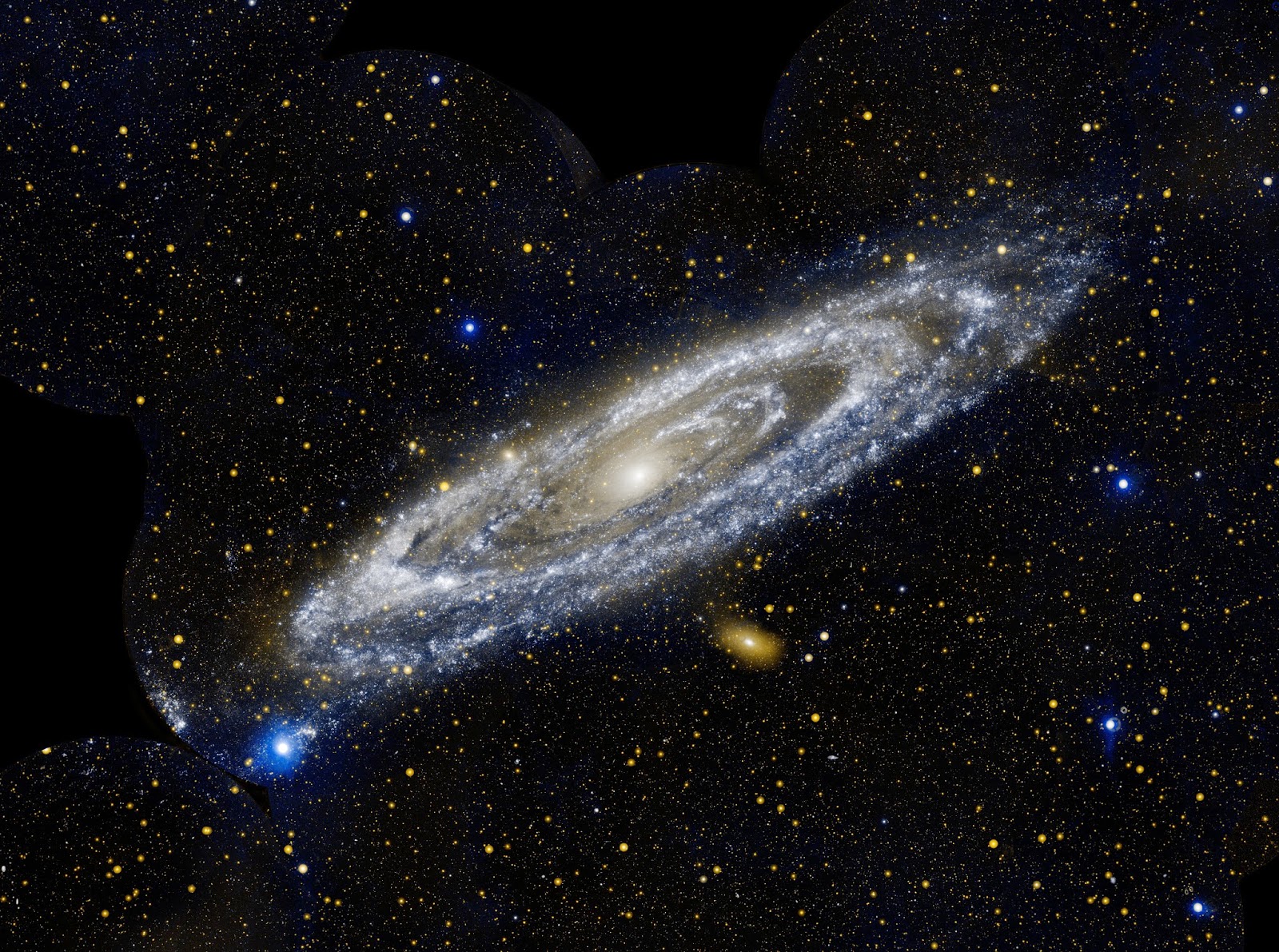
M31 galaxy in the constellation Andromeda contains billions of planets with life according to new data.
ALIEN LIFE IN THE GALAXY AND UNIVERSE
SETI gets a boost recently by news released from astronomers working with the Kepler spacecraft. Minimum, there are tens of billions of planets in our galaxy that are likely to contain life. Moreover, the entire Universe is likely to hold a minimum of 100 billion times 10 billion or a thousand billion billion planets with life.

However, the vastness of the space inside the galaxy and Universe is so great, that many civilizations with warp speed capability would still have great challenges in finding us. For example, if their technology allows warp 10, or travel that's 10 time the speed of light, it will still take 100/10 = 10 million years to reach those galaxies that are 100 million light years distant.

Saturday, December 7, 2013

M3T Massive Molecular Mining Telescope Views Titan

M3T MASSIVE MOLECULAR MINING TELESCOPE IMAGES SATURN'S MOON TITAN
Penetrating Titan's thick atmospheric shroud is a great challenge. Our data observatory is mining the molecular constructs within and under the atmosphere of Moon Titan.

Why? Titan is a very rich moon, filled with a lifetime supply of wealthy hydrocarbons and natural oil, just ready for shipment back to the Earth and Mars as a source of pure energy. Merely scoop it up from the oil lakes and atmosphere - ready for the plucking.

This black gold could power the Earth for generations to come. Soon the oil deposits on the Earth will be depleted and space barging mineral wealth back to the Earth will become an important business.

Our space program is focused on Titan. We're building the Robotic Titan Moon Explorer and continuing to watch the moon with our telescopes to gather data for a future landing and mining operation.

This M3T Telescopic visible energy view is a precursor to the upcoming molecular view. Surprisingly, visible energy shows detail and a penetration through the thick veil of smog clouds. Study shows Titan has heavy smog from methane and hydrocarbons, even lakes of thickened oil, and glimpsing detail through the air is a great challenge. When it happens as seen on this data image, it's a rare event.

Stay tuned for the new upcoming view in moleculars. It sure to be spectacular, unlike anything ever seen before!

Thursday, June 13, 2013

Projected Mapping Device

EZMAP Source projections example
PROJECTED MAPPING DEVICE
How useful is the technique of Projected Mapping?


One of the first uses of Projected Mapping was with the AAR Machine. AAR Machine Projected Control Mapping was invented to transfer, map and project controls from a boiler face plate to the actual functions for operating the Altercated-Alternated Reality Machine (AAR). This method works well and was adopted for additional devices, including Procedural Machines. The final projected destination for the control mapping was the Lab's supercomputer Big Brain. After 30 days of use, the technique is more perfected, works well and is now implemented in almost all new machines.

Projection mapping is in use in other academia and studies to conventionally transfer parts of objectss, such in the case of a spherical planet like the Earth or Mars, to that of a flat surface, often resulting in a mercator projection that can represent maps on a flat-plane paper in two dimensions.

The Lab is using the projection in a different manner to go from a 3D representations on a planar surface that exists only in code or that which is brought into graphical representations, to that which exists only inside the mind as thought, i.e. in these examples, the mind of the supercomputer or the mind of a human transfer agent.

The projection is then linked to the actual function and the function is carried out. In this manner, full control panels containing arrays of function switches can be implemented.

May Update Part 2
AAR Machine Projected Control Mapping
Procedural Machine

EZmap

Wednesday, April 3, 2013

Olympus Mons PGT ET Test Site

Mars map showing Olympus Mons and the intriguing Caldera selected for tests
OLYMPUS MONS SELECTED AS PGT ET TELESCOPE TEST SITE
"It's expected that the PGT ET version telescope will outstrip our wildest imaginations in terms of visual performance and discovery, based on the known performances of previous telescopes and machines. It's currently open as to which research fields will be approached and which subjects will be chosen for the initial tests. Let's examine one possible and intriguing test site that will be scientifically viable and possibly contribute to new discoveries."

"Olympus Mons could erupt at any second!"

INTRODUCTION
We're thinking about pointing the massive adjunctive telescope towards the Solar System's largest volcano, Olympus Mons on Mars, for first light tests. The questions that will possibly will be answered by the PGT ET are, "Is it possible to image inside the Martian Olympus Mons? If it's open at the top, can we journey down deep slopes into the floor of the volcano? How far down will this journey take us? What hidden inexplicable unknowns lie inside?

"Knowledge about the Olympus Mons volcano is vital and critical to future martian colonists" —


Olympus Mons NASA elevation data
OLYMPUS MONS OVERVIEW
Olympus Mons on the planet Mars is an extinct volcano over 16 miles high and three times higher than Mt. Everest on the Earth. It's the largest and highest known volcano in the Solar System. It holds special "geological" benefits and keys to future inhabitants of the Martian surface. At 550 km in diameter and 25 km high, it has mysterious overlapping calderas at the summit and one or two flanking parasitic cones. The caldera depth alone is about 3 km. Olympus Mons is located at the northwestern edge of the Tharsis region, about 1200 km from the other three large Martian shield volcanoes, collectively called the Tharsis Montes (Arsia Mons, Pavonis Mons, and Ascraeus Mons).


Mars Map: Telescope to target the Caldera
CHOOSING THE SITE
For choosing the site, framing, deciding on orientations, obtaining references for image scale and deciding telescope formatting, we can go to Google Mars, and download the update, thus exploring Mars in 3-D just like in Google Earth. This explains how to use it. The objective is to enable the telescope to penetrate, as deep as possible into and through the Olympus Mons Caldera. With the power of the new PGT ET telescope, we may see detail not only on the massive slopes leading to the deep floor depths, but actual detail along the volcano floor. The high vantage point of the PGT ET is favorable for looking down from above to create ideal conditions.

BLOWING UP
If Olympus Mons blows, it could be very good for planet Mars, contributing greenhouse gases that could raise the temperature of Mars, provide more of a substantial climate, enabling more protection against harmful ultraviolet and other rays, and providing a more hospitable environment for future Martian colonists. Viewing, creating, studying ultra high resolution images of the volcano could provide valuable details about and for predicting the behavior of this huge impending feature that could terraform the planet in the future.

CONCLUSION
The Mars giant Olympus Mons volcano is selected for the first test site, to test the new PGT ET telescope. A key feature is the Caldera, an opening into the volcano, possibly extending to an elevated floor of some kind. What type of lava flow creatures live at the bottom, or what variety of floor materials will emerge from the telescope imagery? Will before and after images contribute to understanding the dates and times of future eruption? What unusual features will emerge? How deep can we look inside the OM? Can this exploration contribute to the search for life? Is this region indicative of an ancient ocean where we may find fossils emerging from the caved-in surrounds? Can we see the inside wall slopes and what will they reveal? Can specific Martian axial tilts contribute to angular viewing and can processing enhance their viewing vantage points. Which Adjuncts and Adjunctive Positioning will best facilitate the above, if any? Can the OM contribute to Mars thermodynamic heating a Martian colony base or provide other materials for survival? Are there burrow holes in the side of the slopes. How deep and how steep are the interior walls? Is there slide wash on the interior slopes and to what extent? Is sand visible? Can resolution meet or exceed that which is necessary to see footprints or small creatures? How will this test contribute to expanding PGT-ET programs?

Friday, March 2, 2012

NULT Telescope Kepler 22b

NULT TELESCOPE AND KEPLER 22B
As part of the NULT New Ultra Large Telescope Pointing Suggestion Program, a request to find and image a remote planet outside of our solar system was made. The NULT Telescope was pointed at the coordinates of the remote planet Kepler 22b and this is the result. This is a direct optical image that does not use any techniques of interferometry and is open to study and interpretation. However, it gainfully utilizes the Universe Penetrator in the wide open 10X mode. One may create a method yardstick for the measurement of life on the planet. Thanks to Dave Hein for this telescope pointing suggestion. "Humanoido, could you point NULT at Kepler-22b? It's an earth-like planet (at) 600 light-years away. It's orbit is in the middle of the habitable zone around its sun, and you might be able to detect some evidence of life there."