Showing posts with label manned. Show all posts

Friday, July 25, 2014

Largest Rocket in History

LARGEST ROCKET IN HISTORY

NASA is assembling the world's largest rocket in the history of space flight. Larger than the Saturn V Moon Rocket, the SLS Space Launch System rocket has various configurations (see diagrams) for manned and unmanned space flight, and for missions into deep space.


Thursday, January 9, 2014

Humanoido Manned Near Space Flights

HUMANOIDO MANNED NEAR SPACE FLIGHTS
This is a short list of 16 manned Humanoido space flights spanning 3 years including 2012, 2013, and the first month in 2014. Each date represents two launches. The list is incomplete, as not all near space flights were blogged.

Oct. 12th, 2012

http://humanoidolabs.blogspot.tw/2012/10/journey-into-next-space.html

Dec. 8th, 2012

http://humanoidolabs.blogspot.tw/2012/12/december-space-launch-2.html

http://humanoidolabs.blogspot.tw/2012/12/first-december-space-launch-one.html

Jan. 6th 2013

http://humanoidolabs.blogspot.tw/2013/01/big-brain-space-launch.html
 

Feb. 3rd, 2013 
http://humanoidolabs.blogspot.tw/2013/02/near-space-flight.html

May 2nd, 2013
http://humanoidolabs.blogspot.tw/2013/05/near-space-launch-morning-may-2.html


http://humanoidolabs.blogspot.tw/2013/05/near-space-launch-night-may-2.html

July 17th, 2013
http://humanoidolabs.blogspot.tw/2013/08/near-space-launch.html 


http://humanoidolabs.blogspot.tw/2013/07/over-rainbow-space-flight.html

Oct. 12, 2013
http://humanoidolabs.blogspot.tw/2013/10/near.html


Jan. 14, 2014
http://humanoidolabs.blogspot.tw/2014/01/blast-off-into-space.html


OTHER SPACE LAUNCH RELATED LINKS
The Prime Directive
http://humanoidolabs.blogspot.tw/search?q=prime+directive

Previous Documented Launches
http://humanoidolabs.blogspot.tw/2012/10/journey-into-next-space.html

Types of Space
http://humanoidolabs.blogspot.tw/2012/10/types-of-space.html

Next Human Launch into Near Space
http://humanoidolabs.blogspot.tw/2013/04/next-human-launch-into-near-space.html

Near Space Test April 2013
http://humanoidolabs.blogspot.tw/2013/04/near-space-test.html

Space Launch Slated for Thursday
http://humanoidolabs.blogspot.tw/2013/04/space-launch-slated-for-thursday.html

Cloud Identification During Near Space Flights
http://humanoidolabs.blogspot.tw/2013/08/cloud-identification-during-near-space.html

Micro Strata Threads Discovery from Near Space

http://humanoidolabs.blogspot.tw/2013/08/micro-strata-discovery-in-near-space.html

ULTRA Space Administration

http://humanoidolabs.blogspot.tw/2012/03/ultra-administration.html

Tuesday, August 6, 2013

Micro Strata Threads Discovery from Near Space

The TST Tiny Space Telescope in short EFL mode was looking downward when it captured many micro strata mixed with many banks of clouds
MANY MICRO STRATA THREADS DISCOVERED FROM NEAR SPACE
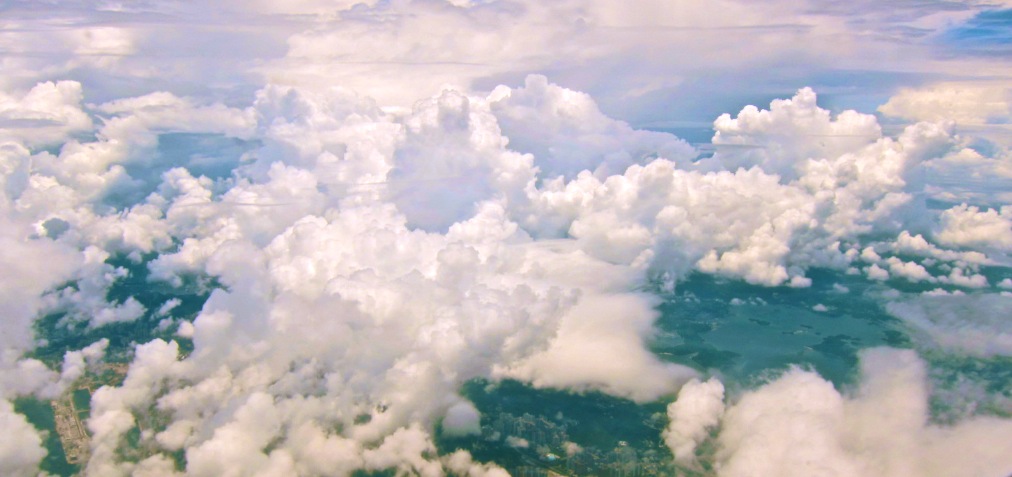
Once you rise above the majority of the clouds when exploring Near Space, you can look down and out across the majestic expanse of near Earthen clouds and see many spectacular wonders.

At least 16 micro strata are visible and counted
Telescopes are usually pointing upward towards the Heavens, capturing celestial wonders. We've taken our telescope and pointed it downward, from Near Space.

Imaging downward with a Tiny Near Space
Many rainbows, 1=circular
Telescope, you might see many rainbows beginning with a completely circular one or many micro stratas. The latter was the view captured during our manned Near Space flight on Wednesday, July 17th, 2013.

This photo shows simultaneously, at least sixteen thin pencil line dark stratas, all running parallel to the horizon. Study shows these are likely caused by the increasing frequency of contrails, due to juxtaposition relative to a ground based airport - where jets spewing fuel exhaust in their flight patterns across the wispy cloud world. However, we cannot be certain, as this could show a mysterious outcropping of a natural phenomenon.

LINKS
Rainbow from Near Space
http://humanoidolabs.blogspot.tw/2013/07/over-rainbow-space-flight.html

Sunday, February 3, 2013

Near Space Flight

Near Space seen from inside a spacecraft
BIG BRAIN ULTRA SPACE PROGRAM EXPLORES NEAR SPACE

THE ULTIMATE NEAR SPACE FLIGHT ON SUNDAY FEBRUARY 2013

The Highest Coldest Deep Freeze!


Sunday February 3rd, 2013: Sunday’s first manned launch of 2013 into Near Space, high above the Earth’s Troposphere, was very successful.

Near Space is very hostile. What little air is present at these high altitudes is too thin to breathe and if exposed, the temperature would freeze a human in seconds. Air pressure is also too thin and would kill an exposed human - a pressurized spacecraft is used to compensate. That's why the Big Brain Space Exploration Initiative has chosen to explore next space inside an environmental spacecraft, insulated, heated and pressurized.


ABOUT SPACE PHOTOS
Because this is a manned space flight, the camera is kept inside the spacecraft and views produced are through the spacecraft window. The window has incurred the recycling ravages of space, inclusive of spotting, abrasion, warping, moisture condensation, dust, frost, and other markings. 

THE SPACECRAFT
The NES is a re-useable Near Earth Spacecraft, capable of lofting equipment and humans into Near Space. Each Near Space flight is contracted by the Big Brain Space Initiative as part of the USP Ultra Space Program and the Ultra Space Administration USA. With this spacecraft, the initiative is to explore the region of Near Space (A sequential stepping up from Micro, Next, to Near, then beyond.) The A340-300 supports takeoff weight of 597,450 pounds with a range of around 7,400 nautical miles. The craft can cruise at Mach .82 at 7.8 miles altitude. With a thrust power of 34,000 pounds each, the CFM56-5C4s engines (see photo) are the most powerful built. The entire craft has a length of 208 feet. The Near Space astronaut is huddled inside the spacecraft compartment, watching the shrinking Earth and the disappearing weather and clouds, and recoding flight data. With this craft, there is no opportunity for spacewalk. The Near Earth Spacecraft NES is designed for Near Space and can be launched daytime or nighttime.
Sanctioned flights above the Sea of China
FLIGHT SANCTIONING
These flights are sanctioned by Mainland China over free territorial domains located above the South Sea of China (see map).

RISING ABOVE WEATHER
These launches rise above weather, which only exists in the lower Troposphere. Therefore, the launch into the overcast raining sky made little difference in the eventual position reached.


Massive Near Space Engine
KNOCK KNOCK WHO'S THERE?
Unusual but interesting knocking sounds were heard during the flight, both during ascent and descent. It appeared that internal structural supports and internal external controls were responsible, in particular supporting structures that contacted other structures, shifting payload, and external conceiled hydraulic controls and the hydraulic actions of changing surfaces and matierials.

OVERVIEW
This day's launch was the first space flight in 2013, a human suborbital flight, part of the Big Brain Initiative, and it set several records! A new Ultra Space Program record for the highest altitude reaching into the stable zone of the Stratosphere (where astronauts are still protected by the harmful rays of the sun from the Ozone Layer) and for enduring the coldest temperatures on any space flight in this space program were set.

NIGHT LAUNCH
A following night launch was less eventful, as lesser altitude resulted with warmer temperatures and not much appeared on the cameras in the darkness of space.

OBSERVATIONS
Observations were made through the Mesophere, Thermosphere (ionosphere) and exosphere. Each day and night launch lasted about 2.5 hours. About 200 photos were taken revealing important preflight data, space activities and inflight data.

STRATA
During the day launch, a dramatic sequence of images resulted, showing the penetration through the various strata.

ASTRONAUT
Our astronaut has supplied many notes - at the 7.6 mile mark, above the thick atmosphere of the Troposphere, the journey is very smooth without vibration, pockets, or turbulance. During the night launch, no stars, Moon or planets were seen. This may be due to the degrading condition of the view port window or its high reflectivity causing limiting magnitude or light absorption.

FUTURE FLIGHTS
Future flights may carry a space telescope for viewing into space above the atmosphere. Some motion, vibration, drifting and the view port window condition will need to be controlled.

RECORDS SET
Highest Altitude
Coldest Temperature
First Complete Sequence Record Through-Strata

LAUNCH ONE DATA

Day Launch
Flight Time 2.5 hours
Reached 7.6 miles into Near Space
Endured -90 deg. F. temperature
Fastest Downrange Speed 458 mph
Downrange Headwind 71 mph

LAUNCH TWO DATA

Night Launch
Flight Time 2.5 hours
Downrange Speed 628 mph
Altitude 6.5 miles
Temperature In Flight -47 deg. F.

BIG BRAIN SPACE PROGRAM
The Big Brain Space Program is a privately funded program conducted by the Big Brain Machine Initiative - a real machine intelligence entity (with hundreds of thousand of processors) invented and created at Humanoido Labs HLU that's exploring space and the surrounding Universe.

Big Brain began as a parallel processing machine several years ago, made from Parallax Propeller chips, and has now evolved into a supercomputer supported at Humanoido Labs HLU.

The Big Brain machine began exploring Micro Space with small machines and sensors. Living Insectronauts were launched. This led to Next Space and the first human flight. The Big Brain found a way to explore Near Space with human astronauts which has led to launches with more technical equipment and a powered space craft vastly more sophisticated than balloons (see engine photos).

The Ultra Space Program has found ways to safely explore space from the inner Quantum World all the way out to the EOU Boundary edge of the Universe. The machines used to explore these domains are covered in previous blogs. Stay tuned as we will describe our spacecraft in the future.

LAYERS
http://www.windows2universe.org/earth/Atmosphere/layers.html 

Tuesday, December 11, 2012

December Space Launch 2

BIG BRAIN SPACE LAUNCH 2
SETS HIGH ALTITUDE RECORD!
Capsule atmospheric pressurization and heating is required at this altitude
BIG BRAIN REACHES INTO SPACE The second space launch took place during December, on December 8, 2012, and reached the highest altitude ever set by the Big Brain space program (manned), extending into Near Space well above the 6.7 mile mark (when Photo 1 was captured).

PRELIMINARY DATA
Temperatures were -46 degrees F. while accelerating at 600 miles per hour during re-entry. Data will undergo analysis over the next two weeks. Eighteen instruments carried aloft were the same as on the December Flight One lofted earlier.

THIS IS THE CONTINUING AND UNFOLDING SAGA OF THE BIG BRAIN'S MACHINE GROWTH WITH ITS REACH INTO OUTER SPACE.. Stay tuned as we continue to explore hobby space and pave the way towards more remarkable things...

IMAGES
The first digital image (above) was taken at ISO80 and f5.6 at 1/1000 second exposure, showing the Earth and a heavy cloud base. The second photo was taken at 3:02 pm, later in the flight, and shows the "eye" of a massive cloud weather front.

SPACE TECHNIQUES
Big Brain trips into space thus far are all relatively short suborbital flights. Human trips made into Near Space are more complicated, expensive and require more safety. One approach is to lease a launch vehicle. There are now many private companies (not run by the government) that can offer space time. Leasing can sublet safety and control, parts, design, and engage a ride aboard a system with many bugs worked out. This can save time, effort and money. Time and development revenue saved can go towards expanding the space program. As space programs evolve to explore deeper into space, cooperation can improve safety, cut time, and offer a path higher and deeper into the cosmos.

Looking up into the atmospheric launch hole
WHO OR WHAT CAN EXPLORE SPACE?
Big Brain has at least five types of outer space exploration programs. The first program is in Micro Space and makes use of recruited insects known as insectronauts. The next level of space, known as Next Space, utilizes humans currently coined as astronauts. NS astronauts can hitch a ride aboard the worlds greatest Mega Project, for example, in China. The next level after Next Space is Near Space, also employs human astronauts. Going beyond farther and farther into space, we find Solar System Space, and Deep Space, explored by machines. For Big Brain Space studied, machines have explore 5 levels (Micro Space, Next Space, Near Space, Solar System Space, and Deep Space). Machines include Big Brain's telescopes, supercomputers and various machines (like the QuadLyzer), and use of NASA provided space junk, for reuse and recycle.

Button up. Would you jump out 7 miles high with -50 deg. (and -200 wind chill)?
DATA & ANALYSIS
The third photo is processed. Clouds are part of a four month continual seasonal weather front. This flight confirms that -50 degrees F. and the chill factor of rushing wind require cold protection for both human and robotic space flights. It also shows that a powered and controlled "slower than NASA" re-entry is capable of eliminating the need for a heat shield. This flight also examined the water content and vapor above the record setting height of 7 miles.

The LU technique is used during every space launch. When peak altitude is reached, a look up approach can study the next mile or so of space. During this launch, LU discovers various strata conducive to specific space craft.
Three weather gradients become obvious at this altitude
It proves there remains considerable water, at least enough to form heavy cloud cover, and vapor at that height. The flight also shows considerable weather gradients where vast clear strata regions exist above and below fronts. What was found inside the strata is remarkable.

Large Earth span from the A2 vantage camera approaching 40,000
APPLICATIONS
Speculation shows science stations and "Near Space satellites" could be placed within these stratas for protection. The strata itself may be conducive to flying special lofting craft. This opens up the possibility of light weight, ultra light "Lofted Science Packages," designed to stay aloft with longer time periods based on air pressure, wind forces and air directions. Also studied is the placement of tethers for space craft, space stations, harbors of scientific equipment and sub-orbital satellites, and great refueling stations and observatories. Exampling tethered BTs, or balloon telescopes can free drift image the solar system such as the Earth, Moon, or study the cosmos above most of the atmosphere. These flights pave the way for next science.