Tuesday, August 24, 2010

AM Algorithm Machine

08-04-2010, 01:37 AM
AM Algorithm Machine
A Tiny Tester for Developing Parallel Algorithms
You can use this tiny tester, built from Parallax parts, for developing parallel algorithms and running tests for much larger machines (including large Propeller based parallel cluster machines under design and construction). It's a real time saver! The tester is an upgrade and a spin-off of the Minuscule BASIC Stamp Super Computing Machine. This is a tiny algorithm machine, simple to build, easy to use. The field of parallel clustering computing is relatively new to hobbyists. Developing techniques and methods is an important aspect of cluster computing to gain the greatest rewards and benefits from not only paralleled space but multiprocessors as well.

Features 
  • Operates in five BUS modes
  • Serial & Parallel options
  • Includes WIDE BUS
  • Handles up to 200 step code
  • Programs in PBASIC
  • Very small footprint
  • Builds with Parallax BASIC Stamp 1 Project Boards #27110
  • Speakers & LEDs for output
  • Twin 9-volt battery operated

SCHEMATIC

Use the above schematic to build the tester, then program it with parallel algorithms to test various interfaces and parallel configs. Provisions are made for converting between single wire, full duplex, and data buss interfaces.
_____________________

Overview
It doesn't matter if you're using stamps or props, parallel techniques work cross platform. Here's a chance to use a language that's been proven over time and develop routines for new parallel machines. The addition of the upgraded interface bus allows for trying out several hardware configurations such a one wire, serial full duplex, and data bus.

Criteria
The AM is currently being used with the UltraSpark 40 Supermicrocontroller Parallel Computing Machine and satisfies several conditions for testing the new series.

Interface
This versatile machine operates in four modes, which can be wired as single mode A, single mode B, or dual modes A & B, or simply C mode. Operate the AM using a single wire and serial PBASIC code commands or program the machine using the seven parallel port bits.

A - Single Wire Serial P0
B - Parallel Bus P3, P4, P5, P6, P7
A + B Dual BUS, as seen above
C - Parallel Bus Only P0, P3. P4, P5, P6, P7


Code and Parallel Algorithms
It is left up to the user to derive various parallel algorithms in PBASIC
code. However, as code becomes available, it can be posted in this thread. The 1st proposal is a split function task for n processors. In this example, one program is written that supplants itself into n processors and auto determines the work share for each processor. Time passes and the work conclusion is collected and concluded. It is ok to create a separate collection program.

10-12-2010, 07:15 AM  Update 10.12.2010 NAME ESTABLISHED
This update includes the name AM - Algorithm Machine. This is a tiny minimal two core machine capable of quickly running tests on simple parallel algorithms. The second advantage of the machine is that it introduces a new wide bus for experimentation.

10-12-2010, 07:20 PM  Update 10.13.10 REVISED SCHEMATIC
Revised Draft Schematic Posted

10-13-2010, 08:56 AM  INTRODUCING WIDE BUS

A - Single Wire Serial P0
B - Parallel Bus P3, P4, P5, P6, P7
A + B Dual BUS, as seen above
C - Parallel Bus Only P0, P3. P4, P5, P6, P7
D - P0 - P7


Regarding bus modes. For a D mode, WIDE BUS, remove the LEDs and Peizo speakers to gain a parallel eight bit BYTE bus data array using pins P0- P7. Connect, P0 to P0, P1 to P1, P2 to P2 up to P7 to P7, confirming a protection resistor (220 ohm) across each port.

10-13-2010, 08:57 AM  BS1 PROJECT BOARD SCHEMATIC
BASIC Stamp 1 Project Board Schematic - Use for Wiring the AM

Schematics may be difficult to find these days. Use this BS1 Project Board schematic when wiring two boards together to create the AM project. The 93LC56 chip is an EEPROM with 256 bytes size or 1/4th K. This holds up to 100 instructions. The microcontroller is a Microchip PIC16C56A running at 4MHz. This gives about 2,000 IPS Instructions Per Second. The serial PC interface runs at 4,800 BAUD for programming and debug. Power can be within the range of 6 to 15 volts.

Source / Sink Current per I/O.................. 20 mA / 25 mA
Source / Sink Current (device) ................ 40 mA / 50 mA
Power Consumption................................ 7 mA running (no loads); 5 mA Sleep (Rev B). On Rev B boards the power LED remains illuminated when the BASIC Stamp is in sleep mode

10-13-2010, 08:57 AM  PROGRAMMING COMMANDS
BRANCH Branch to address specified by offset
BUTTON Monitor & manage button input; branch if button in target state
DEBUG Send variables and/or messages to PC for viewing
EEPROM Store user data in available EEPROM space
END Terminate program and enter low-power mode until reset
FOR...NEXT Create numerically controlled loop
GOSUB Unconditional branch to a subroutine
GOTO Unconditional branch to program address
HIGH Make pin an output high
IF...THEN Compare and conditionally branch to program address
INPUT Make pin an input
LET Optional designator for assignments
LOOKDOWN Search table; if found set output variable to target location
LOOKUP Set output variable to table data specified by offset
LOW Make pin output low
NAP Enter low-power mode for short period
OUTPUT Make pin an output
PAUSE Suspend program for 1 to 65,535 milliseconds
POT Read a 5 – 50 K variable resistance and scale result
PULSIN Measure width of an input pulse
PULSOUT Output timed pulse by inverting pin for some time
PWM Output analog level (requires external RC network for filtering)
RANDOM Generate a pseudo-random number
READ Read byte from EEPROM location
RETURN Return from a subroutine
REVERSE Reverse pin state; make input if output, output if input
SERIN Receive serial data, 300 – 2400 baud, N81 format
SEROUT Transmit serial data, 300 – 2400 baud, N81 format
SLEEP Enter low-power mode for 1 – 65,535 seconds
SOUND Generate tone or white noise
TOGGLE Make pin an output and toggle current state
WRITE Write byte to EEPROM location

10-13-2010, 10:28 AM  MORE PHOTOS 
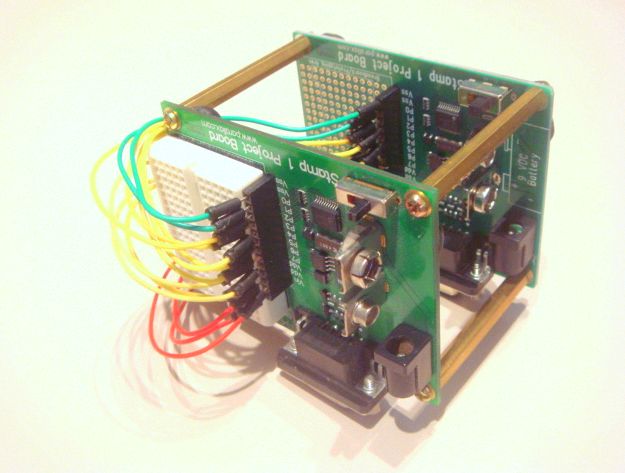
This view of AM - Algorithm Machine, shows a nearly cubical shape, wired in WIDE BUS mode. The solderless breadboard is used only on the top board. Wiring is made with the pin connectors. The bread- board is used for adding the Peizo speaker and LED outputs in other modes.
10-14-2010, 05:33 AM  AM Algorithm Machine BS1-IC Experiment
Instead of using two Stamp 1 Project Boards, this experiment uses a BS1-IC in SIP form. A BS1 module (Parallax part number BS1-IC) plugs into the solderless breadboard on one Stamp 1 Project Board and extends its buss connections directly to the board. The following features result.

    * Significantly Smaller
    * Improves Wiring Efficiency
    * Better Visibility
    * Maintains both Peizo & LED Outputs
    * Requires Only One Battery for Field Use
    * Rewiring is faster

BASIC Stamp 1 Module


BS1 Project Board
Boards setup before wiring.
Setup uses a Revision B Project Board and Revision C BS1-IC. The Project Board programs with a serial to USB converter, and has a choice of battery or power supply operation. Note, the on/off switch at lower right in the photo is especially handy for recycling power.
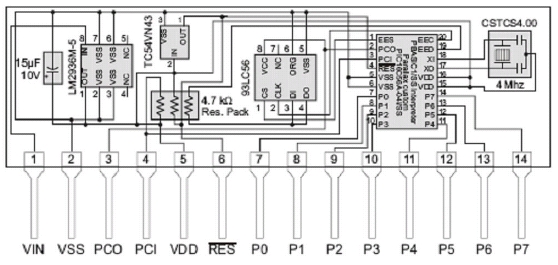

Schematic for rev. c was not found, however, the pinout of BS1-IC Rev. B can also be used for wiring Rev. C.

Note, this experiment is provided for pure academics. In actuality, to program the add-on BS1-IC SIP, add a small three pin programming port and a Parallax Serial Converter, then connect to the PC.

Friday, August 6, 2010

Beginning

08.06.2010 12:44 AM, Code 1-1  In the beginning, how would you fill a Big Brain?

If you had a big brain for your robot, what would you put in it?
I think some similarity to a human brain is good, for example, put in vision processing, memory, and a robot autonomic nervous system. Ok, your turn, fill the brain..

 
Use an extremely large array of sensors similar to that of the human nervous system. Consciousness. The only limit is your imagination. Education. Impressive sensors. Move around and manipulate the world. Keep the brain "out of trouble." That is, keep it from running into things, running off drops or down stairs. Keep itself powered, recharging by returning to a recharging station or battery changing station when needed or keeping itself in light where it could receive recharging through solar panels. It might also include calling out for help with some sort of trouble alarm. Basic robot safety (protecting itself) would be a first priority. Aim for the most basic brain functions first. Give it a model of human intelligence. 

Keep out of trouble, self preservation, maintain itself, protect others, know its environment, and ponder its existence in the Universe, an autonomic nervous system so it can react automatically to many things without much thinking (hot, cold, light, dark, hunger, full, touch, smell, noise, tilt, terrain, wind, hurt..) another place in the brain could determine what is right and wrong. For example, it is wrong to walk inside the house on the white carpet with muddy feet. It is wrong to feed the cat with fish from the aquarium. This list could be endless. The brain will need to prioritize. 

How about a personality section. It can be sarcastic, optimistic, pessimistic, logical like Mr. Spock, wild and crazy as Steve Martin might say, timid and shy, bold and brave to explore strange new worlds seek out new life and boldly go where... The important thing about the personality brain lobe is that it must develop its own personality based on its experiences. Will a good robot follow the law like a mindless cretin or will it have the ability to interpret the law within reason and circumstance.. Which leads into the next section of the brain, which would be a philosophical center and the ability to interpret various philosophies. 

A section in the brain for fuzzy logic, to interpret results in a less rigid fashion, to have the ability to average things, and approximate the information collected. Rather than draw a philosophically incorrect conclusion, the result could be inconclusive, especially when there is no yes or no solution. The gray water section could include interpretation of vision, and other sensory elements and include sets of general algorithms to apply across the board. 

Another brain section called, "Shoot from the hip." In life it becomes necessary to make snap decisions and judgments, in quick situations where and when there is limited or no time to think. For example, a baseball flying at your head and you would want to duck in a particular direction, a baby crawled onto the coming trains tracks you would grab it in the most efficient manner to save it, your information is at home and you must immediately summarize it to pass through the security gate, should you buy red or blue and the person behind you is telling you to hurry up, etc. This is not to be confused with instinctive reactions which also can be programmed in another part of the brain. 

An emotional center in the brain is needed when interacting with humans, otherwise the robot will be very boring.. This can include heightened interest in certain topic, lack of interest in others, robust behaviors for interesting activities..

Thinking should be accessible in some way by output. In SEED, it displayed thoughts on a debug screen. However, in the bigger brain we're designing, it additionally will have motor functions which can move a robot in various ways. Human thinking does not always have visible results but if you can peek into a dream it can be very interesting. On the original Star Trek series, in the early episodes, the ships computer said, "Working," so you knew it was thinking.

Let's say thousands of people were developing common apps and posting each on the net. The brain would access the open door by doorknob routine, and have access to millions of other routines. The intelligence "brain" decides which routine is needed and the robot performs the action to grasp the specific knob/lever/handle and opens the door.


Sunday, July 25, 2010

Multiple Props Projects List

Multiple Props Projects List
Add your multiple Propeller Project here
(updated Wed. Jan. 30, 2013)


Two Props Projects

Mindrobots 2 props, Propeller Slave attached to a QuickStart Proto Board, 2 Props running the same Forth images. Connected via 57,600 bps serial link. No channels between Propellers. Slave functioning needs a terminal session. Additional clusters built as needed.
http://forums.parallax.com/showthread.php?139751-Multi-Propeller-configurations-with-PropForth-v-5.0&highlight=SUPERCOMPUTER


Dr_Acula 2 props http://www.smarthome.viviti.com/prop....com/propeller http://forums.parallax.com/showthrea...reless-network 


Bill Henning Morpheus - 2 props http://forums.parallax.com/showthrea...le-Prop-Design http://mikronauts.com/products/morph...ucts/morpheus/ 

Jazzed Propalyzer - 2 props piggyback http://forums.parallax.com/showthrea...for-Propalyzer Obrien 2 props on a solderless breadboard http://www.objectivej.com/hardware/p...ter/index.html www.objectivej.com/hardware/propcluster/index.html 

Ale 2 props, communicate via 4 bit parallel bus (Beau's 4-bit sync protocol) 

kuroneko 2 props, RAMBlade 104MHz on demoboard (80MHz), 5Mb/s XLINK 

Electricsmith 2 props hardwired on PCB with 2 lines connected between each http://forums.parallax.com/showthrea...l=1#post928314 

Humanoido 2-Prop-Experiment, 2 props, 1 PEK, 1 on same breadboard http://humanoidolabs.blogspot.com/p/genealogy.html

Humanoido Spark 2, 2 props, 1 Proto Board & one in parallel
http://humanoidolabs.blogspot.com/p/genealogy.html

Humanoido PIGGY-TWINS, 2 props, one piggybacked on another
http://humanoidolabs.blogspot.com/p/genealogy.html

Humanoido Dueling Breadboards, 2 props, one on ea., f/interface tests
http://humanoidolabs.blogspot.com/p/genealogy.html

Humanoido BRAIN IN A JAR, 2 props, 1 breadboard, 1 jar 
http://humanoidolabs.blogspot.com/p/genealogy.html
http://forums.parallax.com/showthrea...73#post1014473 

Clock Loop Prop Dual Big Boy, 2 props http://forums.parallax.com/showthread.php?t=124343 

Harley 2 props, requiring more than 32 I/Os and 8 cogs, the master Prop talks to another pcb with keypad and 7-segment + dp LEDs at one baud rate, and comm with 2nd Prop is at a higher rate. This is an attempt to replace some 55 TTL ICs. nickL 2-prop Forth application http://forums.parallax.com/showthrea...Interest-Group
 
Three Props Projects 


Cluso99 TriBlade - 3 props on a circuit board, props working discretely http://bluemagic.biz/cluso.htmbluemagic.biz/cluso.htm http://forums.parallax.com/forums/de...5&m=329999&p=1 

Obrien 3 props stacking using Parallax Proto Boards Obrien 3 props on a solderless breadboard

Christian 3 props

drohne235 The Hive Project - 3 props http://hive-project.dehive-project.de http://forums.parallax.com/showthrea...puter&p=771392 

Heater 3 props on a TriBlade 

Clock Loop Prop BigBoy 3 props versionhttp://forums.parallax.com/forums/attach.aspx?a=45006 forums.parallax.com/forums/attach.aspx?a=45006

Duane Degn Multi Prop Laboratory – 3 props (2 wired + 1 wireless) Added new link! http://forums.parallax.com/showthrea...l=1#post927239 http://forums.parallax.com/showthrea...inuing-Project http://forums.parallax.com/showthrea...Machine-Vision Destructinator 3 props, 1 master + 2 slaves on a solderless breadboard http://forums.parallax.com/forums/de...5&p=2&m=472019 

Loopy Byteloose 3 Propeller Stack http://forums.parallax.com/showthrea...Super-Computer 

kbash & Missouri Automation - 3 props, Multipropcom three Propellers on one circuit board communicate with each other using only two pins each http://forums.parallax.com/showthrea...-communication
 

Four Props Projects

Clock Loop BlackBox Sequencer - 4 props http://forums.parallax.com/forums/de...?f=25&m=364607 

Obrien 4 props on a solderless breadboard Obrien 4 props proto board stack

Humanoido Spark 4, Tiny Tim, 4 props, two proto boards w/2 props on ea
http://humanoidolabs.blogspot.com/p/genealogy.html

Humanoido Tiny Tim, 4 props, experimental wiring platform
http://humanoidolabs.blogspot.com/p/genealogy.html

Jazzed TetraProp, printed circuit board with 4 props http://forums.parallax.com/showthrea...eady-to-ship-!
Five Props Projects Obrien 5 props running off a single eeprom  


kuroneko 5 props capacity, SpinStudio + 4 M-Modules + 1x1 PropMods  

Clock Loop Prop BigBoy, 5 props version http://forums.parallax.com/forums/attach.aspx?a=45021 http://forums.parallax.com/forums/de...?f=25&m=473764 

Humanoido Spark 5, 5 props stacked Proto Boards, Spark 6 forerunner
http://humanoidolabs.blogspot.com/p/genealogy.html

Brian Riley 5 props Multi-Prop PF5. PPUSB slaved to an original PP, both running EEPROM kernel, the PP has two 512 EEPROMs and the USB has one

Six Props Projects


Cluso99 - SixBlade - 6 props with two boards

Humanoido - Spark 6, 6 props 3 proto boards 2 props on ea, led to Spark 8
http://humanoidolabs.blogspot.com/p/genealogy.html

Seven Props Projects

Clock Loop - Prop BigBoy, 7 props version http://forums.parallax.com/forums/attach.aspx?a=45020 

Mikediv - Quasi-Prop Tower, 7 props version http://forums.parallax.com/showthrea...Super-Computer
 

Eight Props Projects

Obrien - 3-dimensional Hypercube, 8 props, 32 cores @ 4 per chip http://www.objectivej.com/hardware/p...ter/index.html http://www.leonheller.com/Propeller/...OM_files/a.htm 

Jazzed - OctoProp 8 stacked props Humanoido - Spark 8, Tertiary ADJUNCT, 8 props 4 proto boards 2 props on ea

Nine Props Projects 


Clock Loop - Prop BigBoy, 9 props version http://forums.parallax.com/forums/attach.aspx?a=45023
 

Ten Props Projects 

Humanoido - Propalot - 10 props on solderless breadboard
http://humanoidolabs.blogspot.com/p/genealogy.html
http://forums.parallax.com/showthrea...palot&p=890215

Humanoido - Spark 10, 10 props, 5 proto boards, 10 props total
http://humanoidolabs.blogspot.com/p/genealogy.html

Humanoido - TTB Test Bed of Ten, 10 props single board
http://humanoidolabs.blogspot.com/p/genealogy.html

Twelve Props Projects

Clock Loop 12 props, 3 black box sequencers in sync, each sequencer has 4 props

Humanoido - Twelvenator, aka Board of Twelve, 12 props on green board
http://humanoidolabs.blogspot.com/p/genealogy.html

DaveJenson - Test Station, 12 Props, 10 temp sensor boards talk to Master http://forums.parallax.com/showthrea...=124172&page=3

Thirteen Props Projects

BTX 13 props, one master + 12 slaves, hand assembled boards http://forums.parallax.com/showthrea...r-board./page2 

Yoichi Nagashima Shizuoka U, 13 Props, Dodeca Prop, 2 displays, 12 video monitors in SUAC

Fifteen Props Projects


Humanoido UltraSpark 15, 15 props, interrupted stack Proto Bds, photo available
http://humanoidolabs.blogspot.com/p/genealogy.html

Seventeen Props Projects

BTX - Multi Propeller Board 17 props, One is: Master - Keyboard - Video Out - SD card reader. And 16 slaves. http://forums.parallax.com/showthrea...r-board./page4
 

TWENTY & OVER PROPS

Twenty Props Projects

Humanoido - Tertiary 20, 20 props, 15 proto boards stacked 5 props, photos
http://humanoidolabs.blogspot.com/p/genealogy.html

Humanoido - UltraSpark 20, 20 props stacked, photo, used for MLEPS
http://humanoidolabs.blogspot.com/p/genealogy.html

Humanoido - Boe-Bot Brain Project, 20 props
http://humanoidolabs.blogspot.com/p/genealogy.html

Twenty-One Props Projects


Humanoido - iBrain 21 Propeller boards, 168 Propeller Cogs, still growing
http://humanoidolabs.blogspot.com/p/genealogy.html

TWENTY-FIVE PROPS & OVER

Twenty-Five Props Projects

Humanoido - MLEPS Super Language Machine, 25 props
http://humanoidolabs.blogspot.com/p/genealogy.html

Twenty-Eight Props Projects

Clock Loop - Prop BigBoy, 28 props on breadboards http://forums.parallax.com/showthrea...=124343&page=3
 

Forty Props Projects

Humanoido - UltraSpark 40 Supermicrocontroller, 40 prop tower, 320 cores, 6,400/8,320 MIPS
http://humanoidolabs.blogspot.com/p/genealogy.html
http://forums.parallax.com/showthrea...raper&p=921524

Humanoido - Boe-Bot Largest Brain 40 props, 321 processors total http://forums.parallax.com/showthrea...oeBot&p=922262
 

FIFTY PROPS & OVER
FIFTY-FIVE PROPS

Clock Loop - The Perturbation Machine http://forums.parallax.com/showthrea...ns55-Propeller
A machine with 1 master and 54 slaves, "432 cores, 1620 I/O, 150Kbps communication, word enumeration, 54 randomly generated IDs, To study the nature of randomness in a digital processor network using the same clock source, 54 prop chips were all connected to a master prop. I like having 1,620 I/O at my fingertips. To study the nature of randomness in a digital processor network using the same clock source, 54 prop chips were all connected to a master prop. The master prop holds the eeprom, and accepts prop plug input for memory/program download. The master prop controls the reset and clock lines for all 54 props. The master prop also sends all combinations of a word out broadcast to all 54 props that are connected bus network style.
When a slave prop sees its number broadcast on the bus line, it replys with the same number. Then the slave prop runs code depending on the number broadcast. Its possible to broadcast messages to all props, or single props, after the initial enumeration is done. Repeats are possible in any system that has reduced choices and increased speeds. If repeats are a worry, then a long sized variable should be used in the random ID generation. Enumeration of the Randomly generated ID's. Every step up in variable size reduces the speed that the whole system can communicate at due to more data being sent over the same speed pipe. The communicaiton speeds of the bus network can be increased with lower value resistors, but the power draw will increase, if the props are connected to the bus with lower values, one needs to adjust all other bus resistors in relation.


Having? You take 55 props, some programming (attached), a bag of 470 ohm resistors(500) (not attached), a 3.3v regulator (2A), a huge breadboard, wire, 57 leds. Using the Real Random object in the obex created by Chip Gracey. This object generates real random numbers by stimulating and tracking CTR PLL jitter. It requires one cog and at least 20MHz. 432 cores, 1,620 I/O, 64.8 A max peak draw - 10.8A continuous, @3.3v. 150kbps - communications using the same rx/tx lines for programming all 54 props. Word location enumeration of 54 randomly generated ID's"


ONE-HUNDRED PROPS


Humanoido Propeller Big Brain, 100 props (Build time = 1 Year)
http://humanoidolabs.blogspot.com/p/genealogy.html
http://humanoidolabs.blogspot.tw/p/t...nformatin.html
The first working massive Machine Brain with 100 Parallax Propeller chips. Designed to explore machine intelligence. Reached Semi-Cognizant state in 2011.


The 800-Core Big Brain is a simple fun hobby project to run experiments and play with endless possibilities. Approximately 16,000 MIPS and 3,200 I/O ports. 3 Partitions - the 3rd is a Magic Floating Partition - holds any number of props from 1 to 50, allows removal & loan to other projects.

Talk, sing, dream, learn, evolve, demonstrate Life, color TV, hearing, speech recognition, keyboard, mouse, 2 LCD displays, host boards, compatibility (Stamps, Props, PCs, Macs), sound out, mic in, stomach, Brain Base, Brain Spans, Brain Stem, EXOskeleton, multiple languages, over 100 x 64K distributed RAM/ROM, LED enabled, crystal/EEPROM supported, Mac/PC support computers, 

3 TeraByte hard drives, Neural Matter Injector syncs & load props in parallel. Developed ParaP, AtOnce, EnhancedChip technologies - parallel-parallel operations, loading @ once, increase p^N, inject 100,000 Simplex Neurons. Expanding Array. Created modest RTOS - handles cogs, loading, timing, neural matter distribution.

Cloning. Executes all-chip-multi-enumeration in a second. Expanding Arrays. HYBRID interface (Serial Communications, Daisy Chain Token Ring Topology, Prop to Prop, Parallel), RI Reduction Interface, AE Automatic Enumerator, Waveform Reliability Filter, No Parts Technology to reduce cost.

Addendum: Many Spinoffs. New Big Brain Index: 
http://humanoidolabs.blogspot.tw/p/index.html
[The Big Brain was upgraded to include an open Partition and was expanded with more props]


Humanoido 100 props. RX Propeller Supercomputer. A Supercomputer made from 100 Propeller chips. This distributed parallel machine with 800 RISC computers qualifies as a retro supercomputer circa 1990s. With 1,600 Counters, 3,200 I/O, 6,400 K Bytes RAM/ROM, 16,000 MIPS theoretical. Proposed Propeller Supercomputer Kit with Schematic Diagram, Enumerator, Parallel Loader, Operations Algorithm, Applications Outline, Instructional PDF... RX Propeller Supercomputer

OVER ONE-HUNDRED PROPS 

Humanoido Over 100 props, variable, 100+ Hybrid Parallax Propeller Supercomputer, completed, upgrade to the Big Brain. The most powerful TeraFLOPS machine at Humanoido Labs. Made by Humanoido. Reached equivalent supercomputing speed in 2012 comparable to the Top 500 List. Massive design with all available props exceeding 800 Propeller RISC processors and 729 Intel and AMD processors and 100,000 VIP Processors. Currently reached the 12th level. Utilized for the Ultra Space Program, Brain Enhancement and AI Projects. More Specs and Information at: 

http://humanoidolabs.blogspot.tw/p/specs.html http://humanoidolabs.blogspot.tw/p/index.html http://humanoidolabs.blogspot.tw/201...brain-era.html http://humanoidolabs.blogspot.tw/p/this-is-about-informatin.html

Numerous other massive Propeller based machines listed here.

http://humanoidolabs.blogspot.com/p/genealogy.html

Works in Progress

Michael O'Brien OBrien Labs: Distributed Parallel Processing
Target goal = 80 Props / 640 cores. "80 Parallax Propeller 8-core microcontroller based parallel processing computer in progress... And now we start the process of getting an 80 propeller chip / 640 core multiprocessor working. Why 640 cores?

In early 2008 i became increasingly interested in hardware based parallelism. The majority of the design and defect issues we are seeing in enterprise software tools development involve concurrent processes and how to fully utilize available cores in existing and future systems. Parallization of software is a huge problem, i decided to approach this from the additional view of "bottom-up" engineering - by designing and writing "architecture-aware" simple systems to start.

A "base-case" architecture would initially do away with microprocessors all together and design a purely parallel machine with very simple cores - like a 1-bit symbolic ALU consisting of a few logic gates. We could realize this custom machine using standard (since the 70's) TTL HSCMOS chips or even a single FPGA. The parallizable algorithm of choice is cellular automata for a symbolic machine or the Mandelbrot set for a floating point machine - we will implement the 256 function/1-dimensional/2-state Wolfram CA in hardware for our first base case parallel machine.

The PCAM implements a boolean function of 3 variables (left,center and right cells on a cell array) - this function has 2^2^n states or 256. This 8 bit byte fits very nicely in the 74 TTL logic family as a single 151/251 data selector can be used as the core of each ALU. Before I start the process of designing modular 2-8 chip boards for a near production prototype - my workspace does not fit more than 40 breadboards on a what - a whiteboard.

We will be encountering issues like power/voltage loading, parasitic capacitance, TTL-HSCMOS fanout and placing at least 4000 wires. Not to mention the hardest part of the process - the software. Here is part of our 80 propeller 640 core propeller multiprocessor prototype in progress - see you in a couple months. You can follow progress of the kilocore prototype on the kilocore.blogspot.com blog."

Laser-Vector 2-props, establish wireless data link over long distance 


Bigfoot computer designed physical cube of 6 SMT props - not built 

Duane Degn Multi Prop Lab, 6 props (4 wired + 2 wireless), design only http://forums.parallax.com/forums/?f...474065#m474065 

Mctrivia CAD Designed a breakaway board for 8 SMT props http://forums.parallax.com/forums/de...?f=25&m=429487 

Obrien The photo at kilokore web site shows partial assembly of 68 props being wired on breadboards. We await more information and details. According to Obrien, he is using the techniques developed by Clock Loop. http://www.kilocore.com/ http://www.objectivej.com/hardware/p...etion_640h.jpg 

Mctrivia propComputer, idea for 7 props on one board http://forums.parallax.com/showthrea...ers-on-1-board.

Cluso99 - pcb, 10 x TriBlades count as 30 but never actually built. The TriBlade pcb was built as 2x5 panels of TriBlades and are broken apart later. http://www.cluso.bluemagic.bizwww.cluso.bluemagic.biz 

Cluso99 - pcb, 10 x RamBlades count as 10 but never actually operated. The RamBlade pcb was built as 2x5 panels of RamBlades and are broken apart after assembly. http://www.cluso.bluemagic.bizwww.cluso.bluemagic.biz)

Jazzed - multiprop pcb. IIRC, 30 prop pcbs on a panel

Clockloop Huge Propeller Grid - target goal 504 props / 4032 cores
http://forums.parallax.com/showthread.php/127983-55-Parallax-Propeller-s-Parallells-Processing-of-Permanent-Perturbations./page2
And now I reveal the point of designing this huge propeller grid.

A.C.S.E.R. Structure complete, wiring/soldering/programming up next. Dec 21st 2012, target completion date, confirmed. Initiate phase 2: soldering minimal antenna and firmware design for hydrogen resonance test. This initial design will require a minimum of 42 propeller chips, with a desired target of 84 chips. After tests with 84 chips, the next step up is to install and wire the maximum # of 504 prop chips. Yes, the final design will require 504 propeller chips. = $4,000.

Once the inital 42 chips are soldered and the system is working, and I have a running program, I will start a new thread in projects outlining the details of this device, its capabilities, tests, methods, schematics, pcb design files, spin programs, and more detailed video and images. The most important part of documentation will be the success or failure of this device to actually do what I intend it to do. It’s (very likely) possible that other uses will be found as I start to test with it.

Humanoido The Blitz Krieg. The most massive and ultimately powerful multifunctional Propeller machine ever designed at the Humanoido Labs Universe. Over 100,000 processors. Designed as a new generation Propeller-chip-based thinking machine that exceeds previous ratings. BK has greater design, creativity, speed, function, size, app capability, and number of processors. Allows exploration into the farthest frontiers of machine intelligence. Designed with previous processor enhancements and the inclusion of recent technology from HLU.


Contributors
Ale
Bigfoot
Bill Henning
Brian Riley
BTX
Christian
Clock Loop
Cluso99
DaveJenson
Destructinator
Dr_Acula
Drohne235
Duane Degn
Electricsmith
Harley
Heater
Humanoido

Humanoido Labs
Jazzed
Kbash
Kuroneko
Laser-Vector
Loopy Byteloose
Mctrivia
Mikediv
Michael O'Brien
Mindrobots
Missouri Automaton
Nglordi (nickL)
Yoichi Nagashima

Wednesday, July 14, 2010

Smartest BoeBot

BOEBOT WITH THE BIGGEST BRAIN
SMARTEST BOEBOT
Boebot is an excellent robot platform for doing experiments. In this tethered experiment, the intelligence of BoeBot is massively increased.

Forty prop chips, providing 320 tiny RISC computers, are added to BoeBot along with the BASIC Stamp Board of Education using twenty Propeller Proto Boards in a high rising skyscraper stack. Available ports now exceed 1,280 and computational speed tops out above a blazing 6,400 MIPS. The balance point is shifted slightly towards the front of BoeBot to increase stability during motion. Motions are typically slowed to stabilize the platform during travel as Smartest BoeBot carries around his big new brain.

Movement
It moves along just fine. If you have seen the space shuttle being moved with a special transport to the gantry, it sort of resembles the Smartest BoeBot. It looks top heavy, as does the Space Shuttle, however it's well balanced, and it moves along slow and perfectly fine on a smooth level surface. From what I can see, the servos work just fine at the slower speed (move slow, start slow, stop slow, and use ramping). A bonus is the added traction to the rubber wheels. I use the standard battery pack and for extended life, use the optional add on battery. For the brain, of course a tether must be used to supply power from an external source. Here the power depends on the clock mode selected.

Details
The project robot has 321 processors in parallel and 1,296 controller ports. There's two Props per board and 20 boards. Boards are PPPBs, Parallax Propeller Proto Boards. The bottom board is the motion control board BOE which uses a BS2 and PBASIC language. The boards above have Propeller processors with SPIN programming.

Arising AI Machine Intelligence
AI self awareness and machine intelligence is a topic that comes up frequently as you can see we are constantly moving closer to achieving this. It's not that far away. But it does appear that the machine brain will think differently than the human brain to achieve the same goals. I think great minds can appreciate the self aware concept and welcome it. We are still approaching the full utilization of parallel computing techniques with multi processor chips and multi chip boards, though progress is being made even at the hobby level

Updates - No Stacking? Introducing the SuperTronic BoeBot!
Not stacked - Exo has board wiring on the outside
Since the creation of the above mentioned Smartest BoeBot robot machine, the Big Brain Propeller project has reached a level of semi cognizance and heralded in the new invention of the SuperTronic machine. The Propeller SuperTronic technique allows the creation of faster machines with more processors and fewer chips. Therefore, the results of these studies and experiments can now be applied to a new "Smartest BoeBot" with more capability. Also, since the time of the original "Smartest BoeBot," new inventive software was created for parallel Propeller machines, and this can also add features to a new Smartest Boebot.

The SuperTronic BoeBot has fewer chips but more processors, and has different intelligence compared to the previous Smartest BoeBot.

The preliminary design is a bigger newer smarter Smartest Boebot in the works using a new concept that does not use stacking. Twenty boards are arranged according to an exoskeleton and placed on top of the new Boebot robot platform along with a BS2 board for various compatibilities. Exoskeleton boards face the outside where wiring is easily reached. This arrangement is great for creating various wiring and rewiring for changing experiments. Advantages here are easy access to the wiring on the outside and all the extra space is usable on the inside of the hollow exo. Now for some numbers, which are all relative of course. The plateau reached is a completely new 54,400 MIPS design for the exo with 21 boards, which allows it to hold a standard cache of 20 Propeller chips, 160 cogs, and approximately 20,640 total processors using techniques of the Big Brain SuperTronic Era (not counting any BASIC Stamps used in the BoeBot design).

SuperTronic BoeBot Specifications
20 x 0001 = 20 Parallax 32-Bit 8-Core Propeller chips
20 x 2720 = 54,400
MIPS Relative Speed 
20 x 1032 = 20,640 Total Computer Processors
20 x 1000 = 20,000 VIP processors, Threaded+Deterministic Parallel
20 x 0016 = 320 Counter Processors
20 x 0008 = 160 Cogs (RISC Processors)
20 x 0008 = 160 Generator Processors
20 x 0032 = 640 Ports
20 x 064K = 1,280K RAM/ROM


Platform: Parallax BoeBot Robot

Interface: Parallel Processing
Projected Software: Loader, Learner, Roamer, Seeker, Avoider, Talker
Functions: Explores randomly, seeks light, avoids light, talks, learns, remembers, total recall


About the Exo
The Exo can have four sides, but usually a slot or two is open on one side to reach into the center for mounting of other components and expansions. Boards connect with simple nuts, bolts and angle iron. Use nylon bolts, nuts, and phenolic washers to reduce weight. Finished wiring can have a Seran type plastic wrap to ensure wires do not disconnect or dislodge. The Exo is not heavier or lighter than a Stack. The Exo advantages of easy access are great and it opens up center line space for upgrades and peripherals. At the base of this space, more batteries could ensure the elimination of the tether and make the new Smartest BoeBot more autonomous.

Links
www.parallax.com
SuperTronic Brain
SuperTronic Brain Era
Era
Smartest BoeBot