|
| Smart Boebot brain app |
40-Prop SkyScraper Computing Machine
UltraSpark 40 - Super Microcontroller
A Propeller project with 40 prop chips providing 320 RISC computers with 1,280 ports and 6,400 to 8,320 MIPS speed.
DOCUMENTED FROM JULY 10, 2010
(demonstration of basic principles to take some characteristics of a supercomputer, in particular the notion of larger multiples of relatively simple processors communicating over a common bus, each doing a portion of a task in parallel)
This is a simple hobby project designed for pure fun and enjoyment! It may be the most fun project I've ever worked on (cool toy). I only started with the prop about 2 months ago. Thanks to everyone on the forum who posted helpful comments as I learned more SPIN and elements of assembler code. Also thanks to those addicted prop-heads who convinced me to take a look at the Propeller chip. I took a look and this is what happened. It's all your fault!
EDIT: the US40 has become a much more massive project taking several turns of development. It is being used primarily now for Academics. Additional posts underscore continuing developments.
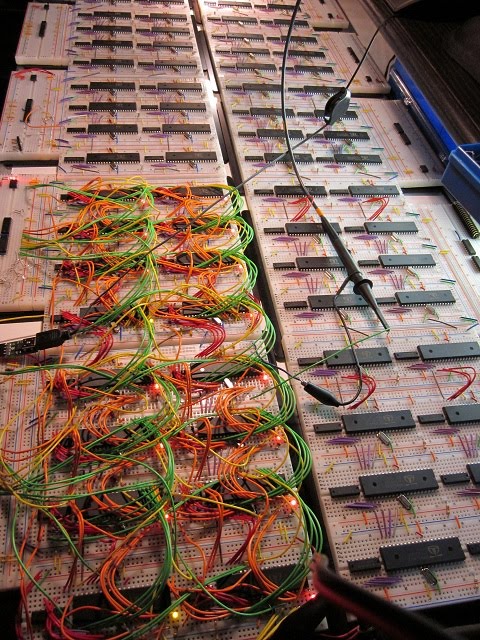
Photo montage shows various views of a simple multiple Propeller chip ongoing project. It will morph into various configurations as new circuits are tested.
Price & Disclaimer
This is a pure hobby project for my personal enjoyment and use only, and is not for sale. If the project does not satisfy your requirements, keep in mind that it was not intended to do so. This is not a product, and the descriptions are offered as is, in whatever degree or lack of degree of completeness for your inspiration and ideas. Good luck!
Form Factor
The UltraSpark 40 easily fits onto a desktop with its small form factor. The space between the Proto Boards is reduced using smaller 5/8-inch spacers. For size comparison, the IBM ThinkPad is the black object under the SkyScraper.
SkyScraper (Tower)
The first Skyscraper took on this shape using 20 Parallax Proto Boards and nylon spacers to achieve a minimal 5/8" board-to-board spacing. Spacing is determined by the vertical height of the board's 1000uF electrolytic capacitor. The SkyScraper has three sides of the board supported. The open end allows more easy routing of wires and cables (not shown in these early pics).
UltraSpark 40 Specifications
40 Props DIP Mix with SMT, Model Number: P8X32A-D40
320 Tiny RISC Computers
Processor/cog/small risc computer Per Chip: Eight
Architecture: 32-bits
Math: Integer and Floating Point
Standard System Clock Speed: DC to 80 MHz
Overclocked to 100MHz
Global RAM/ROM: 40x64 K bytes; 40x32 KRAM / 40x32 KROM
Cog RAM: 512 x 32 bits each x 320 cogs
1,280 ports
640 Counters
20 Dual Expanded Proto Boards with SMT Props
20 Socketed Prop DIPs
Hypered Stack Configuration
Socket Twins Concept
6.4 Billion IPS Standard (Instructions Per Second)
(40 props * 8 cogs * 20 mips = 6,400 MIPS, 6.4BIPS ~= 64MFLOPS)
8.32 Billion IPS Overclocked
(40 x 8 cogs x 26 mips = 8,320 MIPS. 8.32 BIPS ~= 83.2MFLOPS)
Computer Programming Languages approaching 200
Open Ambient or Compressor Cooling
Tiny Parallel Architecture
Computing Array: Parallel Clustering
IEX Technology Endowed
Ext PS Enabled
EEPROMs for Programming, Indexing
Reconfigurable Whole Cubes up to 6 x 6 x 6
Video 3.5-inch TFT LCD AV 4:3 Panel NTSC/PAL 320 x 240 Pixels 12V 3.5W
Terminals
Prop Terminal + special version of FemtoBASIC
Emulation
Emulators: TV, Mouse, and Keyboard
Compatibility/Expansion
HW Proto Boards
HW HYDRA
HW Propeller Demo Board
SW Prop Terminal (virtual keyboard, TV, mouse & keyboard)
SW Digital Storage Scope
OIT (Optics Interface Transceiver)
P-BUS (Prop BUS)
DEEPROM (Dual-EEPROMs)
FLEXPANDABLE (upward mobility path)
SIGNAL ROAMER (not confined to boards)
SKYSCRAPER Expanding F1, F2, F3 ... or B1, B2, B3 ...
Testing Various Designs
Multi-Interface MINT encompasses the chip to chip communications
Circuits for downloading one program into all the props (bootloader)
Path for maintaining 'across the Skyscraper' critical timing
Special oscillator to handle all mult props
Nominal RFI/EMI blanket shield
What is it for?
Hobby only (fun)
Pure Academics
Robots, Robot Control, Sensors
Education, Schools, Students, Educators
Tiny & Simple Parallelism Exampling
running benchmarks
new programming
developing new parallel programming languages
developing & testing new circuits
running many different programming languages
new experiments
exploring capability of 320 little computers running at the same time
developing new apps
robot brain
testing
multi-games
pushing the limits
testing and developing a small neural net
solving codes
New Algorithms
Currently an interest has developed in parallel and various algorithms which has led to some very interesting experiments and results.
Software & Wiring Criteria
Wiring is simplified
Wiring is easily changeable
Speed is maximized for the interface used
Interface facilitates loading all props at the same time
Interface handles frequency synchronization
Code handles identifications
Minimal power consumption is implemented
Interface is compliant with parallel programming and code
Wiring Real Estate Provided
Parts/Circuits are green configured
Software Download
Current software is available and can be downloaded at the Parallax Propeller OBEX. The UltraSpark 40 is a flexible machine and not confined to one design. However, if you want to duplicate the first fundamental design, most of the single wire serial interface drivers will work.
Schematic Download
The schematic that I used is the same as the BASIC Stamp Supercomputer and can be downloaded at that thread. A modification to the value of the resistor may be needed.
Hardware
The first setup included a wire bus in Daisy Chain mode that threaded all of the prop boards through pin 0 and the twin prop. Wire wrap technology is used because the twin prop can be removed and the board will be available for other configurations and recycling into larger projects. A front end prop experiment (one HYDRA) provides TV, Keyboard, game controllers, VGA, mouse, and numerous more capability.
Concept
There are two concepts for communicating internally - 1) the Master/Slave technique and 2) the deterministic approach. More information and examples are provided in the Handbook of BASIC Stamp Supercomputers. The BASIC Stamp Supercomputer uses the Master/Slave approach while the SEED Stamp Supercomputer uses Tiny AI. The UltraSpark 40 can run programs with either approach although different deterministic methods are used for the latter.
Photos & Wires
From a time standpoint, the first pics were taken immediately after the SkyScraper stack was built. This is different from the BASIC Stamp Supercomputer project that had hundreds or thousands of wires protruding. The first UltraSpark 40 design is much more lean and intentionally wired as compact as possible. At higher frequencies there is a consideration to keep wires shortened, and minimal. With overclocking and 100MHz frequencies, such wiring efficiency becomes more important.
Overclocking
I'm experimenting with overclocking and have some very good results. I've found that use of solderless breadboards is possible if the clock is not raised over 100 MHz. Wires need to be kept non looping and minimal length with proper gauge selected. Overclocking raises the current consumption dramatically. Be prepared to use a power supply that can handle the increased amps. If machines are built massively bigger than the UltraSpark 40 with overclocking, they may need to tap into adjacent rooms for power, like a kitchen and a living room for example.
Cryogenic SuperCooling
There's ongoing research and some experiments being developed for supercooling to around dry ice temperatures. Peltier devices are favored though other methods are being tested. More equipment is needed to make this self running. The Cryogenic chamber can be approximately the same as that of the ST4 Astronomical CCD Super Cooled Imaging camera sensor chip. Grouping chips and enlarging the chamber will benefit future designs. I may introduce Virtual CCD Cooling concepts across the Propeller chip.
Color Coding
Colored wire is coded throughout so if a wire falls off, it can easily be remedied by color grouping techniques.
Mixing Art & Science
As some have pointed out, projects may appear have a degree mix of art and science. It may be the way the photos are composed or the construction style of the device, or the way that it can be re-purposed. It's perfectly valid to style your projects by morphing together art and science.
Predecessor Machines
There are at least sixteen machines built before the UltraSpark 40. Each of these machines was utilized to test functions and lay the groundwork for a larger machine. Each project was recycled into the next larger machine. The list will be updated with historical data in a future post.
Demo Board for confirmation
HYDRA front end for mouse, keyboard, TV, VGA
PEK 1 prop on breadboard
2-Prop-Experiment 2 props, 1 PEK, 1 on same breadboard
Spark 2 2 props, 1 Proto Board, one in parallel, recycled for Spark 4
PIGGY-TWINS 2 props, one piggybacked on another
Dueling Breadboards 2 props, one on ea., f/interface tests
Spark 4 Tiny Tim 4 props 2 proto bds w/2 props on ea
Spark 5 5 props, 5 stacked proto boards, Spark 6 forerunner
Spark 6 6 props 3 proto boards 2 props on ea board, led to Spark 8
Spark 8, Tertiary ADJUNCT 8 props 4 proto boards w/2 props on ea
Propalot - 10 props on solderless breadboard, led to Spark 10
Spark 10, 10 props 5 protos 10 props total, Twelvenator forerunner
Twelvenator aka Board of Twelve, 12 props, green board
UltraSpark 15 15 props, interrupted stack Proto Boards
Tertiary 20 20 props, 15 proto boards stacked 5 props, photos
UltraSpark 20 20 props stacked, photos
MLEPS 25 props, boards/breadboards, stripped for UltraSpark 40
Additional Results & Ongoing Studies
Banking experiments
Loading techniques
New inventions (BIN)
PWR management
Horizontal forms
Adjunctive considerations
Forms of communication using LEDs (cheap)
Exploring advantages of FP processing and analysis
BUS expansion
Additional designs with COUNTERs
Chunk space signaling
How a neuron can be implemented
Recycling
(New!) Additions to the US40
Floating Point
Hybrid Integer and FP Mode
Addtl. Processor Functions
Addtl. States in Trinary
Speed Test
Languages
Guest Commentator
It is with great honor that we have comments from Forest Godfrey, a man who has worked on building the world's fastest Jaguar Supercomputer.
http://forums.parallax.com/showthread.php?t=125674&page=2
I like the "supermicrocontroller" name to describe Humanoido's tower. It's phenomenal at doing the things microcontrollers do well: controlling GPIO pins, talking low-level hardware protocols, controlling screens, etc. If your goal is to create a cool piece of microcontroller hardware that nobody else has and can control massive amounts of I/O, the Prop Tower is pretty darn sweet. I've been working to get us to use a Prop in our control paths. Forest Godfrey
Multiple Props Projects List
Add your multiple Propeller Project here
(updated Wed. Jan. 30, 2013)
Two Props Projects
Mindrobots 2 props, Propeller Slave attached to a QuickStart Proto Board, 2 Props running the same Forth images. Connected via 57,600 bps serial link. No channels between Propellers. Slave functioning needs a terminal session. Additional clusters built as needed.
http://forums.parallax.com/showthread.php?139751-Multi-Propeller-configurations-with-PropForth-v-5.0&highlight=SUPERCOMPUTER
Dr_Acula 2 props http://www.smarthome.viviti.com/prop....com/propeller http://forums.parallax.com/showthrea...reless-network
Bill Henning Morpheus - 2 props http://forums.parallax.com/showthrea...le-Prop-Design http://mikronauts.com/products/morph...ucts/morpheus/
Jazzed Propalyzer - 2 props piggyback http://forums.parallax.com/showthrea...for-Propalyzer Obrien 2 props on a solderless breadboard http://www.objectivej.com/hardware/p...ter/index.html www.objectivej.com/hardware/propcluster/index.html
Ale 2 props, communicate via 4 bit parallel bus (Beau's 4-bit sync protocol)
kuroneko 2 props, RAMBlade 104MHz on demoboard (80MHz), 5Mb/s XLINK
Electricsmith 2 props hardwired on PCB with 2 lines connected between each http://forums.parallax.com/showthrea...l=1#post928314
Humanoido 2-Prop-Experiment, 2 props, 1 PEK, 1 on same breadboard http://humanoidolabs.blogspot.com/p/genealogy.html
Humanoido Spark 2, 2 props, 1 Proto Board & one in parallel
http://humanoidolabs.blogspot.com/p/genealogy.html
Humanoido PIGGY-TWINS, 2 props, one piggybacked on another
http://humanoidolabs.blogspot.com/p/genealogy.html
Humanoido Dueling Breadboards, 2 props, one on ea., f/interface tests
http://humanoidolabs.blogspot.com/p/genealogy.html
Humanoido BRAIN IN A JAR, 2 props, 1 breadboard, 1 jar
http://humanoidolabs.blogspot.com/p/genealogy.html
http://forums.parallax.com/showthrea...73#post1014473
Clock Loop Prop Dual Big Boy, 2 props http://forums.parallax.com/showthread.php?t=124343
Harley 2 props, requiring more than 32 I/Os and 8 cogs, the master Prop talks to another pcb with keypad and 7-segment + dp LEDs at one baud rate, and comm with 2nd Prop is at a higher rate. This is an attempt to replace some 55 TTL ICs. nickL 2-prop Forth application http://forums.parallax.com/showthrea...Interest-Group
Three Props Projects
Cluso99 TriBlade - 3 props on a circuit board, props working discretely http://bluemagic.biz/cluso.htmbluemagic.biz/cluso.htm http://forums.parallax.com/forums/de...5&m=329999&p=1
Obrien 3 props stacking using Parallax Proto Boards Obrien 3 props on a solderless breadboard
Christian 3 props
drohne235 The Hive Project - 3 props http://hive-project.dehive-project.de http://forums.parallax.com/showthrea...puter&p=771392
Heater 3 props on a TriBlade
Clock Loop Prop BigBoy 3 props versionhttp://forums.parallax.com/forums/attach.aspx?a=45006 forums.parallax.com/forums/attach.aspx?a=45006
Duane Degn Multi Prop Laboratory – 3 props (2 wired + 1 wireless) Added new link! http://forums.parallax.com/showthrea...l=1#post927239 http://forums.parallax.com/showthrea...inuing-Project http://forums.parallax.com/showthrea...Machine-Vision Destructinator 3 props, 1 master + 2 slaves on a solderless breadboard http://forums.parallax.com/forums/de...5&p=2&m=472019
Loopy Byteloose 3 Propeller Stack http://forums.parallax.com/showthrea...Super-Computer
kbash & Missouri Automation - 3 props, Multipropcom three Propellers on one circuit board communicate with each other using only two pins each http://forums.parallax.com/showthrea...-communication
Four Props Projects
Clock Loop BlackBox Sequencer - 4 props http://forums.parallax.com/forums/de...?f=25&m=364607
Obrien 4 props on a solderless breadboard Obrien 4 props proto board stack
Humanoido Spark 4, Tiny Tim, 4 props, two proto boards w/2 props on ea
http://humanoidolabs.blogspot.com/p/genealogy.html
Humanoido Tiny Tim, 4 props, experimental wiring platform
http://humanoidolabs.blogspot.com/p/genealogy.html
Jazzed TetraProp, printed circuit board with 4 props http://forums.parallax.com/showthrea...eady-to-ship-!
Five Props Projects Obrien 5 props running off a single eeprom
kuroneko 5 props capacity, SpinStudio + 4 M-Modules + 1x1 PropMods
Clock Loop Prop BigBoy, 5 props version http://forums.parallax.com/forums/attach.aspx?a=45021 http://forums.parallax.com/forums/de...?f=25&m=473764
Humanoido Spark 5, 5 props stacked Proto Boards, Spark 6 forerunner
http://humanoidolabs.blogspot.com/p/genealogy.html
Brian Riley 5 props Multi-Prop PF5. PPUSB slaved to an original PP, both running EEPROM kernel, the PP has two 512 EEPROMs and the USB has one
Six Props Projects
Cluso99 - SixBlade - 6 props with two boards
Humanoido - Spark 6, 6 props 3 proto boards 2 props on ea, led to Spark 8
http://humanoidolabs.blogspot.com/p/genealogy.html
Seven Props Projects
Clock Loop - Prop BigBoy, 7 props version http://forums.parallax.com/forums/attach.aspx?a=45020
Mikediv - Quasi-Prop Tower, 7 props version http://forums.parallax.com/showthrea...Super-Computer
Eight Props Projects
Obrien - 3-dimensional Hypercube, 8 props, 32 cores @ 4 per chip http://www.objectivej.com/hardware/p...ter/index.html http://www.leonheller.com/Propeller/...OM_files/a.htm
Jazzed - OctoProp 8 stacked props Humanoido - Spark 8, Tertiary ADJUNCT, 8 props 4 proto boards 2 props on ea
Nine Props Projects
Clock Loop - Prop BigBoy, 9 props version http://forums.parallax.com/forums/attach.aspx?a=45023
Ten Props Projects
Humanoido - Propalot - 10 props on solderless breadboard
http://humanoidolabs.blogspot.com/p/genealogy.html
http://forums.parallax.com/showthrea...palot&p=890215
Humanoido - Spark 10, 10 props, 5 proto boards, 10 props total
http://humanoidolabs.blogspot.com/p/genealogy.html
Humanoido - TTB Test Bed of Ten, 10 props single board
http://humanoidolabs.blogspot.com/p/genealogy.html
Twelve Props Projects
Clock Loop 12 props, 3 black box sequencers in sync, each sequencer has 4 props
Humanoido - Twelvenator, aka Board of Twelve, 12 props on green board
http://humanoidolabs.blogspot.com/p/genealogy.html
DaveJenson - Test Station, 12 Props, 10 temp sensor boards talk to Master http://forums.parallax.com/showthrea...=124172&page=3
Thirteen Props Projects
BTX 13 props, one master + 12 slaves, hand assembled boards http://forums.parallax.com/showthrea...r-board./page2
Yoichi Nagashima Shizuoka U, 13 Props, Dodeca Prop, 2 displays, 12 video monitors in SUAC
Fifteen Props Projects
Humanoido UltraSpark 15, 15 props, interrupted stack Proto Bds, photo available
http://humanoidolabs.blogspot.com/p/genealogy.html
Seventeen Props Projects
BTX - Multi Propeller Board 17 props, One is: Master - Keyboard - Video Out - SD card reader. And 16 slaves. http://forums.parallax.com/showthrea...r-board./page4
TWENTY & OVER PROPS
Twenty Props Projects
Humanoido - Tertiary 20, 20 props, 15 proto boards stacked 5 props, photos
http://humanoidolabs.blogspot.com/p/genealogy.html
Humanoido - UltraSpark 20, 20 props stacked, photo, used for MLEPS
http://humanoidolabs.blogspot.com/p/genealogy.html
Humanoido - Boe-Bot Brain Project, 20 props
http://humanoidolabs.blogspot.com/p/genealogy.html
Twenty-One Props Projects
Humanoido - iBrain 21 Propeller boards, 168 Propeller Cogs, still growing
http://humanoidolabs.blogspot.com/p/genealogy.html
TWENTY-FIVE PROPS & OVER
Twenty-Five Props Projects
Humanoido - MLEPS Super Language Machine, 25 props
http://humanoidolabs.blogspot.com/p/genealogy.html
Twenty-Eight Props Projects
Clock Loop - Prop BigBoy, 28 props on breadboards http://forums.parallax.com/showthrea...=124343&page=3
Forty Props Projects
Humanoido - UltraSpark 40 Supermicrocontroller, 40 prop tower, 320 cores, 6,400/8,320 MIPS
http://humanoidolabs.blogspot.com/p/genealogy.html
http://forums.parallax.com/showthrea...raper&p=921524
Humanoido - Boe-Bot Largest Brain 40 props, 321 processors total http://forums.parallax.com/showthrea...oeBot&p=922262
FIFTY PROPS & OVER
FIFTY-FIVE PROPS
Clock Loop - The Perturbation Machine http://forums.parallax.com/showthrea...ns55-Propeller
A machine with 1 master and 54 slaves, "432 cores, 1620 I/O, 150Kbps communication, word enumeration, 54 randomly generated IDs, To study the nature of randomness in a digital processor network using the same clock source, 54 prop chips were all connected to a master prop. I like having 1,620 I/O at my fingertips. To study the nature of randomness in a digital processor network using the same clock source, 54 prop chips were all connected to a master prop. The master prop holds the eeprom, and accepts prop plug input for memory/program download. The master prop controls the reset and clock lines for all 54 props. The master prop also sends all combinations of a word out broadcast to all 54 props that are connected bus network style.
When a slave prop sees its number broadcast on the bus line, it replys with the same number. Then the slave prop runs code depending on the number broadcast. Its possible to broadcast messages to all props, or single props, after the initial enumeration is done. Repeats are possible in any system that has reduced choices and increased speeds. If repeats are a worry, then a long sized variable should be used in the random ID generation. Enumeration of the Randomly generated ID's. Every step up in variable size reduces the speed that the whole system can communicate at due to more data being sent over the same speed pipe. The communicaiton speeds of the bus network can be increased with lower value resistors, but the power draw will increase, if the props are connected to the bus with lower values, one needs to adjust all other bus resistors in relation.
Having? You take 55 props, some programming (attached), a bag of 470 ohm resistors(500) (not attached), a 3.3v regulator (2A), a huge breadboard, wire, 57 leds. Using the Real Random object in the obex created by Chip Gracey. This object generates real random numbers by stimulating and tracking CTR PLL jitter. It requires one cog and at least 20MHz. 432 cores, 1,620 I/O, 64.8 A max peak draw - 10.8A continuous, @3.3v. 150kbps - communications using the same rx/tx lines for programming all 54 props. Word location enumeration of 54 randomly generated ID's"
ONE-HUNDRED PROPS
Humanoido Propeller Big Brain, 100 props (Build time = 1 Year)
http://humanoidolabs.blogspot.com/p/genealogy.html
http://humanoidolabs.blogspot.tw/p/t...nformatin.html
The first working massive Machine Brain with 100 Parallax Propeller chips. Designed to explore machine intelligence. Reached Semi-Cognizant state in 2011.
The 800-Core Big Brain is a simple fun hobby project to run experiments and play with endless possibilities. Approximately 16,000 MIPS and 3,200 I/O ports. 3 Partitions - the 3rd is a Magic Floating Partition - holds any number of props from 1 to 50, allows removal & loan to other projects.
Talk, sing, dream, learn, evolve, demonstrate Life, color TV, hearing, speech recognition, keyboard, mouse, 2 LCD displays, host boards, compatibility (Stamps, Props, PCs, Macs), sound out, mic in, stomach, Brain Base, Brain Spans, Brain Stem, EXOskeleton, multiple languages, over 100 x 64K distributed RAM/ROM, LED enabled, crystal/EEPROM supported, Mac/PC support computers,
3 TeraByte hard drives, Neural Matter Injector syncs & load props in parallel. Developed ParaP, AtOnce, EnhancedChip technologies - parallel-parallel operations, loading @ once, increase p^N, inject 100,000 Simplex Neurons. Expanding Array. Created modest RTOS - handles cogs, loading, timing, neural matter distribution.
Cloning. Executes all-chip-multi-enumeration in a second. Expanding Arrays. HYBRID interface (Serial Communications, Daisy Chain Token Ring Topology, Prop to Prop, Parallel), RI Reduction Interface, AE Automatic Enumerator, Waveform Reliability Filter, No Parts Technology to reduce cost.
Addendum: Many Spinoffs. New Big Brain Index:
http://humanoidolabs.blogspot.tw/p/index.html
[The Big Brain was upgraded to include an open Partition and was expanded with more props]
Humanoido 100 props. RX Propeller Supercomputer. A Supercomputer made from 100 Propeller chips. This distributed parallel machine with 800 RISC computers qualifies as a retro supercomputer circa 1990s. With 1,600 Counters, 3,200 I/O, 6,400 K Bytes RAM/ROM, 16,000 MIPS theoretical. Proposed Propeller Supercomputer Kit with Schematic Diagram, Enumerator, Parallel Loader, Operations Algorithm, Applications Outline, Instructional PDF... RX Propeller Supercomputer
OVER ONE-HUNDRED PROPS
Humanoido Over 100 props, variable, 100+ Hybrid Parallax Propeller Supercomputer, completed, upgrade to the Big Brain. The most powerful TeraFLOPS machine at Humanoido Labs. Made by Humanoido. Reached equivalent supercomputing speed in 2012 comparable to the Top 500 List. Massive design with all available props exceeding 800 Propeller RISC processors and 729 Intel and AMD processors and 100,000 VIP Processors. Currently reached the 12th level. Utilized for the Ultra Space Program, Brain Enhancement and AI Projects. More Specs and Information at:
http://humanoidolabs.blogspot.tw/p/specs.html http://humanoidolabs.blogspot.tw/p/index.html http://humanoidolabs.blogspot.tw/201...brain-era.html http://humanoidolabs.blogspot.tw/p/this-is-about-informatin.html
Numerous other massive Propeller based machines listed here.http://humanoidolabs.blogspot.com/p/genealogy.html
Works in Progress
Michael O'Brien OBrien Labs: Distributed Parallel Processing
Target goal = 80 Props / 640 cores. "80 Parallax Propeller 8-core microcontroller based parallel processing computer in progress... And now we start the process of getting an 80 propeller chip / 640 core multiprocessor working. Why 640 cores?
In early 2008 i became increasingly interested in hardware based parallelism. The majority of the design and defect issues we are seeing in enterprise software tools development involve concurrent processes and how to fully utilize available cores in existing and future systems. Parallization of software is a huge problem, i decided to approach this from the additional view of "bottom-up" engineering - by designing and writing "architecture-aware" simple systems to start.
A "base-case" architecture would initially do away with microprocessors all together and design a purely parallel machine with very simple cores - like a 1-bit symbolic ALU consisting of a few logic gates. We could realize this custom machine using standard (since the 70's) TTL HSCMOS chips or even a single FPGA. The parallizable algorithm of choice is cellular automata for a symbolic machine or the Mandelbrot set for a floating point machine - we will implement the 256 function/1-dimensional/2-state Wolfram CA in hardware for our first base case parallel machine.
The PCAM implements a boolean function of 3 variables (left,center and right cells on a cell array) - this function has 2^2^n states or 256. This 8 bit byte fits very nicely in the 74 TTL logic family as a single 151/251 data selector can be used as the core of each ALU. Before I start the process of designing modular 2-8 chip boards for a near production prototype - my workspace does not fit more than 40 breadboards on a what - a whiteboard.
We will be encountering issues like power/voltage loading, parasitic capacitance, TTL-HSCMOS fanout and placing at least 4000 wires. Not to mention the hardest part of the process - the software. Here is part of our 80 propeller 640 core propeller multiprocessor prototype in progress - see you in a couple months. You can follow progress of the kilocore prototype on the kilocore.blogspot.com blog."
Laser-Vector 2-props, establish wireless data link over long distance
Bigfoot computer designed physical cube of 6 SMT props - not built
Duane Degn Multi Prop Lab, 6 props (4 wired + 2 wireless), design only http://forums.parallax.com/forums/?f...474065#m474065
Mctrivia CAD Designed a breakaway board for 8 SMT props http://forums.parallax.com/forums/de...?f=25&m=429487
Obrien The photo at kilokore web site shows partial assembly of 68 props being wired on breadboards. We await more information and details. According to Obrien, he is using the techniques developed by Clock Loop. http://www.kilocore.com/ http://www.objectivej.com/hardware/p...etion_640h.jpg
Mctrivia propComputer, idea for 7 props on one board http://forums.parallax.com/showthrea...ers-on-1-board.
Cluso99 - pcb, 10 x TriBlades count as 30 but never actually built. The TriBlade pcb was built as 2x5 panels of TriBlades and are broken apart later. http://www.cluso.bluemagic.bizwww.cluso.bluemagic.biz
Cluso99 - pcb, 10 x RamBlades count as 10 but never actually operated. The RamBlade pcb was built as 2x5 panels of RamBlades and are broken apart after assembly. http://www.cluso.bluemagic.bizwww.cluso.bluemagic.biz)
Jazzed - multiprop pcb. IIRC, 30 prop pcbs on a panel
Clockloop Huge Propeller Grid - target goal 504 props / 4032 cores
http://forums.parallax.com/showthread.php/127983-55-Parallax-Propeller-s-Parallells-Processing-of-Permanent-Perturbations./page2
And now I reveal the point of designing this huge propeller grid.
A.C.S.E.R. Structure complete, wiring/soldering/programming up next. Dec 21st 2012, target completion date, confirmed. Initiate phase 2: soldering minimal antenna and firmware design for hydrogen resonance test. This initial design will require a minimum of 42 propeller chips, with a desired target of 84 chips. After tests with 84 chips, the next step up is to install and wire the maximum # of 504 prop chips. Yes, the final design will require 504 propeller chips. = $4,000.
Once the inital 42 chips are soldered and the system is working, and I have a running program, I will start a new thread in projects outlining the details of this device, its capabilities, tests, methods, schematics, pcb design files, spin programs, and more detailed video and images. The most important part of documentation will be the success or failure of this device to actually do what I intend it to do. It’s (very likely) possible that other uses will be found as I start to test with it.
Humanoido The Blitz Krieg. The most massive and ultimately powerful multifunctional Propeller machine ever designed at the Humanoido Labs Universe. Over 100,000 processors. Designed as a new generation Propeller-chip-based thinking machine that exceeds previous ratings. BK has greater design, creativity, speed, function, size, app capability, and number of processors. Allows exploration into the farthest frontiers of machine intelligence. Designed with previous processor enhancements and the inclusion of recent technology from HLU.
Contributors
Ale
Bigfoot
Bill Henning
Brian Riley
BTX
Christian
Clock Loop
Cluso99
DaveJenson
Destructinator
Dr_Acula
Drohne235
Duane Degn
Electricsmith
Harley
Heater
Humanoido
Humanoido Labs
Jazzed
Kbash
Kuroneko
Laser-Vector
Loopy Byteloose
Mctrivia
Mikediv
Michael O'Brien
Mindrobots
Missouri Automaton
Nglordi (nickL)
Yoichi Nagashima