Big Brain & Humanoido Merge Q&A Part 2
Last time we expected to handle questions regarding USB port, power requirements, spin off tech such as uploading things to a human brain that one would learn in school, a new way of space travel, how to teleport, and the addition of experiences and sensory information. Now let's continue the interview with Humanoido...
First, an update to the question about pain from the surgical interface implants into the human side of the body. In some cases there are small protruding sections of the machine sticking out of the human body and at night, moving around to attempt sleep is a sometimes difficult prospect as the devices are poked, pinched, bumped and weight is distributed in those locations in non-even ways. This can cause some very sight pain twinges but so far it's mostly insignificant and nothing to be alarmed about.
Q - How is the power handled?
A - On the human side, an implantable battery supplies micro-current to the interface beneath the flesh and on the machine side, a USB port charges the Cyborg components.
Q - What is the potential spin off of this technology?
A - I believe in the future, to learn a process such as Kung Fu, or Social Studies, you will simply upload a package for instant neural learning. This new type of learning will make schools obsolete for humans with the full range of Cyborg enhancements and enough installed memory to handle all the data.
Q - What are some new things being developed at Humanoido Labs in regard to this new man and machine merging?
A - We want to upload more than just numerical and image data. The system could be expanded by the upload and download of feelings, emotions, thoughts, dreams, memories and other sensory perceptions.
Q - How does this effect space travel?
A - Merging a human with a machine allows the brain and other parts of the human to enjoy teleportation beaming, through laser light, to other planets and places in the solar system, and to new star systems, all at the speed of light. This could obsolete rocket space travel.
to be continued...
BIG BRAIN made by Humanoido is a giant intelligent AI machine. Over twenty years in the making, living and sentient, approaching one trillion processors/constructs. Join us in the exciting adventure as it continues to evolve!
Showing posts with label part 2. Show all posts
Saturday, November 16, 2019
Big Brain & Humanoido Merge Q&A Part 2
Saturday, January 14, 2017
Genealogy Part 2
GENEALOGY PART 2
Genealogy Part 1 has filled up with 1,076 documented Humanoido inventions, so part 2 will continue where Part 1 left off. An estimated 2,000 inventions were created and the Genealogy Project is designed to retrace the history of each. In the meantime, the documentation should continue with recent entries.
New Inventions Introduced
Mobile Brain
http://humanoidolabs.blogspot.tw/2017/01/mobile-brain.html
The purpose of Mobile Brain is to demonstrate the characteristics of a thinking brain (from Brain in a Jar) that has the power of mobility (from BoeBot) with an added PING ultrasonic sensor and the ability to change positions for different viewpoints.
Genealogy Part 1
http://humanoidolabs.blogspot.tw/p/genealogy.html
Humanoid Robots Site
Space1 Site
Space1 Index
Big Brain Site
Big Brain Index 1
Big Brain Index 2
Big Brain Timeline
Big Brain Contributions
Genealogy Part 1 has filled up with 1,076 documented Humanoido inventions, so part 2 will continue where Part 1 left off. An estimated 2,000 inventions were created and the Genealogy Project is designed to retrace the history of each. In the meantime, the documentation should continue with recent entries.
New Inventions Introduced
Mobile Brain
http://humanoidolabs.blogspot.tw/2017/01/mobile-brain.html
The purpose of Mobile Brain is to demonstrate the characteristics of a thinking brain (from Brain in a Jar) that has the power of mobility (from BoeBot) with an added PING ultrasonic sensor and the ability to change positions for different viewpoints.
Genealogy Part 1
http://humanoidolabs.blogspot.tw/p/genealogy.html
Humanoid Robots Site
Space1 Site
Space1 Index
Big Brain Site
Big Brain Index 1
Big Brain Index 2
Big Brain Timeline
Big Brain Contributions
Sunday, July 14, 2013
Propeller Simple Spin Board Part 2
![]() |
| Schematic: Simple Spin Board |
SIMPLE SPIN BOARD
PART 2: Updated schematic, more simple software, 1st circuit to run at low power
If you missed Part 1 of the Propeller Simple Spin Board, find it at this link:
Propeller Simple Spin Board
A More Simple Program
Here's a program with 5 statements instead of 7 to blink the LED on pin 15. Later we will show a program with only 4 steps in Spin.
FIRST MOD DISABLING THE BROWNOUT DETECTOR
In this first modification to the Propeller Simple Spin Board, the connection from BOEn to Ground is removed. Insert a new connection between BOEn and Vdd. This will disable the brownout detector by connecting it to high, and prevent the board from resetting at 2.7 volts or less. (not shown on schematic)
I can't seem to disable brown out detection, if I connect BOEn to Vdd even at 3.3v the Prop won't do anything.
Put an external pullup on RST (a 220 ohm resistor from RST to VDD).
When BOE Brown Out Enable is grounded, the Propeller chip has an internal pullup activated. When BOE is held high, the internal pullup is not active, and an external pullup is required on RST to restore functioning.
VOLTAGES
I can't seem to disable brown out detection, if I connect BOEn to Vdd even at 3.3v the Prop won't do anything.
Put an external pullup on RST (a 220 ohm resistor from RST to VDD).
When BOE Brown Out Enable is grounded, the Propeller chip has an internal pullup activated. When BOE is held high, the internal pullup is not active, and an external pullup is required on RST to restore functioning.
VOLTAGES
The Propeller Simple Spin Board is capable of operations at voltages much lower than 3.3, 3.0 or 2.7 volts and disabling the brownout detector BOEn will make this possible. This will allow longer battery operations as the voltage drops down, and running on tiny pen cells, watch batteries and other low power sources. How low can you go below 2.7 volts? This is left as a student exercise. A new schematic will reflect this change. For more information
http://tymkrs.tumblr.com/post/116554...pins-explained
Q&A Section
Q&A Section
Q - I can't seem to disable brown out detection, if I connect BOEn to Vdd even at 3.3v the Prop won't do anything.
A - Put an external 220 ohm resistor pullup from RST to VDD. When BOE Brown Out Enable is
grounded, the Propeller chip has an internal pullup activated. When BOE
is held high, the internal pullup is not active, and an external pullup
is required on RST to restore functioning.
Saturday, July 6, 2013
Propeller Spin Brain Part 2
MORE ABOUT THE SPIN BRAIN
PROPELLER SPIN BRAIN PART 2
"The Spinning Brain"
Continuing with our previous edition about the Spin Brain, we will look at five Parallax Propeller chips connected together to make a new type of processing machine, examining more elements and specs about this cute little machine.
In this Edition of The Spinning Brain, we will cover
- 5 Chip Inventory
- Processors
- Speed Units
- Related Links
CHIP INVENTORY
Five chips provide for the following useful elements of functional inventory:
5 Chip Inventory
* Five AI individuals (5 chips)
* 40 Deterministic Cores (5x8 Cogs)
* 160 GPIO Pins (5x32)
* 160K RAM (5x32K)
* 160K ROM (5x32)
* 80 Counters (5x16)
* 40 Video Generators (5x8)
* 13,600 MIPS (5x2720 Theoretical)*
* 160 Hard Processors (5x32)
* 5,000 Vprocessors (5x1,000)
* 5,160 Total Processors (5,000+160)
* SPIN, PASM Programming Languages
PROCESSORS
Each Cog is a RISC processor and each chip has eight. Each counter is a processor with exactly one instruction: a conditional ADD. A chip has 16 counters. Each video generator is a processor with one instruction: a Shift by one or two. A chip has eight video generators.
Processors per Chip
08 Cogs
16 Counters
08 Video Generators
32 Total Processors per chip
SPEED UNITS
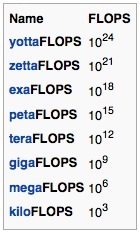
MIPS - Millions instructions per second
DFLOP - D stands for ten (DECA)
HFLOP - H stands for hundred (HECTO)
KFLOP - K stands for thousand (KILO)
MFLOP - M stands for million (MEGA)
GFLOP - G stands for billion (GIGA)
TFLOP - T stands for trillion (TERA)
13,600 MIPs is 13,600,000,000 IPS or 13.6 billion instructions per second, related to 13.6 GFLOPs. In going from 5 chips to 100: 20x13.6=272 GFLOPS.*
* Note this is a relative theoretical comparison from one Propeller chip to a series of Propellers within the contextual definitions we have established for one chip, and is not intended as a comparison to other machines with other designs.
LINKS
Spin Brain
Supertronic Spin Brain
FLOPS
Parallax
Propeller Info
Propeller Chip
PROPELLER SPIN BRAIN PART 2
"The Spinning Brain"
Continuing with our previous edition about the Spin Brain, we will look at five Parallax Propeller chips connected together to make a new type of processing machine, examining more elements and specs about this cute little machine.
In this Edition of The Spinning Brain, we will cover
- 5 Chip Inventory
- Processors
- Speed Units
- Related Links
CHIP INVENTORY
Five chips provide for the following useful elements of functional inventory:
5 Chip Inventory
* Five AI individuals (5 chips)
* 40 Deterministic Cores (5x8 Cogs)
* 160 GPIO Pins (5x32)
* 160K RAM (5x32K)
* 160K ROM (5x32)
* 80 Counters (5x16)
* 40 Video Generators (5x8)
* 13,600 MIPS (5x2720 Theoretical)*
* 160 Hard Processors (5x32)
* 5,000 Vprocessors (5x1,000)
* 5,160 Total Processors (5,000+160)
* SPIN, PASM Programming Languages
PROCESSORS
Each Cog is a RISC processor and each chip has eight. Each counter is a processor with exactly one instruction: a conditional ADD. A chip has 16 counters. Each video generator is a processor with one instruction: a Shift by one or two. A chip has eight video generators.
Processors per Chip
08 Cogs
16 Counters
08 Video Generators
32 Total Processors per chip
SPEED UNITS
MIPS - Millions instructions per second
DFLOP - D stands for ten (DECA)
HFLOP - H stands for hundred (HECTO)
KFLOP - K stands for thousand (KILO)
MFLOP - M stands for million (MEGA)
GFLOP - G stands for billion (GIGA)
TFLOP - T stands for trillion (TERA)
13,600 MIPs is 13,600,000,000 IPS or 13.6 billion instructions per second, related to 13.6 GFLOPs. In going from 5 chips to 100: 20x13.6=272 GFLOPS.*
* Note this is a relative theoretical comparison from one Propeller chip to a series of Propellers within the contextual definitions we have established for one chip, and is not intended as a comparison to other machines with other designs.
LINKS
Spin Brain
Supertronic Spin Brain
FLOPS
Parallax
Propeller Info
Propeller Chip
Saturday, June 1, 2013
May Update Part 2
![]() |
| Big Brain section with self monitor |
The Lab’s last May update was on the 20th. This update covers May 21 to May 31, 2013.
May was a fantastic month with 42 science postings at the blog site and it included the construction of four powerful telescopes (GGT, SRT, MMT, IET) and several new machines (Gravatomic, Molecular, Inference, Alternate Reality).
NEW TELESCOPES CONSTRUCTED
GGT - Gargantuan Gravatomic Telescope
SRT - Space Recycler Telescope
MMT - Molecular Mining Telescope
IET - Inference Engine Telescope
NEW MACHINES CONSTRUCTED
New machines constructed in May included Gravatomic, Molecular, Inference, and Alternate Reality. The AAR Machine can see alternate realities.The Gravatomic Machine was pipe fit onto the GGT Telescope to see objects in gravatomic constructs. The Molecular Machine was fit on the MMT to see objects in molecular transformations (see links below). The Inference Engine was developed for elements of idea, creativity, vision, innovation, reasoning, interpolation, extrapolation, and running experiments to explore the sixth dimensional element of Imagination Power.
NEW TECHNIQUE
Also invented is AAR Machine Projected Control Mapping from a boiler face plate to the actual functions for operating the Altercated-Alternated Reality Machine (AAR). This method will be adopted for future machines, especially Procedural Machines.
NEW CONTROLS
New controls were developed for the AAR.
AAR Machine New Controls Arrangement
AAR Control Boiler Plate
AAR Machine Projected Control Mapping
AAR Reality Machine Controls Developed
RELATED LINKS
INFERENCE
IET Inference Engine Telescope First Light
IET Inference Engine Telescope Construction
New Expert Inference Engine
IET Telescope Greatest Journey
Inference Engine Icon
GRAVATOMIC
Age of Gravatomic GGT Gargantuan Gravatomic Telescope
Gravatomic Machine
First Light GGT Gargantuan GravAtomic Telescope
MOLECULAR
MMT Molecular Mining the Cradle of Stars MMT Horsehead Nebula Wide View
Genius Molecular Microscope GMM
MGT Molecular Genius Telescope
MMT Molecular Strip Mining
Interface Molecular Stage Cascader & PGT Telescope
ALTERNATE REALITY
Altercated Alternated Reality Machine
Generating Altercated Alternated Reality
AAR Altercated Alternated Reality Machine Establishment
POSTS FROM MAY 21 TO MAY 31
Machine Variety
AAR Altercated Alternated Reality Machine
AAR Alternate Reality Machine Added Controls
AAR Machine New Controls Arrangement
Lab Machine Type
AAR Control Boiler Plate
AAR Machine Projected Control Mapping
AAR Reality Machine Controls Developed
AAR Altercated Alternated Reality Machine Establis...
Strange Things about Living in a Foreign Country
MMT Molecular Strip Mining
MMT Horsehead Nebula Wide View
Propeller COSMAC ELF II Annexes the Future
Seeing the Future
Extremely Powerful Telescopes Update
MMT Molecular Mining Telescope Horsehead Nebula
Altercated Alternated Reality Machine
Generating Altercated Alternated Reality
IET Telescope Greatest Journey
IET Inference Engine Telescope First Light
IET Inference Engine Telescope Construction
New Expert Inference Engine
Inference Engine Icon
Humanoido Lab May 2013 Update
Friday, July 6, 2012
SEED Supercomputer Part 2
![]() |
| SEED BASIC Stamp Supercomputer SBS stages |
PART 2
APP Notes - GOING WIRELESS
These are images of the first version Bstat Base Station. This test unit includes a Parallax wireless radio frequency transmitter and receiver, a piezo speaker, and various test circuits in place that will be used for switches and controls.
![]() |
| SBS BSTAT adds wireless radio control to BASIC Stamp Supercomputers |
The BSS is all about the entire range of BS2's and their advantages, and
the SBS is all about the BS1 and its advantages. With the new SBS,
compared to the other peripherals, the 20ma draw of a green screen was
very heavy, and it's offered as an option.
With this project, the purity of the BS1 is maintained, the learning experience shows that it has good advantages. Even the remote base Bstat which
communicates wirelessly with the SBS has a BS1 for a heart and it
drives audio, radio transmitters, receivers, switches, LED, same as what
a BS2 or Propeller can do. Anyone, of course, can build the SBS project
and add a Propeller chip board as an upgrade, with TV, mouse and
keyboard.
![]() |
| Views of a fully operational SBS supercomputer |
It's interesting how many people have now strung together Stamps, and Propeller Chips, to make supercomputers. It is not surprising that many doing this with the Propeller Chip are playing catch-up with the software to utilize the hardware. Both are very important considerations and must have a perfect marriage to harmoniously accomplish work. I would suggest starting with Basic Stamp projects and then working up to the Propeller chips, mainly to gain some experience working with Stamps at a more fundamental level and to create some working systems that have minimal development time, and especially since one can now follow the plans posted in the Forum. With the second Stamp Supercomputer, the hardware is well established and one may either use existing software examples or concentrate on developing all new software, as is accomplished with SEED.
Minuscule Stamp Supercomputer
Announcing a Minuscule Stamp Supercomputer. Mainly for testing this project. It's the smallest qualifier for a Stamp Supercomputer. Start with two and go up. Details and function, plus working transmitter and receiver serial software:
humanoido
STAMP TINY AI SOFTWARE
The stamp ai code is now posted in the software section of this series
of postings. Stamp AI is one program that gives life to the Stamp SEED
Supercomputer using only 256 bytes and less than 100 code statements.
The same code evolves in each of the ten computers, they are born,
unique personalities arise, they may get to know their neighbors, nap,
sleep, dream, have memories, are self aware, deterministic, do work,
thinking, and finally go into suspended animation with a heart beat
every 2.6 seconds at 25 ua.
Schematic
The schematic now posted into page 1 of this post series - includes details
for all utilized ports and lines, power distribution, enumeration
circuits and the Parallax transceiver for wireless communication. This
runs stamp ai.bs1 software, also posted, and is the Worlds 1st Living Stamp Supercomputer.
Life Forms
Each stamp computer is a life form. However, a single life form could
result by combining all individual life forms. The code is nearly maxed
out, but includes enough space for a few more statements such as the
Piezo Language expansion or other ideas. The code makes no significant
effort to compress so there's plenty of room to gather up more
programming space. Note the schematic is fully detailed and simplified so that any reasonably versed person can build it. Comments are welcome.
How stamp_ai.bs1 code works
“Stamp AI gives a living soul to small Stamp microprocessors”
By Humanoido July 2009
Stamp SEED Supercomputer! All new! This is a ten core, ten month project, with the 1st Stamp AI software to fit into 256 bytes eeprom - self determinate, evolving, enumerating, dreaming, poetic, noisy, talkative, and downright friendly. It runs on only one program that self evolves differently in each of the ten computers. It's evolutionary - it's revolutionary! http://forums.parallax.com/forums/default.aspx?f=21&m=361377&p=1 Load stamp_ai.bs1 into all ten computers. Connect to the computer you want to monitor and load the code. Turn off the entire supercomputer when the blue debug screen appears (before any words appear on the screen). Now turn on the supercomputer. The debug screen will show the thinking of the computer it is connect to. This is the viewer. It shows what the life form is thinking and doing. It even shows dreams. All life forms are unique and develop individual personalities. There is an unseen birthing process that takes place. This is the DNA part of the program, with directives, declarations, and initializations. Then, introduction takes place. Suddenly, evolution begins. The life form looks at pin 1 from which it determines its own unique identity, using a resistor capacitor circuit. Next, the unique identification (self enumerating) is used to determine its computer number and its physical location to know which block it lives on. The supercomputer is divided into ten blocks, computer 1 lives on the lowest block while computer ten lives on the top block (deterministic). This personal information is committed to memory. There are two memory locations, 0 and 1, designated for the id and computer number. Throughout the life of the entity, this information is remembered and recalled. Now the life form will take a series of naps. The NAP number is 0, which represents 18 milliseconds. In between each nap, there is a dream. Dreams are pseudo random in nature and occur in Vers Libre, a kind of abbreviated poetic verse.
Dreams also include numbers and their pseudo random bit representation. Dreams are unique because they are seeded with the unique personal id. After napping and dreaming, a deep sleep results. The length of sleep is directly related to the life form’s computer number. The lower computer number life forms have shorter sleep, while the higher number life forms spend more of their time sleeping. Sleeping can have cause and effect, because in the next waking phase, a life form will talk - call out and speak its personal information to its neighbors. These are the friendly ones. Whether neighbors hear this information depends on whether they are sleeping or awake. The lazy ones will miss the information. In the extreme case, life form 10 sleeps so much that he misses hearing all of his neighbors, and becomes somewhat of a hermit. His memory has little information. Life form one sleeps the least time, and as a consequence, knows all his neighbors and is very friendly. His memory is rich and filled with all the neighbors information. In the next phase of life, the memories about the neighbors are recalled. All of this appears on the viewer. Thinking and information always appear on the viewer. This is a unique privilege to see the life form’s thought process on the screen. No life form is complete without doing some work in life. Each life form will start talking about its computer number, identification, how many seconds it did sleeping, how many neighbors it heard, how many neighbors it missed hearing, and how many dreams it had. These life forms do not live long compare to humans. Their actual lives are approximately one minute long. At the end of a life cycle, hibernation takes place. This is a kind of suspended animation with a heart beat of once every 2.6 seconds. Memories and information are retained but there is no known way to retrieve it in this time era.
Personality galore! You’ll find these life forms interesting, unique and with varying personalities. The differences from one to the other include different identifications, different computer numbers, different dreaming, varied sleep times, some are friendly and some don’t know any neighbors. Some have filled enriched memories and remember all their neighbors while others can only remember two things and spend all their time sleeping. The code could have sufficient modification to prevent the life form from dying, and to create an indefinite hibernation in which it can wake up on demand. Instead of and END statement, the code could terminate in a continuous loop. Inside the loop, it looks at a pin status. If the pin goes high, the program can go back to some place in the code for continued function. Another way to preserve the life form’s state is discussed in the Stamp SEED Supercomputer Handbook.
Sometimes the life form will become sick and require personal sick leave. The sicknesses are varied. For example, the following maladies are discussed in further detail elsewhere – psychotic breakdown, fitful sleep, sudden death, brain amnesia, unable to resuscitate, alternate identity syndrome, stroke, epileptic pins, and stuttering.
The Handbook of BASIC Stamp Supercomputing
includes the Stamp Seed Supercomputer and additional information, projects, etc. Download it here.
Other Supercomputer Sources
- SEED Stamp Supercomputer (Self Evolving Enumerating Deterministic)
- BSS Basic Stamp Supercomputer
- TCS TriCore Stamp Supercomputer
- MSS Minuscule Stamp Supercomputer
- TSS Tiny Stamp Supercomputer
- M.O.M. Master Offloader Machine
- 2S 2-Stamp BSS (BS2sx + BS2px)
- AM Algorithm Machine
- Spring Projects
Software
Tiny AI for the Basic Stamp SEED Supercomputer
http://www.p-robot.com/index.php/ai-for-basic-stamp.html
Tiny AI for the TriCore Supercomputer
http://forums.parallax.com/showthread.php?114352-TriCore-Stamp-Supercomputer&p=822511#post822511
Subscribe to:
Posts (Atom)