Friday, February 10, 2012

Pure Thought

IS PURE THOUGHT WORK OR NO WORK?
Can a "thinking only" Big Brain or Propeller Elf do work? The scenario: a Propeller Elf is given a thinking program, as in calculating a non ending progression of numbers, that continues forever to think, as long as the power is applied within the closed system as a whole. It may become a pseudo perpetual motion or perpetual thinking machine. In this case, is work being performed? It depends on the program and the definition of work. Taking the Physics definition of work, a program that loops, and moves processor bits from point A to point B and back again, is doing no work at all, regardless of how many times it completes full loops. If the code moves processor bits from point A to point B which don't return, work is accomplished. In physics, mechanical work is a scalar quantity that can be described as the product of a force times the distance through which it acts, and it is called the work of the force. In the Prop Elf, the scalar quantity of bits that do mechanical work (become a 0 or a 1) traverse distance through the propagation of electrons in the chips substrate. The conclusion is, the Prop Elf may have two different types of thinking programs, one which is doing work and one that does no work, by definition. One thinking program can also terminate in one state or another, designating work or no work.

Reference
http://en.wikipedia.org/wiki/Work_(physics) If a constant force of magnitude F acts on a point that moves d in the direction of the force, then the work W done by this force is calculated W=Fd.

Thursday, February 9, 2012

Fake Prop

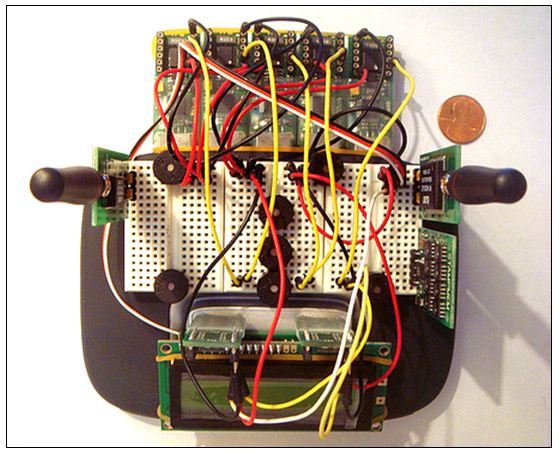
EXPERIMENTAL FAKE PROP MADE WITH BASIC STAMPS
Fake Prop during assembly

Sometimes you need to recycle a project to get more fun out of it. This is what happened with the TSS.

This fun project emulates simple exampling parallel functions of a Propeller chip by connecting together a cluster of Basic Stamp processors. Each Stamp represents one Cog, has its own operating program and communicates through a common BUS using PBASIC programming language. Output is to a built-in green screen LCD monitor. Unlike the real Prop, the Fake Prop can be rewired in between its Cogs.

Fake Cog with 8 ports
Fake Prop Schematic


The Fake Prop (FP) has seven BS1 Stamp processors to experiment with Cog emulation, LCD monitor, radio transmitter, radio receiver and a 64K EEPROM memory board, interfaced to a Belkin USB Hub. The FP is larger than a Prop but still small enough to fit into a soup bowl or Parka coat pocket. The yellow wires are for the port-to-port one wire interface. The black wires are adjoining Vss and red wires are Vdd. White represents a serial signal wire. By comparison, the American penny shows size comparison. FP includes an optional serial “green screen” by Parallax.

Assembly
( ) Plug in seven Stamp computers to the Belkin 7-port hub
( ) Run wire from P0 Computer 1 to P0 Computer 2, repeat to 7
( ) Connect all grounds together with jumper wires (Vss)
( ) Connect all +5 volts together (Vdd)
( ) Consult the schematic to wire the peripherals

Assemble everything directly onto the Belkin HUB. USB Stamps are plugged into all available USB ports. The powered HUB has the ability to draw external power to supply the demand created by seven processors.

Parts List
R1 - 1K Resistor
R2 to R8 - 220 Ohm Resistor
Z1 - Z7 - Piezo Speaker
7 - USB BASIC Stamp

Peripherals Used in this Project, from Parallax
7 – Five Volt Piezo Speakers
1 – Green Screen Serial LCD
1 – 433 Mhz Radio Transmitter
1 – 433 Mhz Radio Receiver
1 – 64K EEPROM Memory Board

New Experiments
The Fake Prop is intended for academics and exampling study, and is primarily just for fun. However, one idea is to create a bunch of external fake props, using any processors which are available, and their native programming languages to create prop emulation software. Then radio transceivers link directly to a project like the Big Brain, which has the ability to receive downlink. This "Fake Brain" can operate alongside the real brain.

How does FP stack up against a real Prop?

     EEPROM  SPEED  MEMORY  COGS  SPEAKER  TX  RX  LCD  I/O
FAKE 1.75K   28MHz  64K+     7       7      1   1   1   56
REAL   32K   80MHz  32K      8       0      0   0   0   32

The Fake Prop costs more and is larger/heavier than the real Prop, roughly 2.5 times slower with EEPROM that's 21 times smaller. However, it has twice as much memory,  1.75 times more I/O, and tighter programming code.

FP has some things the real Prop does not have at all like the ability to rewire in between Cogs and access to 3 solderless breadboards for work space, seven speakers, a serial green screen, and full scale long range radio transceiver. For more comparisons, refer to the processor manuals and link. 

Links
Tiny Stamp Supercomputer
TSS

Jet Stream

BIG BRAIN MONITORS JET STREAM TO SEE THE UNIVERSE
The Jet Stream above Asia
Reference Map of Asia
The Big Brain has devised a way to see the Universe through crystal clear seeing conditions by monitoring the Jet Stream. The Jet Stream is a fast changing high velocity wind vortex in the upper atmosphere that grossly degrades seeing conditions. By going to this site, the Brain can monitor and view Jet stream conditions and know when to conduct telescopic observational programs extending to other planets and the far reaches of the galaxy and Universe. Look for gaps and holes, curvatures where the Jet Stream is absent. Maps are available for most world locations and include additional important climatology maps such as visibility, wind, dew point, humidity, wind chill, heat index and temperature. (source of land reference maps)


Propeller Elf

TINY PROPELLER ELF COMPUTER WITH NO PARTS
Incredible as it seems, this tiny working and thinking brain computer has no parts! It's another Big Brain offspring known as Adjunct 009. To view a list of all adjuncts and offspring, click here.

The Propeller Elf (PE) is a Propeller thinking brain computer with no parts. It's goal in life is to think. It runs on SPIN software using the conventional support for the Parallax Propeller chip and communicates through a standard Propeller Plug. Prop Elf is a spin off of the Big Brain "No Parts" project. All software utilized is found at the Parallax Propeller Forum. PE uses eight internal processors known as Cogs and also utilizes the internal components built into the Propeller chip. Thinking takes place with the RC clock and the chips built in protection circuits so no crystal, resistors or caps are required. It can use virtual devices. Debugging is with the PST Parallax Serial Terminal software. For more information regarding the internal structure of the Propeller chip, refer to the Parallax Propeller manual and downloads.


Pure Thought - Work or No Work?

Monday, February 6, 2012

Nano Telescope

BIG BRAIN INVENTS THE FIRST NANO REFRACTOR TELESCOPE
This telescope is practically invisible!

Water molecules can be subdivided into smaller and smaller quantities until finally they reach nano proportions of infinitesimally small dimensions. The Big Brain has taken two droplets of water separated by a finite calculated distance, and varied their dimensional properties by the size of a controllable aperture for creating a primary lens and a second ocular lens of varied focal length to create the first Nano Refractor Telescope. The water droplets may be replaced with droplets of cured resin which can facilitate positioning in multiple dimensions. A single Nano Telescope is practically invisible and the Big Brain has enough power to simultaneously, in parallel, control over 800. 

Experiments
It uses a vertical design, objective lens and ocular with two spaced platforms, with varied size pinholes, and water drops. If the pinhole becomes too small, the lens shape from the water tension is lost. Experimentally, substances, such as oil were introduced to study the effect on the shape of the lens. To negate evaporation, glycerin drops can sub for water. I began experimenting with resin and very small pinhole aperture stops of various materials. Another idea is the stretching and compressing of materials to reshape a molecular lens, thus modifying its focal length and magnification when the lens composition is slow viscous. Clear spherical beads work as tiny lenses and very small spheres are readily made and cured in low micro gravity as shown by NASA. It's possible to fabricate microscopes and magnifiers from water drops and cameras have pin hole lenses. Potential uses: tiny telescopes in the human body, a fly eye
with binocular vision, special multi-fiber optics apps, and satellite
devices. 

Nano Refracting Telescopes with hardened molecular elements can be placed inside the human body non-intrusively as telescope nano eyes to remotely cure disease, correct defective genes and "strands of DNA," repair failing organs and serve as an optical view center from remote locations at a distance. Thousands of Nano Telescopes can monitor the internal human body in ways never before possible. Nano Telescopes may also simulate Fly Eyes for greater vision in robotics and satellites.


Links

Universe Sky Hole

Brain Views the Universe through Massive Sky Holes
Taiwan Sky Holes from a satellite image
What can you do with a massive hole? Believe it or not, looking through holes can be rewarding. No, these are not Mole holes in the ground but rather Sky Holes in the Earth's atmosphere.

It has become apparent from this location on the island surrounded by ocean (Taiwan is surrounded by the East China Sea to the north, the Pacific Ocean (Philippine Sea) to the east, South China Sea to the south and the Taiwan Strait to the west.), and at this time of year when it rains nearly continuously, in order to continue the Big Brain's astronomical research and observational telescope program in observing the Universe, one must view through holes. These holes, or sky openings, can last anywhere from only 5 or 10 minutes on up to several hours. It's a challenging situation. Equipment must be set up and ready to go fully operational at a moments notice.

High resolution Wundermap
Wundermaps at weather underground can provide scalable high resolution detail to locate small holes over specified locations.

Ultra Fine Seeing - It's worthwhile to be be ready for Universe observing. Astronomers that know the work of Don Parker and his telescopic Mars astro imaging results can attest to the some of the finest seeing conditions that result when observing out across the ocean from Florida USA. The ocean can provide a stable temperature and atmospheric gradient capable of producing ultra fine seeing, a great advantage of being located within the ocean or next to it. Computing Sky Holes - Sky holes are computed using satellite imagery that is updated, from which the rate of movement and hole position can be measured and calculated.

New Word Definitions
Sky Hole - a sky opening or break in clouds where a clear sky exists for a period of time lasting from 5 minutes to several hours, then closes up where cloudiness, overcast and/or rain continues. Telescopic viewing is possible during the appearance of Sky Holes.

http://www.taiwanese-secrets.com/geography-of-taiwan.html
http://englishintaiwan.com/news-and-weather/taiwan-weather

Robotic Telescope Views Universe

BIG BRAIN'S ROBOTIC TELESCOPE VIEWS THE UNIVERSE
Big Brain's Meade ETX-60AT Robotic Telescope
The Big Brain has several telescopes fully completed and operational. The most complete scaled experimental robotic telescope has full GOTO computerized features which are controllable by interfacing. The data base includes thousands of deep sky objects, goto features by RA and DEC and can hone in on planets, asteroids, comets, deep space positions, selected objects and the Moon. This telescope is a model Meade ETX-60AT, which is 60mm in diameter and a refractor design, ideal for testing robotic functions that may be used in a much larger telescope, in particular the ULT Ultra Large Telescope which is currently being designed by the Big Brain. Also under design is the opposite size telescope at the tiny end of the spectrum, a very small Telescope with unique features that only the Big Brain can utilize. Research with telescopes is an important part of the Big Brain program for purposes known only to the brain.

Saturday, February 4, 2012

Brain Taps

USING BRAIN TAPS
REGULATE Propeller Clocks Using TAPS
Propeller chips each have a PLL Phase Locked Loop. It's used to "wind up" the external clock source. The taps are located at 1x, 2x, 4x, 8x and 16x. To use a tap, select the program instruction, for example a 16x tap with a 5MHz crystal will result in a Propeller running its system clock at 80MHz. Remember, using crystals will add an extra part to each chip, though increases speed over a single chip with no external crystal.

Brain Memory Part 1

UNDERSTAND BRAIN MEMORY PART 1

In the Parallax Propeller SPIN language scenario, a single chip's external EEPROM holds a 32K program. (One Propeller chip holds 32K RAM which is shared by all 8 processors.) The code transfers into the chip's 32K, which is also used for variables. In the Big Brain, this cloned code is multiplied by 100 times in the first two arrays, for 3,200K RAM of program code. A reset initiates transfer of 32K from the EEPROM into the chip-RAM in all chips and programs begin execution in each chip. Depending on programs, self modification can take place and evolution results.

Thursday, February 2, 2012

New Math & Fibonacci

NEW MATH & FIBONACCI PACES BIG BRAIN In 7th grade, New Math was introduced. I simply did not get it. In an effort to help, my mother took New Math class in the evenings. New Math was so time demanding, she dropped out of class! The next year, New Math was dropped from the school curriculum. I somehow made it past those days and went on to graduate from the university with a degree in Mathematics.

New Math is being introduced to the Big Brain. Don't worry, it's not the old version, but rather a sequence of mathematical applications designed to pace the Big Brain in various ways. The following is a list of potential math applications to run with Propeller chips from which there's an enormous amount of web based information. One area of interest is in the generation of Fibonacci numbers. You can play with these numbers using the Online Generator  or take a look at Bomber's creation of code posted at the Parallax Forum.

Code below. Description quote: "Using a Basic Stamp version of a Fibonacci number generator, I created a Propeller version. It is able to generate Fibonacci numbers up to 1,836,311,903! It is designed to run off of a C3 (using only TV output and an LED hooked up to pin 15). The code can be easily modified to give output to the PST or VGA output. EDIT: Rev 1.4 of code released. The main differencs are as follows: 1) No "magic" numbers  2) Waits for the monitor to 'initalize' (our monitor takes several seconds to realize it is recieving a signal)  3) Increased timing duration. EDIT: Rev 1.5 of code released. Adds a zero at the beginning of the sequence."

List of Big Brain Math Applications &
Numerical Subjects for Development
-------------------------------------------
Derivative calculator
Integral calculator
Definite integrator
Limit calculator
Equation solver
Expression simplifier
Factoring calculator
Expression calculator
Inverse function
Taylor series
Matrix calculator
Matrix arithmetic
Prime numbers
Number factoring
Fibonacci numbers
Bernoulli numbers
Euler numbers
Complex numbers
Factorial calculator
Gamma function
Combinatorial calculator
Fractions calculator
Statistics calculator
Equation editor
Graphing calculator


Program to Calculate Fibonacci Numbers
by Bomber

CON
  _clkmode = xtal1 + pll16x                            ' define clock frequency
  _xinfreq = 5_000_000
  
  CR          = $D                                     ' Carriage Return    
  
OBJ
 time    : "Timing"                                    ' Timing conviences
 TVtxt    : "tv_text"                                  ' Television Display Object

VAR
  long a, b, c                                         ' a and b are the last two numbers in the sequence
                                                       ' c is the new number being added to the end of the sequence.


PUB Main                                  
 TVtxt.start(12)                                       ' Start TV terminal       
 dira [15] := 1                                        ' Enable blinky light
 outa [15] := 1                                        ' Turn off blinky light (active low)   

 TVtxt.out($0)                                         ' Set the text color as on  
 TVtxt.out(0)
    
 a := 1                                                ' Make variable a = 1
 b := 1                                                ' Make variable b = 1


 repeat                                                ' Endless repeat


   a := b                                              ' Make a equal to b 
   b := c                                              ' Make b equal to c   
   c := a + b                                          ' Add a + b (stored in c)


   TVtxt.dec(c)                                        ' Display number
   TVtxt.out(CR)                                       ' Carriage Return
   
   if c == 1836311903                                  ' Prevent sequence from carrying over
     End
     
   time.Pause(250)                                     ' Wait for 1/4 of a second (250ms)
PUB End
  TVtxt.str(string(CR, "END OF COMPUTABLE SEQUENCE"))  ' Display error message
  
 repeat                                                ' Endless repeat
   outa [15] := 0                                      ' Blink LED (P15)
   time.Pause(250)
   outa [15] := 1
   time.Pause(250)